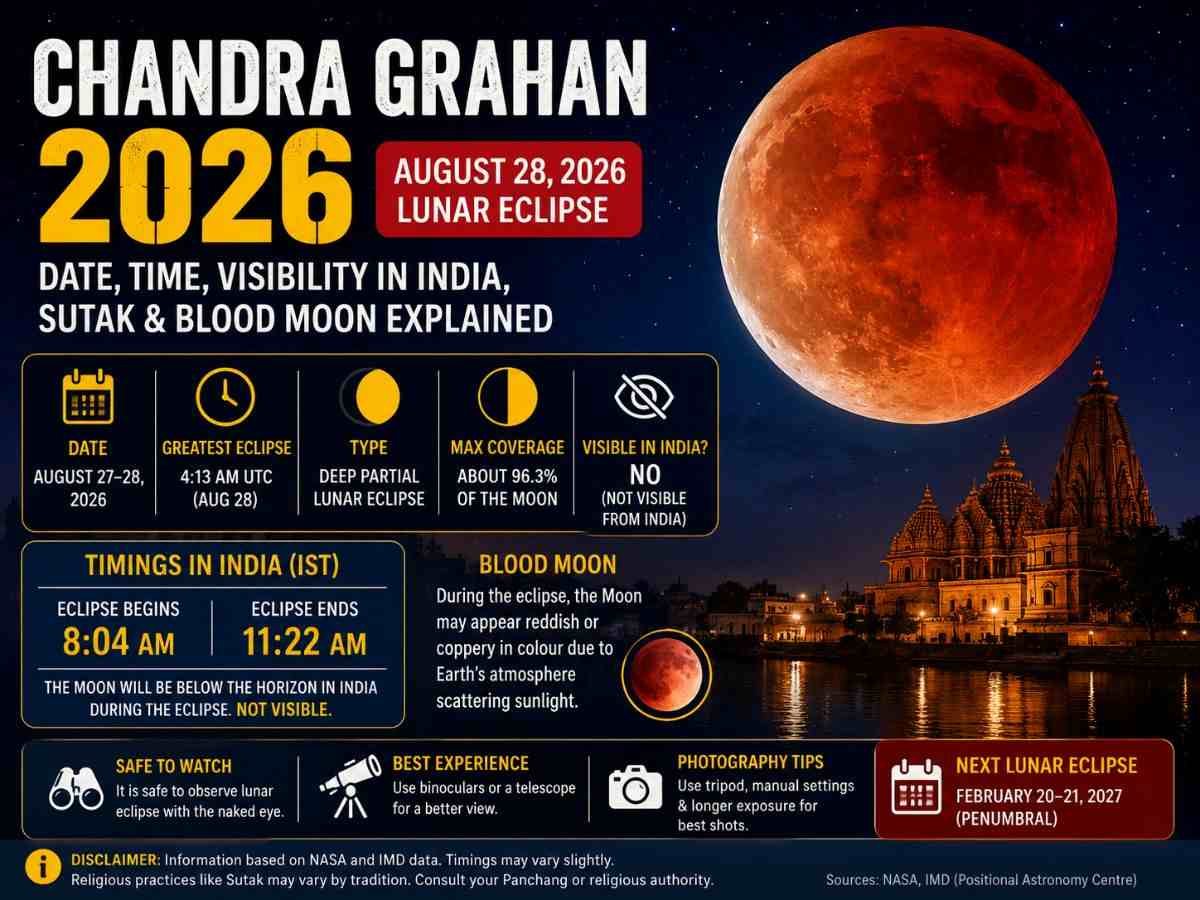
Chandra Grahan 2026: A major celestial event is set to take place on August 27–28, 2026, depending on the observer’s time zone. The astronomical event itself is dated August 28 in Universal Time (UTC).
This will be a deep partial lunar eclipse, meaning a very large portion of the Moon will pass through Earth’s darkest shadow, but the entire lunar disk will not be covered.
NASA says that at the moment of greatest eclipse, around 4:13 a.m. UTC on August 28, approximately 96.3% of the Moon’s disk will be within Earth’s umbra.
That makes this eclipse particularly interesting because, visually, it can come very close to resembling a total lunar eclipse.
However, there is an important point for Indian readers:
The August 28, 2026 Chandra Grahan will not be visible from India.
The India Meteorological Department’s Positional Astronomy Centre states that the partial lunar eclipse begins at approximately 8:04 a.m. IST and ends at 11:22 a.m. IST, and specifically confirms that the eclipse will not be visible in India.
Chandra Grahan 2026 Date and Time
The August 2026 lunar eclipse begins during the night of August 27 in some parts of the world and continues into August 28.
NASA lists the main eclipse timing in Universal Time, with the partial phase beginning at approximately 2:34 UTC and greatest eclipse occurring at approximately 4:13 UTC.
Chandra Grahan 2026: Key Timings
| Event | Time |
|---|---|
| Eclipse date | August 27–28, 2026 |
| Astronomical date | August 28 |
| Partial phase begins | Around 2:34 UTC |
| Greatest eclipse | Around 4:13 UTC |
| Partial phase duration | About 3 hours 18 minutes |
| Maximum lunar-disk obscuration | About 96.3% |
| India eclipse begins | 8:04 AM IST |
| India eclipse ends | 11:22 AM IST |
| Visible from India | No |
NASA’s lunar-eclipse catalogue gives the August 28 eclipse a partial-eclipse magnitude of about 0.930 and a partial phase lasting approximately 3 hours 18 minutes.
Will Chandra Grahan 2026 Be Visible in India?
No, the August 28, 2026 lunar eclipse will not be visible from India.
This is one of the most important facts for Indian readers searching for “Chandra Grahan 2026” today.
According to the official India Meteorological Department information, the eclipse occurs from 8:04 AM to 11:22 AM IST, and it will not be visible in India.
The reason is astronomical rather than mysterious: the Moon will not be above the horizon from India during the relevant portion of the eclipse.
So, people in Delhi, Mumbai, Kolkata, Bengaluru, Chennai, Hyderabad and other Indian cities will not be able to directly watch the August 28 lunar eclipse in the night sky.
This is also why readers should be careful with social-media posts or videos suggesting that the eclipse will be visible across India on the night of August 28.
Where Will the August 2026 Lunar Eclipse Be Visible?
NASA says the deep partial eclipse will be visible across large parts of the Americas, western Europe and western Africa. NASA’s broader future-eclipse listing also identifies visibility across parts of the Americas, Europe, Africa and western Asia.
The exact viewing experience will depend on the observer’s location.
Some locations will see the eclipse from beginning to end, while others will see only part of the event because the Moon will rise or set during the eclipse.
Weather conditions will also determine whether the Moon can actually be seen.
Main visibility regions include:
- North America
- South America
- Parts of Europe
- Parts of Africa
- Some surrounding oceanic regions
- Parts of western Asia, depending on the eclipse phase and local horizon
Why Is the August 2026 Chandra Grahan So Special?
The biggest reason is the depth of the partial eclipse.
At maximum eclipse, NASA estimates that approximately 96.3% of the Moon’s disk will be within Earth’s umbra.
In simple terms, almost the entire Moon will move into Earth’s darkest shadow.
Only a relatively small section will remain outside the umbra.
That makes this a particularly dramatic partial lunar eclipse.
It is important, however, not to describe it as a total lunar eclipse.
A total lunar eclipse requires the entire lunar disk to enter Earth’s umbra.
Since a small portion of the Moon remains outside it during the August 2026 event, the official classification is partial lunar eclipse.
What Is Chandra Grahan?
A Chandra Grahan, or lunar eclipse, happens when Earth comes between the Sun and Moon and Earth’s shadow falls on the Moon.
Normally, sunlight illuminates the Moon’s surface.
During a lunar eclipse, Earth blocks some or all of the direct sunlight reaching the lunar surface.
There are three main types of lunar eclipse:
1. Total Lunar Eclipse
The entire Moon enters Earth’s umbra.
2. Partial Lunar Eclipse
Only part of the Moon enters the umbra.
3. Penumbral Lunar Eclipse
The Moon passes through Earth’s lighter outer shadow, called the penumbra.
The August 28, 2026 event belongs to the partial lunar eclipse category.
Why Does the Moon Turn Red During a Lunar Eclipse?
Another popular search term associated with Chandra Grahan is “Blood Moon.”
During a lunar eclipse, the Moon can appear reddish, orange or copper-coloured.
This happens because some sunlight passes through Earth’s atmosphere before reaching the Moon.
Earth’s atmosphere scatters shorter blue wavelengths more strongly, while reddish and orange wavelengths can continue through the atmosphere and be refracted toward the lunar surface.
As a result, the portion of the Moon inside Earth’s umbra can take on a distinctive coppery appearance.
NASA notes that during the August 2026 eclipse, once the partial phase progresses, observers can perceive the Moon’s eclipsed portion as coppery in colour.
However, “Blood Moon” is a popular descriptive term rather than the formal astronomical classification.
The August 2026 event remains a deep partial lunar eclipse.
Is Chandra Grahan 2026 a Blood Moon?
It can produce a reddish or coppery appearance in the eclipsed portion of the Moon, particularly around the deeper stages of the partial eclipse.
But calling the entire event a “Blood Moon” should be understood as popular terminology.
The scientific classification is:
Partial Lunar Eclipse — August 28, 2026.
NASA’s data indicates that about 96.3% of the lunar disk will be inside Earth’s umbra at greatest eclipse.
Chandra Grahan 2026 and Sutak Kaal: What Should Indians Know?
Sutak Kaal is a traditional concept associated with eclipses in some Hindu practices.
Different religious traditions, regions and Panchang authorities can follow different interpretations regarding Sutak, its duration and whether it applies when an eclipse is not visible from a particular location.
From the astronomical perspective, however, the key fact is straightforward:
The August 28, 2026 lunar eclipse is not visible from India.
The official IMD information gives the India timing as approximately 8:04 AM to 11:22 AM IST and states that the eclipse will not be visible from India.
Therefore, editorial content should avoid presenting one universal Sutak rule as an established scientific fact.
Readers who follow religious customs should consult their family tradition, local Panchang or a qualified religious authority for guidance.
Can You Watch Chandra Grahan With Naked Eyes?
Yes. A lunar eclipse is safe to view with the naked eye.
Unlike a solar eclipse, you do not need special eclipse glasses to watch a lunar eclipse.
If you are located in an area where the August 2026 eclipse is visible, you can observe it directly.
Binoculars or a telescope can make the changing appearance of the Moon even more interesting.
For photographers, a tripod and a camera with a telephoto lens can help capture the Moon more clearly.
How to Photograph the August 2026 Lunar Eclipse
For people in the visibility zone, the eclipse provides an excellent opportunity for night-sky photography.
Use a tripod
A stable camera is particularly important as the Moon becomes darker during the eclipse.
Use manual exposure if possible
Automatic camera settings may struggle as the Moon’s brightness changes.
Avoid excessive digital zoom
Optical zoom or a telephoto lens generally produces better results.
Take multiple photographs
The Moon’s brightness and colour will change throughout the eclipse.
Include the surrounding landscape
Adding buildings, mountains or trees can give the image a stronger sense of scale.
Is Chandra Grahan 2026 the Only Lunar Eclipse of the Year?
No. NASA lists two lunar eclipses in 2026:
- March 3, 2026 — Total Lunar Eclipse
- August 28, 2026 — Partial Lunar Eclipse
There are also two solar eclipses in 2026: an annular solar eclipse on February 17 and a total solar eclipse on August 12.
The March 3 lunar eclipse was total, while the August event is partial.
This makes 2026 a particularly interesting year for eclipse watchers.
When Is the Next Chandra Grahan After August 2026?
According to NASA’s lunar eclipse catalogue, the next lunar eclipse after August 28, 2026, will occur on February 20–21, 2027.
However, it will be a penumbral lunar eclipse, which is considerably subtler than a total or deep partial eclipse.
NASA’s schedule then lists further penumbral eclipses in July and August 2027.
Chandra Grahan 2026: Important Facts at a Glance
| Question | Answer |
|---|---|
| What is Chandra Grahan? | Lunar eclipse |
| Date | August 27–28, 2026 |
| Official astronomical date | August 28 |
| Type | Deep partial lunar eclipse |
| Maximum coverage | About 96.3% of Moon’s disk |
| Greatest eclipse | Around 4:13 UTC |
| Partial phase | About 3h 18m |
| India timing | 8:04 AM–11:22 AM IST |
| Visible in India? | No |
| Blood Moon appearance possible? | Yes, coppery/red portion |
| Safe to watch directly? | Yes |
| Main visibility | Americas, Europe, Africa and some western Asia |
| Next lunar eclipse | February 20–21, 2027 |
The timing and classification are based on NASA and official Indian astronomical information.
Chandra Grahan 2026: FAQs
When is Chandra Grahan 2026?
The August 2026 Chandra Grahan occurs on August 27–28, depending on the observer’s time zone. NASA gives the astronomical date as August 28 in Universal Time.
Is Chandra Grahan on August 28 visible in India?
No. The India Meteorological Department says the eclipse will not be visible from India.
What time does Chandra Grahan start in India?
According to the IMD, the eclipse begins at approximately 8:04 AM IST and ends at approximately 11:22 AM IST.
Is August 2026 lunar eclipse total or partial?
It is a partial lunar eclipse. NASA describes it as a deep partial eclipse, with approximately 96.3% of the Moon’s disk entering Earth’s umbra.
Will there be a Blood Moon in 2026?
The eclipsed portion of the Moon can appear coppery or reddish, which is why the popular term “Blood Moon” may be used.
Is it safe to watch a lunar eclipse?
Yes. A lunar eclipse is safe to observe with the naked eye.
Can Chandra Grahan be seen from Delhi?
No. The August 28, 2026 lunar eclipse will not be visible from Delhi or other parts of India because the Moon is below the horizon during the event.
Can Chandra Grahan be seen from Mumbai?
No. Mumbai will not have a direct view of the August 2026 lunar eclipse.
What is the next lunar eclipse after August 2026?
The next lunar eclipse is a penumbral lunar eclipse on February 20–21, 2027, according to NASA.
Is Sutak applicable during Chandra Grahan 2026?
Sutak is a matter of traditional religious practice, and interpretations can vary. Since the August 2026 eclipse is not visible from India, readers following specific religious customs should consult their preferred Panchang or religious authority rather than relying on a single generalized online claim.
Final Takeaway
The August 27–28, 2026 Chandra Grahan is one of the most interesting lunar events of the year.
It will be a deep partial lunar eclipse, with approximately 96.3% of the Moon’s disk entering Earth’s umbra at greatest eclipse. The event can produce a striking coppery or reddish appearance in the eclipsed portion of the Moon.
But for Indian readers, the most important fact is that this Chandra Grahan will not be visible from India.
The IMD puts the eclipse’s India timing at approximately 8:04 AM to 11:22 AM IST, when the Moon is below the horizon.
So while skywatchers across parts of the Americas, Europe and Africa will have an opportunity to witness the event, people in India will not be able to observe it directly from their locations.
Chandra Grahan 2026 Date: August 28, 2026
Chandra Grahan Type: Deep Partial Lunar Eclipse
India Visibility: No
India Timing: 8:04 AM to 11:22 AM IST
Maximum Eclipse: Around 4:13 UTC
Moon’s Disk in Umbra: About 96.3%
Disclaimer: This article explains astronomical facts and summarizes traditional Chandra Grahan-related beliefs where relevant. Religious practices such as Sutak Kaal vary by tradition and should not be presented as scientific facts. Readers should consult an appropriate religious authority for questions about personal or religious observances.
More in World
 WorldIndus Waters Treaty Row: Ishaq Dar Seeks India Dialogue, Data Sharing29 Aug 2026
 WorldMcDonald’s Spicy Chicken McNuggets Are Back: September 2026 Return28 Aug 2026
 WorldLunar Eclipse August 2026: Date, Time, Visibility, Sturgeon Moon and Why India Won’t See It25 Aug 2026
 WorldGayle King Criticises Hayden Panettiere’s Mother Over Statement: ‘Thanks, Mom, For Nothing’20 Aug 2026
 WorldModerna Cancer Vaccine: mRNA Melanoma Shot Succeeds in First Phase 3 Trial19 Aug 2026
 WorldUK Salmonella Outbreak: One Dead, 207 Ill in Cases Linked to Imported Eggs18 Aug 2026
Read Next
 EntertainmentMunmun Dutta Shares Empty Taarak Mehta Ka Ooltah Chashmah Set: ‘Looks Haunted’ When Nobody Is Shooting19 Sep 2026
 EntertainmentBhuvan Bam on India’s Got Latent Season 2 Episode 7: Panel, Samay Raina Show & What Happened18 Sep 2026
 SportsAbhishek Sharma Hits Fastest T20I Century: 30-Ball Hundred Breaks Rohit Sharma’s Record17 Sep 2026