
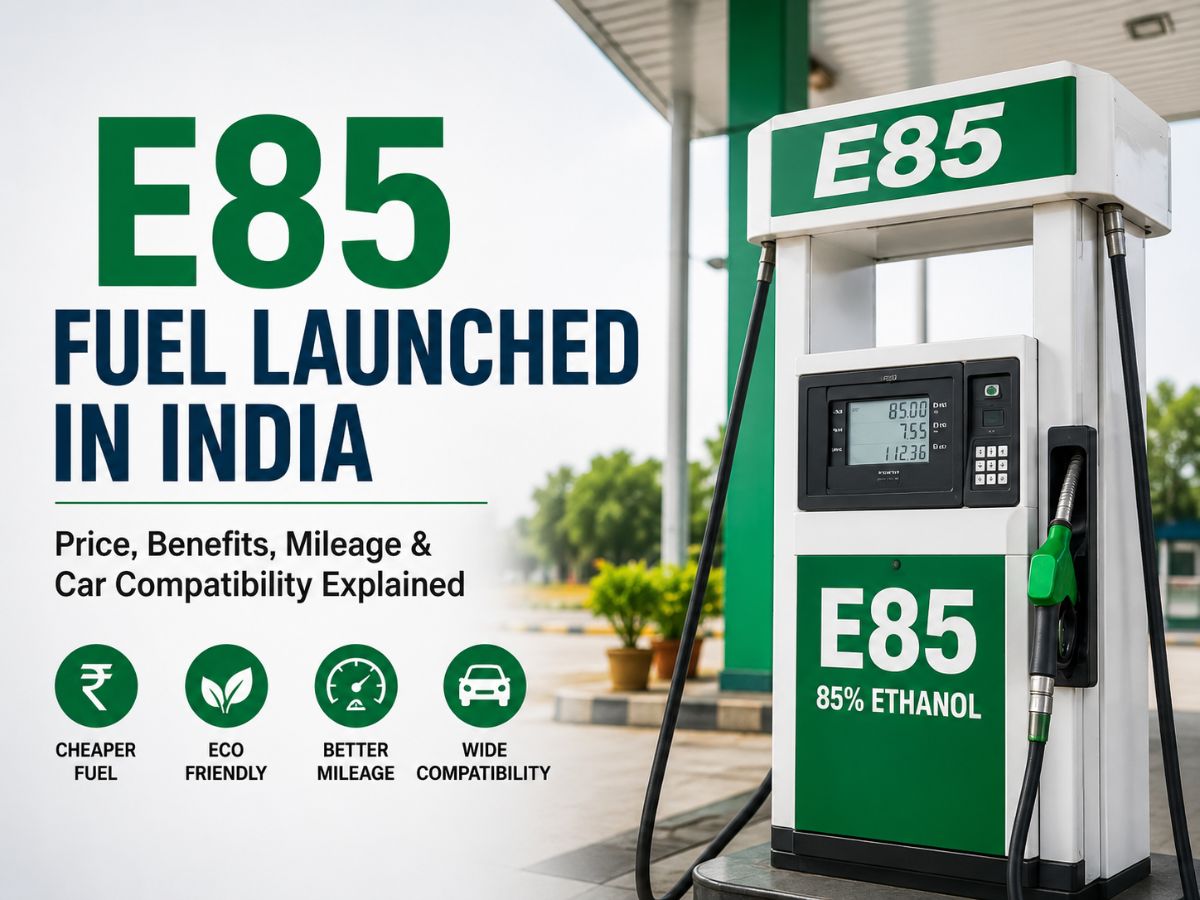
E85 Fuel Launched: India has made an important move toward cleaner and cheaper transportation with the launch of E85 fuel. As fuel prices affect daily expenses, the introduction of ethanol-blended fuel is viewed as a major improvement for both consumers and the environment.
E85 fuel, which has up to 85% ethanol and 15% petrol, aims to cut fuel costs, reduce emissions, and help India pursue sustainable energy. With its rollout starting in cities like Delhi, many car owners are now wondering if E85 will be the future of fuel in India.

What is E85 Fuel?
E85 is a type of flex fuel that contains a high percentage of ethanol, a renewable fuel made from agricultural products like sugarcane and corn.
Key Features of E85 Fuel:
- Contains 85% ethanol and 15% petrol
- Designed for flex-fuel vehicles (FFVs)
- Produces lower carbon emissions
- Considered a cleaner alternative to petrol
E85 is already widely used in countries like the United States and Brazil, and India is now gradually adopting it as part of its energy strategy.
E85 Fuel Price in India
One of the biggest reasons behind the buzz around E85 fuel is its price advantage.
Expected Price Benefits:
- E85 is expected to be ₹15–₹20 cheaper per litre than petrol
- Lower production cost due to domestic ethanol manufacturing
- Reduced dependency on imported crude oil
For daily commuters, this price difference can lead to significant monthly savings.
Benefits of E85 Fuel
1. Cost Savings for Consumers
E85 fuel is more affordable compared to traditional petrol, making it a budget-friendly option for vehicle owners.
2. Environment-Friendly
Ethanol burns cleaner than petrol, reducing:
- Carbon emissions
- Air pollution
- Environmental impact
This aligns with India’s goal of achieving lower emissions.
3. Supports Farmers and Local Economy
Ethanol production uses agricultural products, which:
- Boosts farmer income
- Reduces reliance on oil imports
- Strengthens rural economy
4. Energy Security
By promoting ethanol-based fuel, India can reduce its dependency on global oil markets, improving long-term energy stability.
Mileage of E85 Fuel: What to Expect?
Mileage is one of the most important factors for Indian consumers.
Reality Check on Mileage:
- E85 may deliver slightly lower mileage than petrol
- However, lower price compensates for reduced efficiency
- Optimized flex-fuel engines can deliver balanced performance
Car Compatibility: Which Vehicles Can Use E85?
Not all vehicles can run on E85 fuel. It is specifically designed for flex-fuel vehicles (FFVs).
Compatible Vehicles:
- Flex-fuel cars (FFVs)
- Vehicles designed to handle high ethanol blends
Not Compatible:
- Standard petrol cars (without modification)
- Older vehicles not designed for ethanol fuel
What is a Flex-Fuel Vehicle?
A flex-fuel vehicle can run on:
- Petrol
- Ethanol blends (E20, E85)
- Any mix of both
Automakers in India are gradually introducing FFVs to support this transition.
E85 vs Petrol: Differences
| Feature | E85 Fuel | Petrol |
|---|---|---|
| Cost | Cheaper | Expensive |
| Emissions | Lower | Higher |
| Mileage | Slightly lower | Higher |
| Compatibility | FFVs only | All petrol vehicles |
| Environmental Impact | Eco-friendly | Less eco-friendly |
E85 clearly offers environmental and cost benefits, though compatibility remains a key limitation.
Government’s Role : E85
The Indian government is actively promoting ethanol blending under its biofuel policy.
Key Initiatives:
- Ethanol blending targets (E20, E85)
- Support for flex-fuel vehicle manufacturing
- Incentives for ethanol production
The goal is to achieve:
- Reduced oil imports
- Cleaner environment
- Sustainable fuel ecosystem
Challenges in E85 Fuel Adoption
Despite its advantages, E85 faces some challenges:
1. Limited Availability
Currently, E85 is available only in select cities.
2. Vehicle Compatibility
Most vehicles in India are not yet compatible with E85.
3. Awareness Gap
Many consumers are still unaware of:
- Benefits of E85
- Usage guidelines
- Compatibility issues
4. Infrastructure Development
Fuel stations need upgrades to support ethanol-based fuels.
What Does E85 Mean for Indian Consumers?
For everyday users, E85 represents a shift toward:
- Lower fuel expenses
- Cleaner driving experience
- Future-ready mobility
However, switching to E85 will depend on:
- Availability in your city
- Whether your vehicle supports it
Future of E85 Fuel in India:
E85 fuel is expected to grow rapidly in the coming years.
Future Trends:
- More flex-fuel vehicles in the market
- Expansion of E85 fuel stations
- Increased government support
- Greater consumer awareness
If implemented effectively, E85 could play a major role in transforming India’s fuel ecosystem.
Is E85 Fuel Worth It?
E85 fuel brings a mix of affordability, sustainability, and innovation to India’s fuel market.
While challenges remain, the long-term benefits are clear:
- Lower costs
- Reduced emissions
- Stronger energy independence
For consumers with compatible vehicles, E85 can be a smart and future-ready choice.
Also Read:
FAQs
- What is E85 fuel?
- E85 is a fuel blend containing 85% ethanol and 15% petrol.
- Is E85 cheaper than petrol?
- Yes, it is expected to be ₹15–₹20 cheaper per litre.
- Can all cars use E85 fuel?
- No, only flex-fuel vehicles (FFVs) are compatible.
- Does E85 give good mileage?
- Mileage may be slightly lower, but overall savings remain positive.


Leave a Reply