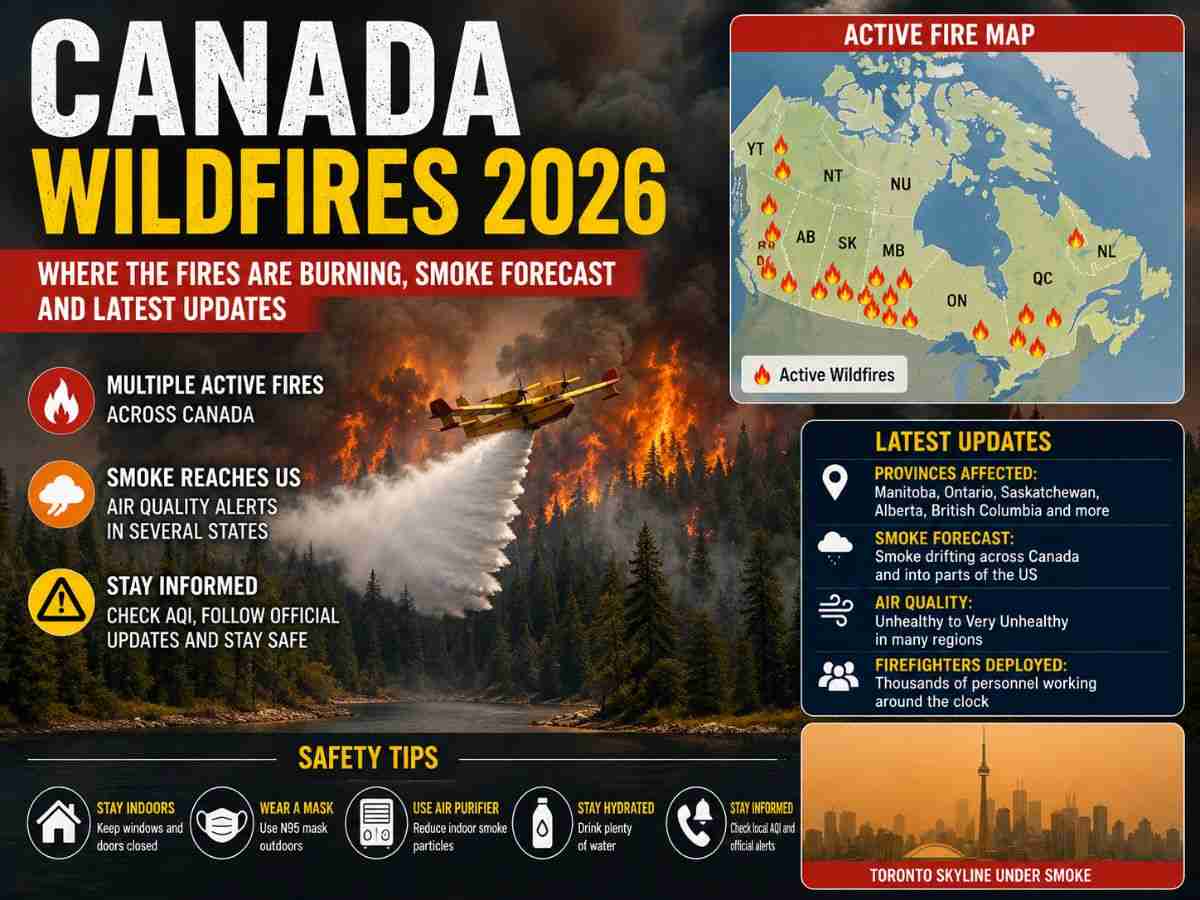
The Canada Wildfires 2026 season has once again become one of the biggest environmental stories in North America. Hundreds of active wildfires across several Canadian provinces have produced massive smoke plumes that are drifting thousands of kilometres, triggering air quality alerts in Canada and parts of the United States.
As firefighters continue to battle intense blazes fueled by dry weather, strong winds, and high temperatures, millions of residents are being advised to limit outdoor activities. Cities including Toronto, along with several communities across Ontario, Manitoba, Saskatchewan, Alberta, and neighboring U.S. states, have experienced hazy skies and unhealthy air quality.
Here’s everything you need to know about the Canada Wildfires 2026, including where the fires are burning, smoke forecasts, affected areas, health risks, and what officials are doing to contain the situation.
Canada Wildfires 2026: Latest Situation
Canada is facing another challenging wildfire season, with multiple large fires burning across western and central provinces. While wildfire activity is common during the summer months, weather experts say prolonged heatwaves, dry vegetation, and gusty winds have accelerated fire growth in several regions.
Authorities continue to monitor active fire zones while emergency crews work around the clock to protect communities and critical infrastructure.
Current priorities include:
- Containing rapidly spreading wildfires
- Protecting nearby towns and Indigenous communities
- Monitoring smoke movement
- Issuing evacuation orders where necessary
- Supporting thousands of firefighters deployed across the country
Where Are the Canada Wildfires Burning?
Several provinces remain under heightened wildfire activity.
Manitoba
Manitoba continues to experience numerous active fires, with some affecting forested areas and nearby communities. Emergency response teams remain on high alert.
Ontario
Northern Ontario has reported several significant fires, while smoke has drifted south toward major urban centres including Toronto.
Saskatchewan
Wildfires remain active across forest regions, prompting firefighting operations and precautionary evacuations.
Alberta
Dry conditions have increased wildfire risks across parts of Alberta, where crews continue suppression efforts.
British Columbia
Although conditions vary by region, wildfire monitoring remains ongoing due to persistent summer heat.
Why Is Smoke Traveling So Far?
One of the biggest concerns during Canada Wildfires 2026 is the enormous amount of smoke traveling across North America.
Wildfire smoke contains microscopic particles known as PM2.5, which are small enough to enter the lungs and bloodstream.
Weather systems can carry smoke:
- Hundreds of kilometres within Canada
- Across the Canada-US border
- Into major American cities
- Over the Great Lakes region
- Toward parts of the northeastern United States
This explains why communities located far away from active fires may still experience poor air quality.
Smoke Forecast: Which Areas Could Be Affected?
Meteorologists continue tracking smoke movement using satellite imagery and atmospheric models.
Depending on changing wind patterns, smoke may affect:
- Ontario
- Manitoba
- Saskatchewan
- Quebec
- Toronto
- Great Lakes region
- Northeastern United States
- Midwest U.S.
Smoke concentrations can change throughout the day depending on wind direction and weather conditions.
Residents are encouraged to check their local air quality index (AQI) before planning outdoor activities.
Why Air Quality Alerts Matter
Health agencies issue air quality alerts when wildfire smoke reaches unhealthy levels.
Poor air quality can affect everyone but poses greater risks for:
- Children
- Older adults
- Pregnant women
- People with asthma
- Individuals with heart disease
- People suffering from respiratory illnesses
Even healthy individuals may experience temporary symptoms during heavy smoke events.
Common Health Symptoms From Wildfire Smoke
Exposure to wildfire smoke may cause:
- Eye irritation
- Sore throat
- Persistent coughing
- Shortness of breath
- Chest discomfort
- Headaches
- Fatigue
- Difficulty breathing during exercise
Anyone experiencing severe breathing problems should seek immediate medical attention.
How to Stay Safe During Wildfire Smoke Events
Health experts recommend taking several precautions during periods of poor air quality.
Stay Indoors
Keep windows and doors closed whenever possible.
Reduce Outdoor Exercise
Avoid jogging, cycling, or strenuous physical activity outdoors.
Use Air Purifiers
HEPA air purifiers can help reduce indoor smoke particles.
Wear a Protective Mask
If you must spend time outdoors during heavy smoke, a properly fitted N95 mask offers better protection than cloth masks.
Stay Hydrated
Drinking plenty of water may help reduce throat irritation caused by smoke.
What Is Causing More Frequent Wildfires?
Scientists point to several factors contributing to increasingly severe wildfire seasons:
- Higher average temperatures
- Longer periods of drought
- Earlier snowmelt
- Dry forests
- Lightning strikes
- Human-caused ignitions
- Strong seasonal winds
Many climate researchers believe warming temperatures have extended Canada’s wildfire season, allowing fires to burn longer and spread more rapidly.
How Firefighters Are Responding
Thousands of firefighters from across Canada and international partners have been deployed to combat active wildfires.
Response efforts include:
- Ground firefighting crews
- Water-bombing aircraft
- Helicopter operations
- Bulldozers creating firebreaks
- Emergency management teams
- Community evacuation support
Authorities continue to prioritize public safety while protecting homes, forests, and infrastructure.
Impact on Daily Life
Wildfires are affecting more than forests.
Residents have reported disruptions including:
- Flight delays due to reduced visibility
- Road closures
- Temporary evacuations
- School activity changes
- Outdoor event cancellations
- Reduced tourism in affected regions
Businesses dependent on outdoor recreation are also feeling the impact.
Environmental Impact
Beyond immediate fire damage, wildfires have long-term environmental consequences.
These include:
- Habitat destruction
- Loss of biodiversity
- Increased greenhouse gas emissions
- Soil degradation
- Water contamination
- Forest ecosystem disruption
Recovery of burned forests may take decades depending on the severity of the fires.
Could More Smoke Reach the United States?
Yes. Meteorologists say smoke movement depends largely on wind direction and atmospheric conditions. Even if active fires remain inside Canada, smoke can continue affecting several U.S. states, especially around the Great Lakes and northeastern regions.
Residents should monitor local weather forecasts and air quality advisories as conditions may change quickly.
What Experts Are Saying
Wildfire experts stress that smoke can travel much farther than the flames themselves.
Environmental agencies recommend staying informed through official wildfire updates, weather forecasts, and local emergency alerts.
Experts also note that while wildfire smoke episodes may be temporary, repeated exposure over several weeks can increase health risks for vulnerable individuals.
More in World
 WorldIndus Waters Treaty Row: Ishaq Dar Seeks India Dialogue, Data Sharing29 Aug 2026
 WorldMcDonald’s Spicy Chicken McNuggets Are Back: September 2026 Return28 Aug 2026
 WorldChandra Grahan 2026: August 28 Lunar Eclipse Date, Time, Visibility in India, Sutak and Blood Moon Explained27 Aug 2026
 WorldLunar Eclipse August 2026: Date, Time, Visibility, Sturgeon Moon and Why India Won’t See It25 Aug 2026
 WorldGayle King Criticises Hayden Panettiere’s Mother Over Statement: ‘Thanks, Mom, For Nothing’20 Aug 2026
 WorldModerna Cancer Vaccine: mRNA Melanoma Shot Succeeds in First Phase 3 Trial19 Aug 2026
Read Next
 EntertainmentMunmun Dutta Shares Empty Taarak Mehta Ka Ooltah Chashmah Set: ‘Looks Haunted’ When Nobody Is Shooting19 Sep 2026
 EntertainmentBhuvan Bam on India’s Got Latent Season 2 Episode 7: Panel, Samay Raina Show & What Happened18 Sep 2026
 SportsAbhishek Sharma Hits Fastest T20I Century: 30-Ball Hundred Breaks Rohit Sharma’s Record17 Sep 2026