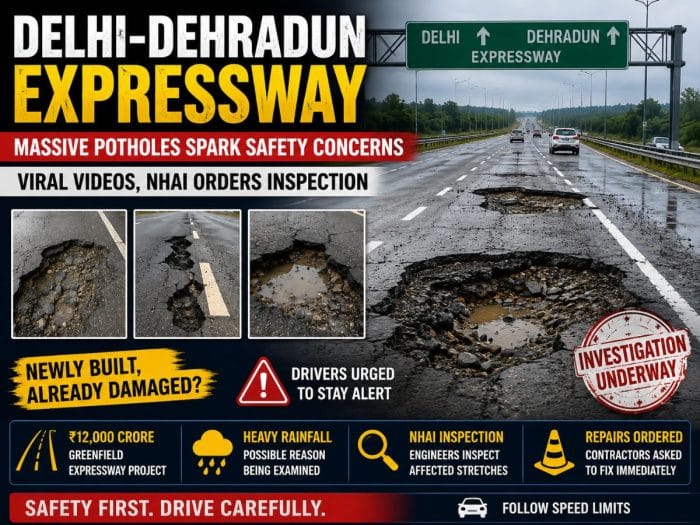
The Delhi-Dehradun Expressway, one of India’s most ambitious highway infrastructure projects, has come under intense scrutiny after multiple large potholes appeared on newly constructed stretches following recent rainfall. Viral videos circulating on social media have raised serious questions about construction quality, road safety, and maintenance standards on the multi-crore expressway.
The incident has quickly become a major talking point across the country, prompting responses from government agencies, political leaders, commuters, and infrastructure experts.
Here’s everything we know so far.
What Happened?
Several videos recorded by commuters showed large potholes developing on sections of the Delhi-Dehradun Expressway, particularly near parts of Uttar Pradesh shortly after heavy rains.
The damaged road surface appears significant enough to force drivers to slow down or change lanes suddenly, increasing the risk of accidents.
The videos spread rapidly across social media platforms, with many users questioning how such damage could occur on a newly built expressway costing thousands of crores of rupees.
Why Is the Incident Making Headlines?
The Delhi-Dehradun Expressway has been promoted as a flagship infrastructure project designed to:
- Reduce travel time between Delhi and Dehradun
- Improve connectivity across northern India
- Boost tourism
- Enhance logistics movement
- Improve regional economic growth
Because of its importance and massive investment, visible road damage shortly after sections became operational has attracted nationwide attention.
Where Were the Potholes Reported?
According to multiple media reports, potholes were noticed on sections of the expressway after recent rainfall.
Authorities have begun inspecting the affected stretches to determine:
- Whether the damage resulted from poor drainage
- Construction defects
- Water accumulation
- Surface layer failure
- Heavy vehicle movement
The exact engineering assessment is still underway.
NHAI Responds
Officials associated with the National Highways Authority of India (NHAI) have acknowledged the issue and initiated inspections.
According to reports:
- Engineers visited the affected locations.
- Contractors were instructed to repair damaged stretches immediately.
- Technical teams began examining the cause of the road failure.
- Officials indicated that accountability would be fixed if construction defects were identified.
Further findings are expected after the technical inspection is completed.
Political Reactions
The viral images have also triggered political reactions.
Opposition leaders questioned:
- Construction quality
- Use of public funds
- Monitoring mechanisms
- Project supervision
Some leaders described the incident as an example of poor infrastructure quality despite significant public expenditure.
Government representatives, however, have stated that technical investigations should be completed before drawing conclusions.
Why Do Roads Develop Potholes?
Infrastructure experts say potholes can develop for several reasons, including:
Heavy Rainfall
Water enters small cracks beneath the road surface.
Poor Drainage
If rainwater is not removed quickly, it weakens the road foundation.
Construction Defects
Improper compaction or poor-quality materials may reduce road durability.
Temperature Changes
Repeated expansion and contraction can weaken asphalt.
Heavy Traffic
Large commercial vehicles accelerate wear and tear if the road base is compromised.
Only a detailed engineering inspection can determine the exact cause in this case.
Why Is This a Major Concern?
Expressways are designed for:
- High-speed travel
- Heavy traffic
- Long-term durability
- Improved road safety
Even relatively small surface failures can become dangerous because vehicles travel at significantly higher speeds compared to ordinary highways.
Large potholes may increase the risk of:
- Tire bursts
- Vehicle damage
- Loss of control
- Multi-vehicle accidents
- Traffic congestion
About the Delhi-Dehradun Expressway
The Delhi-Dehradun Expressway is among India’s biggest road connectivity projects.
Key features include:
- Faster travel between Delhi and Dehradun
- Reduced travel time
- Modern access-controlled design
- Wildlife corridors
- Elevated sections
- Multiple interchanges
- Improved connectivity for Uttarakhand
Once fully operational, the project is expected to significantly improve tourism, trade, and regional transportation.
What Happens Next?
Authorities are expected to:
- Complete technical inspections
- Repair affected stretches
- Review construction records
- Identify responsible contractors if required
- Release findings after engineering analysis
Further action will depend on the official investigation.
What Drivers Should Do
Until repairs are completed, commuters using the expressway should:
- Follow posted speed limits.
- Maintain safe following distance.
- Avoid sudden lane changes.
- Stay alert during rainy weather.
- Report visible road hazards to highway authorities where possible.
Why Infrastructure Maintenance Matters
Building highways is only one part of infrastructure development.
Regular maintenance, drainage management, structural inspections, and timely repairs are equally important to ensure long-term road safety.
As India continues investing in expressways and high-speed corridors, quality assurance and post-construction monitoring will remain essential for public confidence.
The appearance of large potholes on sections of the Delhi-Dehradun Expressway has sparked widespread debate over construction quality and infrastructure oversight. While authorities have launched inspections and initiated repairs, the final cause of the damage has not yet been officially confirmed.
Until the investigation is complete, it remains important to rely on verified updates rather than speculation. The findings are expected to determine whether the issue resulted from weather-related factors, engineering shortcomings, or other construction-related causes.
As repairs continue, the incident serves as a reminder that maintaining world-class infrastructure requires not only major investments but also continuous quality monitoring and accountability.
More in India
 IndiaPunjab State Dear Rakhi Bumper Result 2026: ₹7 Crore Prize, Winners List29 Aug 2026
 India100-Foot Tricolour Installed at Doda Stadium for 80th Independence Day (15 Augest 2026): Why It Matters in Chenab Valley Jammu Kashmir15 Aug 2026
 IndiaIndependence Day 2026: India Marks 80th I-Day as Vande Mataram Echoes From Red Fort for the First Time15 Aug 2026
 IndiaDeep Amavasya 2026: The Sacred Festival That Celebrates the Power of Light and Positivity12 Aug 2026
 IndiaH1N1 Cases Jump 6 Times in Delhi: Doctors Explain Symptoms, Prevention and Risk Factors10 Aug 2026
 BreakingNational Handloom Day 2026: Date, Theme, History, Significance and Why India Celebrates Its Weaving Heritage6 Aug 2026
Read Next
 SportsAsian Games 2026 Live: India and Pakistan Schedule, Results, Medal Tally, Cricket, Hockey and Latest Updates20 Sep 2026
 EntertainmentMunmun Dutta Shares Empty Taarak Mehta Ka Ooltah Chashmah Set: ‘Looks Haunted’ When Nobody Is Shooting19 Sep 2026
 EntertainmentBhuvan Bam on India’s Got Latent Season 2 Episode 7: Panel, Samay Raina Show & What Happened18 Sep 2026