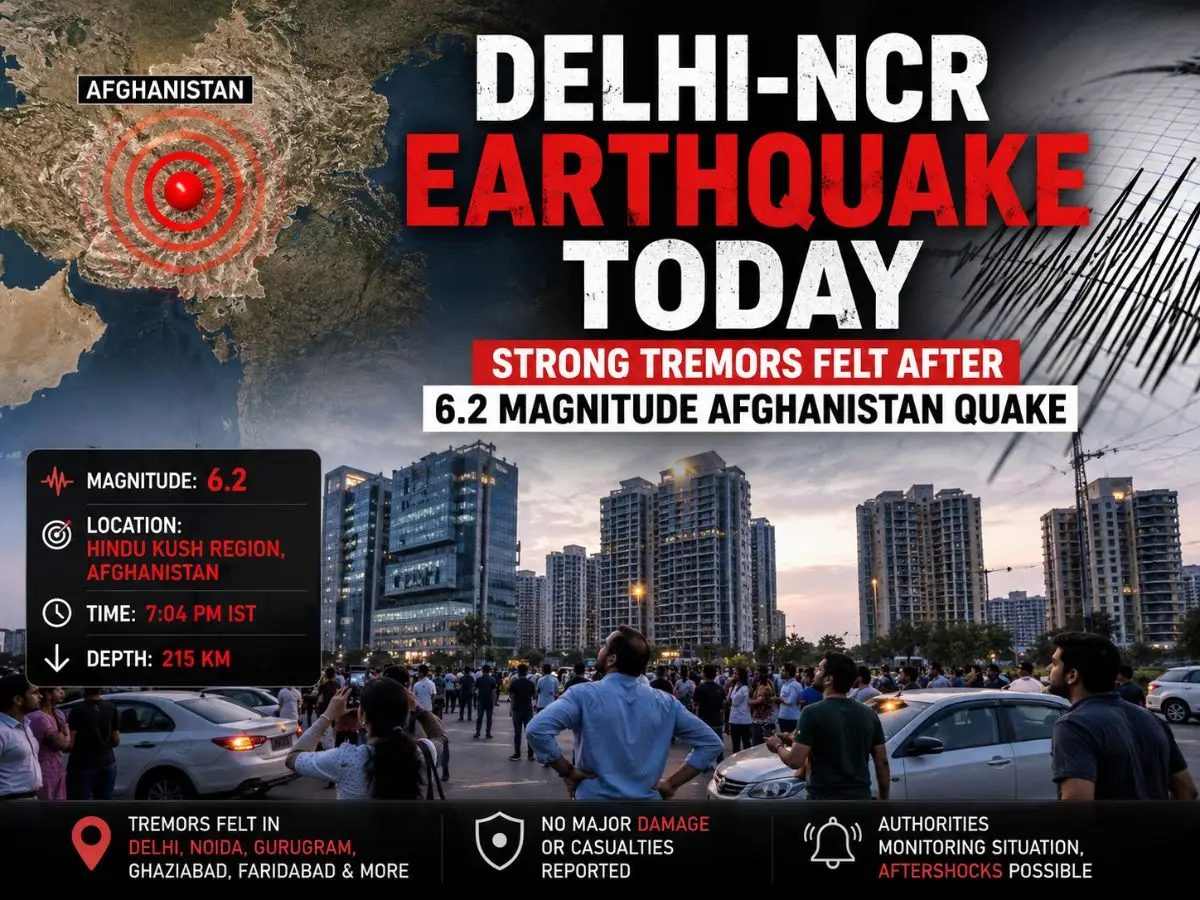
The Delhi-NCR earthquake today became one of the most searched topics after powerful tremors were felt across Delhi, Noida, Gurugram, Ghaziabad, and several parts of North India on Saturday evening. According to the National Centre for Seismology (NCS), the earthquake originated in Afghanistan’s Hindu Kush region with a magnitude of 6.2 and occurred at approximately 7:04 PM IST. Although the epicentre was hundreds of kilometres away, the quake’s intensity was strong enough for people across Delhi-NCR to experience shaking in homes, offices, and high-rise buildings. Fortunately, no immediate reports of casualties or major structural damage have emerged. Here’s everything you need to know about the Delhi earthquake today, why tremors were felt so far away, and what experts are saying about the event.
Why Were Strong Earthquake Tremors Felt in Delhi-NCR Today?
The earthquake in Delhi-NCR was caused by a powerful 6.2 magnitude earthquake that struck deep beneath Afghanistan’s Hindu Kush mountain range. According to seismic experts, the earthquake occurred at a depth of around 215 kilometres, allowing seismic waves to travel long distances across South Asia.
Because the earthquake was unusually deep, its energy spread over a wider geographical area instead of causing severe destruction near the epicentre. This is why residents in Delhi, Noida, Gurugram, Faridabad, Ghaziabad, Chandigarh, Jammu and Kashmir, and several neighbouring regions reported feeling prolonged tremors.
Many people rushed outdoors as buildings gently swayed, while social media quickly filled with videos and eyewitness accounts describing the experience.
What Did the National Centre for Seismology Say About the Earthquake?
The National Centre for Seismology (NCS) confirmed that the earthquake struck Afghanistan’s Hindu Kush region at 7:04 PM IST with a magnitude of 6.2.
According to the NCS:
- Magnitude: 6.2
- Location: Hindu Kush Region, Afghanistan
- Depth: Approximately 215 km
- Time: 7:04 PM IST
The agency explained that the significant depth helped reduce the earthquake’s destructive impact despite the wide area over which tremors were experienced.
Authorities also stated that monitoring systems continue tracking aftershocks and any additional seismic activity.
Which Areas Felt the Delhi Earthquake Tremors?
The Delhi earthquake tremors were reported across several parts of northern India as well as neighboring countries.
Areas where tremors were reported include:
- Delhi
- Noida
- Gurugram
- Ghaziabad
- Faridabad
- Greater Noida
- Jammu & Kashmir
- Punjab
- Haryana
- Himachal Pradesh
- Chandigarh
Outside India, tremors were also reported in:
- Pakistan
- Afghanistan
- Tajikistan
- Uzbekistan
- China
- Kyrgyzstan
- Turkmenistan
The widespread reach highlights how powerful deep-focus earthquakes can affect regions located hundreds or even thousands of kilometers from the epicenter.
Was There Any Damage After the Delhi-NCR Earthquake Today?
As of the latest official updates, no major damage or casualties have been reported following the Delhi NCR earthquake today.
Emergency authorities confirmed that:
- No large-scale structural collapse has been reported.
- No injuries have been officially confirmed.
- Public transportation continues to operate normally.
- Authorities are monitoring the situation.
Experts believe the considerable depth of the earthquake significantly reduced its destructive power on the surface.
Nevertheless, residents have been advised to remain alert in case of aftershocks occur later.
Pakistan Also Experienced Earthquake Activity Earlier
Interestingly, the Afghanistan earthquake came shortly after another earthquake affected Pakistan earlier the same day.
Earlier reports indicated:
- Magnitude between 5.3 and 5.5
- Depth around 75 km
- No immediate casualties
- No significant structural damage
Pakistan frequently experiences seismic activity because it lies along the boundary where the Indian Plate collides with the Eurasian Plate. This tectonic movement also contributes to earthquakes affecting northern India from time to time.
Why Does Afghanistan Experience Frequent Earthquakes?
Afghanistan is one of the world’s most earthquake-prone countries because it lies at the collision zone of the Indian Plate and the Eurasian Plate. As these massive tectonic plates continue pushing against one another, enormous pressure builds beneath the Earth’s surface. When that pressure is suddenly released, earthquakes occur.
The Hindu Kush mountain range, where the latest earthquake originated, regularly experiences deep-focus earthquakes. These earthquakes can be felt across vast regions, including Delhi-NCR, Pakistan, Central Asia, and parts of China. While deeper earthquakes often cause less surface damage than shallow ones, they can still generate strong tremors over long distances. This explains why residents in Delhi-NCR experienced noticeable shaking even though the epicenter was located hundreds of kilometers away in Afghanistan.
Is Delhi-NCR Located in an Earthquake-Prone Zone?
Yes. Delhi-NCR falls under Seismic Zone IV, making it one of India’s high-risk earthquake regions.
Several active geological faults surround the capital, including the Himalayan Frontal Fault and nearby fault systems. Although Delhi rarely experiences large earthquakes directly beneath the city, strong earthquakes originating in the Himalayas or neighboring countries can still produce noticeable tremors across the region.
Experts have repeatedly advised residents to ensure that buildings follow earthquake-resistant construction standards. Modern infrastructure, emergency preparedness, and public awareness play a vital role in reducing earthquake-related risks.
Because millions of people live in high-rise apartments across Delhi-NCR, understanding earthquake safety measures remains extremely important.
What Should You Do During an Earthquake?
Knowing how to react during an earthquake can significantly reduce the risk of injury.
Indoors
- Drop to the ground immediately.
- Take cover under a sturdy table or desk.
- Protect your head and neck.
- Stay away from windows, mirrors, and heavy furniture.
- Avoid using elevators until authorities declare the building safe.
Outdoors
- Move to an open area away from buildings, electric poles, and trees.
- Stay clear of bridges and flyovers.
- Remain calm until the shaking completely stops.
Driving
- Pull over safely.
- Avoid stopping beneath bridges or power lines.
- Stay inside the vehicle until the tremors end.
Preparedness and quick decision-making can make a significant difference during any seismic event.
Can Aftershocks Occur After a Major Earthquake?
Yes. Aftershocks are common following moderate or powerful earthquakes.
Although they are generally weaker than the main earthquake, aftershocks can continue for hours, days, or even weeks. In some situations, damaged buildings become more vulnerable during aftershocks, increasing the risk of collapse.
Authorities usually monitor seismic activity continuously after significant earthquakes. Residents are encouraged to stay informed through official government updates rather than relying on rumors circulating on social media.
If additional tremors occur, following standard earthquake safety guidelines remains the best course of action.
Why This Earthquake Was Widely Felt but Caused Limited Damage
Seismologists believe the primary reason behind the widespread tremors was the earthquake’s considerable depth of approximately 215 kilometers.
Deep-focus earthquakes release energy differently compared to shallow earthquakes. Instead of concentrating destructive force near the epicenter, seismic waves travel farther across continents.
As a result:
- Tremors were experienced across multiple countries.
- Structural damage remained minimal.
- Casualties were avoided in many affected regions.
- Residents experienced prolonged shaking despite being far from the epicenter.
Experts also note that the Himalayan region remains one of the world’s most active seismic belts, making continuous monitoring essential for disaster preparedness.
More in India
 IndiaPunjab State Dear Rakhi Bumper Result 2026: ₹7 Crore Prize, Winners List29 Aug 2026
 India100-Foot Tricolour Installed at Doda Stadium for 80th Independence Day (15 Augest 2026): Why It Matters in Chenab Valley Jammu Kashmir15 Aug 2026
 IndiaIndependence Day 2026: India Marks 80th I-Day as Vande Mataram Echoes From Red Fort for the First Time15 Aug 2026
 IndiaDeep Amavasya 2026: The Sacred Festival That Celebrates the Power of Light and Positivity12 Aug 2026
 IndiaH1N1 Cases Jump 6 Times in Delhi: Doctors Explain Symptoms, Prevention and Risk Factors10 Aug 2026
 BreakingNational Handloom Day 2026: Date, Theme, History, Significance and Why India Celebrates Its Weaving Heritage6 Aug 2026
Read Next
 EntertainmentMunmun Dutta Shares Empty Taarak Mehta Ka Ooltah Chashmah Set: ‘Looks Haunted’ When Nobody Is Shooting19 Sep 2026
 EntertainmentBhuvan Bam on India’s Got Latent Season 2 Episode 7: Panel, Samay Raina Show & What Happened18 Sep 2026
 SportsAbhishek Sharma Hits Fastest T20I Century: 30-Ball Hundred Breaks Rohit Sharma’s Record17 Sep 2026