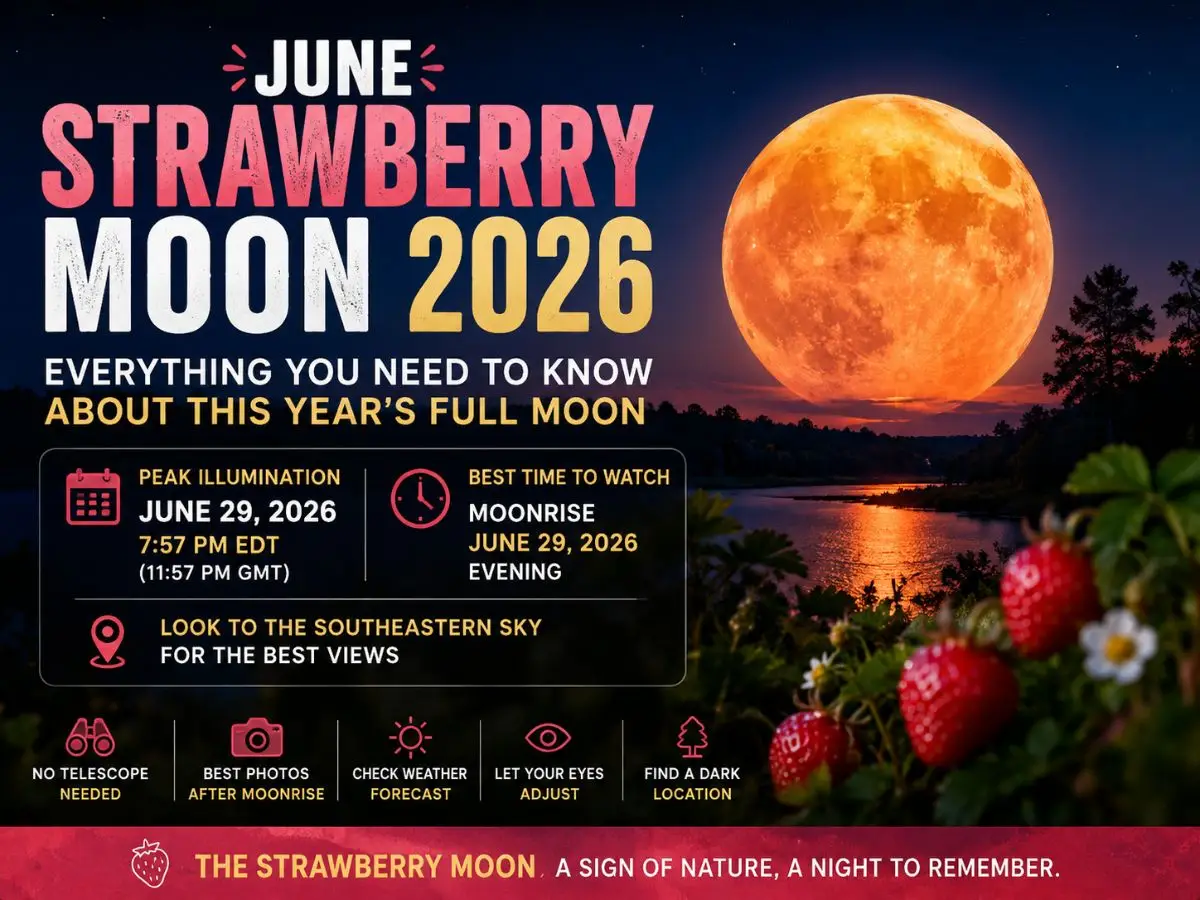
The June Strawberry Moon 2026 is one of the most anticipated celestial events of the year, drawing the attention of skywatchers, photographers, and astronomy enthusiasts worldwide. Although its name may suggest a pink or red-colored Moon, the Strawberry Moon does not actually change colour. Instead, the name comes from Native American traditions that marked June as the season for harvesting wild strawberries. This year’s June Strawberry Moon 2026 is especially significant because it will follow a low path across the sky in the Northern Hemisphere, creating a beautiful golden glow near the horizon. Whether you’re planning to watch it with family, photograph it, or simply learn about its meaning, here’s everything you need to know about the Strawberry Moon 2026, including its date, peak time, visibility, and best viewing tips.
What Is the Strawberry Moon?
The Strawberry Moon is the traditional name for the full moon that appears every June. Contrary to popular belief, it does not look like a strawberry or turn pink. Instead, the name was given by the Algonquian Native American tribes, who used June’s full moon as a signal that wild strawberries were ripe for harvesting.
Many cultures around the world have given unique names to June’s full moon. However, the term Strawberry Moon became widely recognised through the Old Farmer’s Almanac and is now commonly used by astronomers, skywatchers, and the media.
Although the Moon remains the same celestial body throughout the year, each monthly full moon carries historical and seasonal significance that has been passed down for generations.
When Is the June Strawberry Moon 2026?
The June Strawberry Moon 2026 will reach peak illumination at 7:57 PM EDT on June 29, 2026, which corresponds to 11:57 PM GMT.
For skywatchers in India, the peak illumination will occur at approximately 5:27 AM IST on June 30.
However, experts recommend watching the Moon shortly after moonrise on the evening of June 29, as this is when it appears largest and most colorful due to atmospheric conditions.
Unlike many astronomical events that require telescopes or special equipment, the Strawberry Moon 2026 can easily be enjoyed with the naked eye.
Why Is the Strawberry Moon So Special?
Every year’s Strawberry Moon is unique, but the June Strawberry Moon 2026 has several features that make it especially fascinating.
First, it occurs close to the Northern Hemisphere’s summer solstice, meaning the Moon will travel along one of the lowest paths across the sky during the year.
Instead of climbing high overhead, the Moon will remain close to the southeastern and southern horizons throughout the night. This creates longer viewing opportunities and stunning photography conditions.
Secondly, the Strawberry Moon often appears with a warm golden or orange glow shortly after rising. This color is created because moonlight passes through a thicker layer of Earth’s atmosphere, scattering blue wavelengths while allowing warmer colors to dominate.
As a result, many observers mistakenly believe the Moon has changed color when it is actually an atmospheric effect.
Why Does the Strawberry Moon Look Bigger Near the Horizon?
One of the most interesting questions people ask every year is why the Strawberry Moon appears unusually large.
The answer lies in something called the Moon Illusion.
The Moon does not physically grow larger when it rises or sets. Instead, your brain compares the Moon with nearby buildings, mountains, trees, and other objects on the horizon.
This comparison creates an optical illusion that makes the Moon seem much bigger than when it is high overhead.
Astronomers have studied this phenomenon for centuries, and while the exact psychological reasons are still debated, the Moon Illusion remains one of the most fascinating experiences for skywatchers.
Best Time to Watch the Strawberry Moon in India
If you’re planning to enjoy the June Strawberry Moon 2026 in India, timing is important.
Although the Moon reaches full illumination at 5:27 AM IST on June 30, the best viewing opportunity will actually be during the evening of June 29, shortly after moonrise.
Watching the Moon near the horizon offers several advantages:
- It appears larger because of the Moon Illusion.
- The golden-orange color becomes more noticeable.
- The surrounding landscape creates beautiful photographic compositions.
- Weather conditions are generally more favorable before midnight.
Clear skies and an unobstructed southeastern horizon will provide the best experience.
How Can You Watch the Strawberry Moon?
Watching the Strawberry Moon 2026 requires very little preparation, making it one of the easiest astronomical events to enjoy.
For the best experience:
Choose a Dark Location
Move away from bright city lights whenever possible. Parks, open fields, beaches, and hilltops usually offer excellent viewing conditions.
Face the Southeast
The Moon will rise in the southeastern sky before slowly moving across the southern horizon.
Check the Weather
Cloud cover can significantly reduce visibility, so checking the local weather forecast beforehand is recommended.
Allow Your Eyes to Adjust
Spend about 15 to 20 minutes outdoors so your eyes can naturally adapt to darker surroundings.
Bring Binoculars
Although binoculars are optional, they can reveal more details on the lunar surface, including craters and darker maria.
No telescope is required because the Strawberry Moon is bright enough to be enjoyed with the naked eye.
How Can You Take Better Photos of the Strawberry Moon?
The June Strawberry Moon 2026 presents an excellent opportunity for photographers.
Experts recommend taking photographs during the first hour after moonrise, when the Moon appears larger and warmer in color.
To improve your images:
- Use a tripod for stability.
- Include buildings, trees, mountains, or monuments for scale.
- Zoom in if using a smartphone.
- Lower exposure settings to avoid overexposure.
- Capture the Moon while it remains close to the horizon.
These simple techniques can produce impressive results without professional equipment.
FAQ’s (Strawberry Moon 2026)
- Does the Strawberry Moon Turn Pink?
- No. Despite its name, the Strawberry Moon does not appear pink. The name comes from the strawberry harvesting season rather than the Moon’s appearance.
- Why Is It Called the Strawberry Moon?
- Native American Algonquian tribes used June’s full moon to mark the short season when wild strawberries became ready for harvest.
- Do You Need a Telescope?
- No. The Moon is bright enough to be viewed comfortably without any special equipment.
- Why Does It Look Orange?
- The orange or golden color occurs because moonlight travels through more of Earth’s atmosphere when the Moon is close to the horizon.
- Is It Safe to Watch?
- Yes. Unlike solar eclipses, full moons are completely safe to observe with the naked eye.
The June Strawberry Moon 2026 promises to be one of the most beautiful astronomical events of the year, offering skywatchers a chance to witness a spectacular full moon glowing low across the horizon. Although the Moon itself will not appear pink, its rich golden hues, low trajectory, and fascinating cultural history make it a memorable sight. Whether you’re watching from India or elsewhere in the world, choosing a location with a clear southeastern view shortly after moonrise will provide the best experience. Additionally, photographers can capture stunning images during the first hour after moonrise, while casual observers can enjoy the event without any special equipment. As one of summer’s most iconic celestial displays, the Strawberry Moon 2026 is a perfect reminder of the beauty and wonder of the night sky.
Also Read: KEAM Rank List 2026 Released: Download Engineering & Pharmacy Merit List at cee.kerala.gov.in
More in World
 WorldIndus Waters Treaty Row: Ishaq Dar Seeks India Dialogue, Data Sharing29 Aug 2026
 WorldMcDonald’s Spicy Chicken McNuggets Are Back: September 2026 Return28 Aug 2026
 WorldChandra Grahan 2026: August 28 Lunar Eclipse Date, Time, Visibility in India, Sutak and Blood Moon Explained27 Aug 2026
 WorldLunar Eclipse August 2026: Date, Time, Visibility, Sturgeon Moon and Why India Won’t See It25 Aug 2026
 WorldGayle King Criticises Hayden Panettiere’s Mother Over Statement: ‘Thanks, Mom, For Nothing’20 Aug 2026
 WorldModerna Cancer Vaccine: mRNA Melanoma Shot Succeeds in First Phase 3 Trial19 Aug 2026
Read Next
 EntertainmentMunmun Dutta Shares Empty Taarak Mehta Ka Ooltah Chashmah Set: ‘Looks Haunted’ When Nobody Is Shooting19 Sep 2026
 EntertainmentBhuvan Bam on India’s Got Latent Season 2 Episode 7: Panel, Samay Raina Show & What Happened18 Sep 2026
 SportsAbhishek Sharma Hits Fastest T20I Century: 30-Ball Hundred Breaks Rohit Sharma’s Record17 Sep 2026