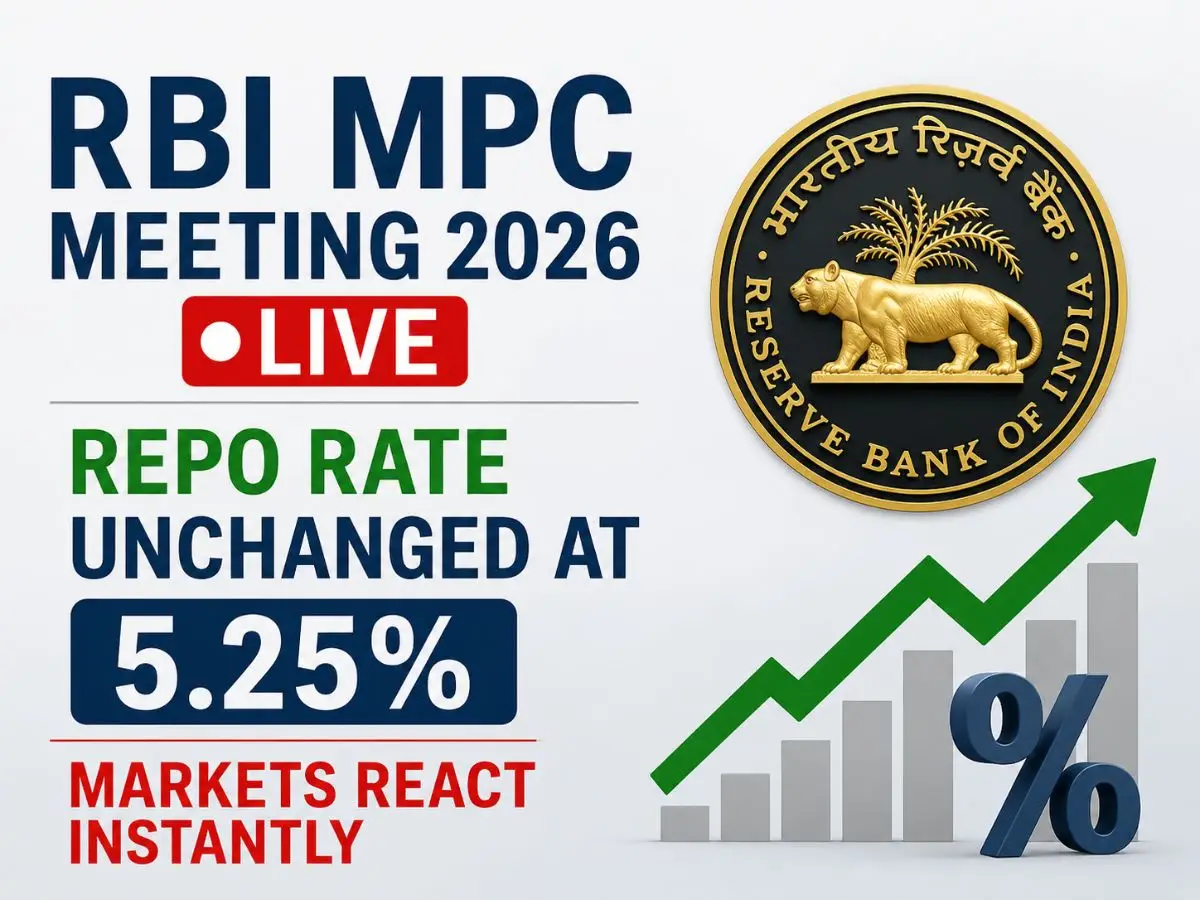
RBI MPC Meeting 2026 LIVE: At its recent monetary policy meeting, the Reserve Bank of India (RBI) decided not to raise the repo rate yet again and instead maintained it at 5.25%. The announcement was made by RBI Governor Sanjay Malhotra and comes at a time when inflation, growth and the global economy are attracting significant attention and concern from economists. The immediate reaction to the announcement was felt in the capital markets. The Sensex, Nifty and rupee all experienced a reasonable amount of movement shortly after the press conference.
What is the RBI MPC Meeting?
The Monetary Policy Committee (MPC) of RBI is responsible for setting the benchmark interest rates in India. It meets regularly to assess:
- Inflation trends
- Economic growth
- Global financial conditions
The MPC consists of six members, including the RBI Governor, and decisions are taken based on majority votes.
RBI Repo Rate 2026: What Was Announced Today?
In the latest RBI policy announcement:
- Repo Rate: 5.25% (Unchanged)
- Policy Stance: Neutral / accommodative (depending on update)
- Inflation Outlook: Closely monitored
- Growth Forecast: Stable with cautious optimism
The decision to keep the repo rate unchanged indicates that RBI is aiming to balance inflation control with economic growth.
Why Did RBI Keep the Repo Rate Unchanged?
The following economic reasons influenced the RBI’s decision to keep the repo rate unchanged:
- Inflation concerns: While there has been some apparent easing of inflationary pressures over recent months, they remain within a critical band. Hence, the RBI prefers to err on the side of vigilance than take a risk and change the repo rate in a volatile manner.
- Global economic uncertainty: Global stock markets remain extremely volatile and uncertain due to geo–political tensions and the slowdown of the economies of large developed and emerging market countries.
- Support for growth: The steady repo rate offers stability to both companies and households by preventing further increases in borrowing costs to complete their financing.
- Policy stability: A steady repo rate instills confidence in both the capital markets and the banks and reduces the potential for unnecessary disruptions in the capital markets.
Market Reaction: Sensex, Nifty & Rupee Respond Instantly
Following the RBI announcement, markets reacted quickly:
- Sensex & Nifty: Showed positive momentum as investors welcomed policy stability
- Banking Stocks: Saw mixed reactions depending on lending outlook
- Rupee: Strengthened slightly against the US dollar
Market experts believe that a stable rate environment boosts investor confidence and supports economic growth.
What Does This Mean for Your EMI and Loans?
One of the biggest concerns for common people is how RBI decisions affect their finances.
Home Loans & EMIs
- No immediate change in EMIs
- Existing borrowers will continue with current interest rates
Personal Loans
- Interest rates likely to remain stable
Credit Cards
- No major impact expected
New Borrowers
- Stable rates may encourage borrowing
Overall, this decision brings relief to borrowers as there is no increase in loan costs.
Impact on Fixed Deposits and Savings
While borrowers benefit from stable rates, depositors may see:
- Fixed Deposit Rates: Likely to remain unchanged
- Savings Interest Rates: No major increase expected
Banks may wait for future policy changes before adjusting deposit rates.
RBI MPC Meeting 2026 Live: Key Points
Here are the biggest highlights from today’s policy:
- Repo rate unchanged at 5.25%
- RBI maintains a cautious approach
- Inflation remains a key focus area
- Markets react positively
- Borrowers get relief from rate hikes
What Economists Are Saying :
Experts believe that RBI’s decision reflects a balanced and cautious strategy.
- Some analysts expected a rate cut, but RBI chose stability
- Others believe this is a temporary pause before future action
- Many see this as a positive sign for long-term growth
Overall, the policy indicates that RBI is closely monitoring both domestic and global factors.
What to Expect Next from RBI?
Looking ahead, the RBI may take future actions based on:
- Inflation trends
- Global interest rate movements
- Domestic economic performance
Possible scenarios include:
- Rate cuts if inflation falls significantly
- Rate hikes if inflation rises again
- Continued pause for stability
How Should Investors React?
Investors should consider the following:
- Stock markets may remain stable in the short term
- Banking and financial stocks could see movement
- Long-term investors should focus on fundamentals
Why This RBI Policy Matters for Every Indian
The RBI’s monetary policy affects:
- Loan interest rates
- Savings and investments
- Business growth
- Overall economic stability
Even if you are not directly involved in financial markets, this decision impacts your daily financial life.
FAQ’s:
- What is the repo rate in 2026?
- The repo rate remains at 5.25% as per the latest RBI MPC meeting.
- Will EMIs increase after this policy?
- No, EMIs are expected to remain unchanged.
- Why did RBI not change interest rates?
- To maintain stability amid inflation concerns and global uncertainty.
- How does RBI policy affect common people?
- It impacts loan interest rates, EMIs, savings, and investments.
- When is the next RBI MPC meeting?
- The next meeting schedule will be announced by RBI.
More in Business
 BusinessUPI Charges 2026: What Changes Above ₹2,000 From October 15? 0.4% MDR, Who Pays and Full Rules Explained15 Sep 2026
 BusinessBRICS Summit 2026 Delhi: New Delhi Declaration, Key Decisions & India Impact12 Sep 2026
 BusinessWho Is Tengku Puteri Ilyana Alia? Meet the Malaysian Princess Who Married British Racer Chris Froggatt13 Aug 2026
 BreakingNational Handloom Day 2026: Date, Theme, History, Significance and Why India Celebrates Its Weaving Heritage6 Aug 2026
 BusinessITR Filing Last Date 2026: Deadline, Late Fee, Penalties & Filing Guide for AY 2026-2729 Jul 2026
 BusinessNew IRCTC Website Beta Version Live Today: Features, Login Process and Booking Guide15 Jul 2026
Read Next
 EntertainmentMunmun Dutta Shares Empty Taarak Mehta Ka Ooltah Chashmah Set: ‘Looks Haunted’ When Nobody Is Shooting19 Sep 2026
 EntertainmentBhuvan Bam on India’s Got Latent Season 2 Episode 7: Panel, Samay Raina Show & What Happened18 Sep 2026
 SportsAbhishek Sharma Hits Fastest T20I Century: 30-Ball Hundred Breaks Rohit Sharma’s Record17 Sep 2026