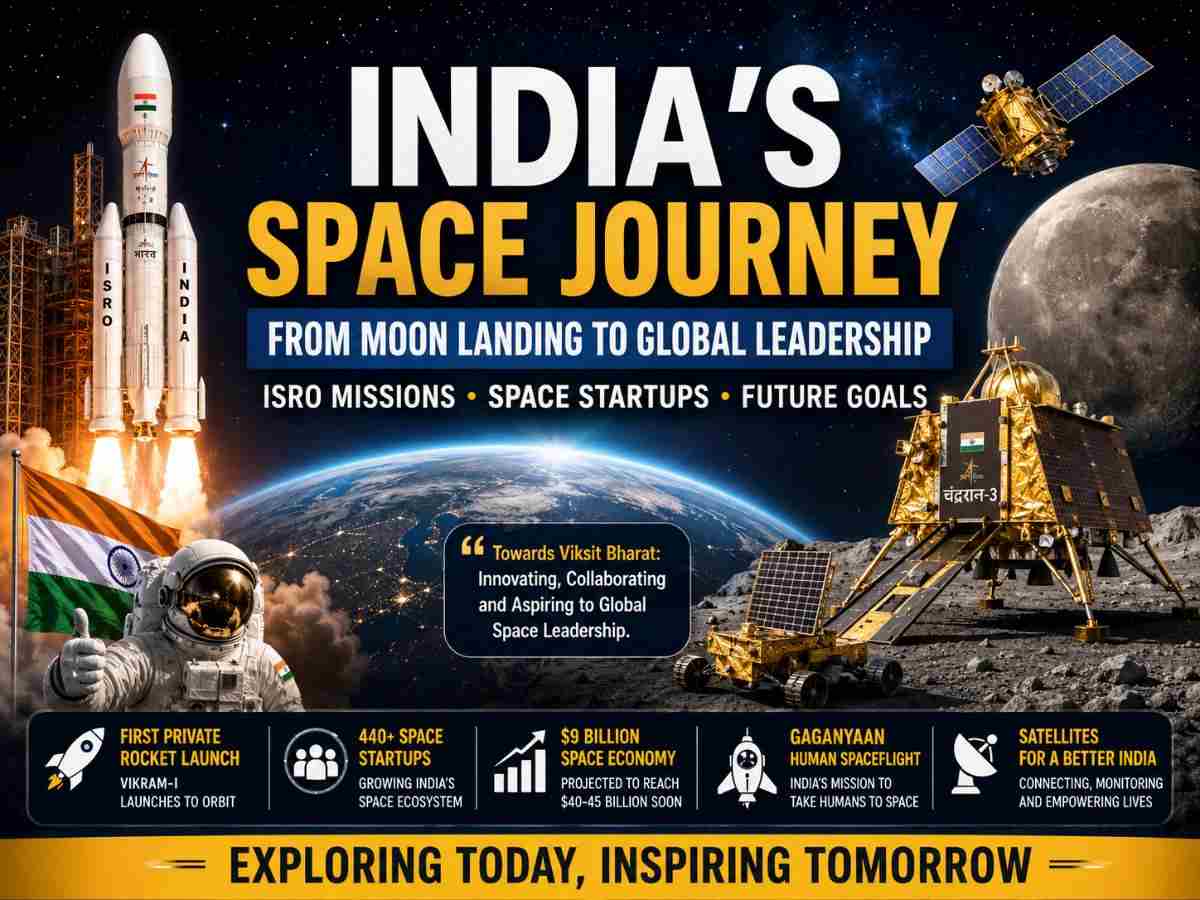
As of August 2026, India has around 440 registered space-technology startups — up from just one in 2014. The space economy is worth roughly US$9 billion, with government projections of US$40–45 billion within a decade. In July 2026, Skyroot Aerospace’s Vikram-I became the first privately built Indian rocket to reach orbit from Indian soil.
That last sentence would have sounded implausible a decade ago. For most of its history, India’s space programme meant one thing: ISRO.
It still means ISRO. But it now means a lot more besides — and that shift is the real story of Indian space in 2026.
What space exploration actually covers
Space exploration is the study of everything beyond Earth’s atmosphere — the Moon, the Sun, planets, asteroids, comets, Earth orbit and deep space. It uses satellites, launch vehicles, telescopes, robotic probes and, increasingly, crewed missions.
But the framing most people carry — rockets going away from Earth — is only half of it.
A large share of what space technology does is send information back. Your weather forecast. Your maps app. Crop monitoring for farmers. Flood assessment during a cyclone. Rural connectivity where laying cable is impractical.
For India, space has always been justified in those terms. Scientific ambition and national utility, in the same budget line.
From modest beginnings to a full ecosystem
India’s space programme started with limited infrastructure and a deliberate choice: build indigenous capability rather than import it.
That choice took decades to pay off. Over time, India developed its own satellites, launch vehicles, remote-sensing systems and mission control. The programme expanded into telecommunications, meteorology, Earth observation, navigation and scientific research.
ISRO became the institution holding all of it together — and today works alongside universities and private industry rather than in isolation.
Chandrayaan-3 changed the national conversation
The Chandrayaan programme is where India’s space story became something ordinary people followed.
Chandrayaan-1 (2008) was India’s first lunar mission and made significant contributions to Moon science.
Chandrayaan-2 (2019) attempted a soft landing. The lander did not make it. The orbiter, however, kept working and kept returning data — a partial failure that was still scientifically productive.
Chandrayaan-3 landed on 23 August 2023. The Vikram lander touched down successfully, making India the first country to soft-land in the lunar south polar region.
The technical achievement was controlled landing plus rover operations. The cultural achievement was different: millions watched live. Schools stopped. Families argued about descent trajectories at dinner.
Space stopped being a specialist subject in India that week.
Beyond the Moon: the Sun, and Earth itself
Aditya-L1, India’s first dedicated solar mission, operates from a halo orbit around the Sun-Earth L1 point. From there it can watch the Sun continuously.
This is not abstract research. Solar eruptions and space weather disrupt satellites, communication networks and power infrastructure. Understanding solar activity is, in practical terms, infrastructure protection.
India has also expanded Earth observation considerably. Satellite imagery now supports monitoring of agriculture, forests, floods, cyclones, glaciers and urban growth.
It is worth repeating the point: many space missions exist to improve life on Earth, not to leave it.
SpaDeX: why docking matters more than it sounds
The SpaDeX mission demonstrated autonomous docking and undocking between two spacecraft, plus power transfer between them. ISRO says the achievement made India the fourth nation to demonstrate space docking.
Docking sounds like a technicality. It is closer to a prerequisite.
Without it, you cannot realistically do:
- Space-station operations
- In-orbit servicing and satellite maintenance
- Crew-transfer missions
- Assembly of large structures in orbit
- Complex deep-space missions with multiple modules
For a country planning human spaceflight and eventually its own space station, docking is not optional. It is the door.
Gaganyaan: the hardest thing India has attempted
Gaganyaan aims to send Indians to Low Earth Orbit and bring them back safely.
The gap between launching a satellite and launching a person is enormous. A crewed mission needs human-rated launch vehicles, life-support systems, crew escape mechanisms, thermal protection, recovery systems, extensive astronaut training and multiple redundant safety tests.
If a satellite launch fails, you lose hardware. If a crewed launch fails, you lose people. Every system has to be qualified accordingly.
In July 2026, ISRO conducted an Integrated Main Parachute Air Drop Test to qualify the main parachute system for the first uncrewed Gaganyaan G1 mission.
That is one test, in a long sequence, for one subsystem. It is a useful reminder of what “preparing for human spaceflight” actually involves — years of unglamorous validation before anyone flies.
ISRO has also outlined a longer-term vision including sustained human presence in Low Earth Orbit and the proposed Bharatiya Antariksh Station.
Skyroot’s Vikram-I: the private sector reaches orbit
On 18 July 2026, Skyroot Aerospace’s Vikram-I lifted off from the Satish Dhawan Space Centre and deployed two satellites into Low Earth Orbit.
According to ISRO, it was the first privately developed Indian rocket to successfully reach orbit from Indian soil.
For decades, “Indian launch capability” and “ISRO” were the same phrase. That is no longer strictly true.
What changes with private launch providers is not primarily capability — it is pace and business model. A startup can iterate faster, accept different risk, and chase commercial customers in ways a national agency structurally cannot.
The numbers behind the shift
| Indicator | Figure (Aug 2026) |
|---|---|
| Registered space-tech startups | ~440 (vs 1 in 2014) |
| Space economy value | ~US$9 billion |
| Projected value (next decade) | US$40–45 billion |
| IN-SPACe authorisations | 113, to 52 non-government entities |
| NSIL technology transfers | 118 agreements, 83 technologies |
Figures from an August 2026 government factsheet. Earlier projections placed the economy at ~US$8.4 billion in 2023, reaching ~US$44 billion by 2033.
Indian space startups now work across launch vehicles, satellite manufacturing, Earth observation, propulsion, space communications, space situational awareness, navigation, data analytics and defence applications.
That last list matters for a reason people often miss: you do not need to be an aerospace engineer to work in space. Software developers, data scientists, electronics engineers, manufacturing specialists and entrepreneurs are all part of this ecosystem now.
The technology-transfer model
One quiet but important mechanism is technology transfer.
ISRO and the Department of Space have been moving technologies developed in government laboratories into Indian industry. Government data records 118 technology-transfer agreements covering 83 technologies through NSIL.
This is how publicly funded research turns into commercial products — and how a national programme seeds an industry rather than competing with one.
IN-SPACe sits alongside this as the body designed to authorise and support non-government space activity.
Where India goes next
Several directions are moving in parallel:
- Human spaceflight — Gaganyaan, working toward the first crewed mission
- Space stations — the long-term Bharatiya Antariksh Station vision
- Lunar exploration — building on Chandrayaan’s technical and scientific groundwork
- Solar research — Aditya-L1’s continuing observations
- Earth observation — climate, agriculture and disaster monitoring
- Commercial launch — private providers competing in the global market
- Space science — astronomy, planetary science and microgravity research
India’s position internationally
Space capability has become a marker of technological standing.
The GSLV-F16/NISAR mission, launched in July 2025, was the first joint ISRO-NASA mission — a signal of where India now sits in international collaboration.
Cooperation of that kind lets countries share expertise, infrastructure and cost on problems too large for any one nation.
What this means for the next generation
Students today grow up with satellite data, space-science outreach, robotics competitions and technology demonstrations that simply did not exist for earlier cohorts. ISRO’s STEM programmes now include student activities, robotics challenges, hackathons and research opportunities.
That access matters, because the field ahead needs breadth — scientists, engineers, programmers, designers, doctors, entrepreneurs and researchers who understand operating beyond Earth.
Final takeaway
India’s space programme began small and deliberately self-reliant. In 2026 it is something else entirely: a working ecosystem.
Chandrayaan-3 proved India can land on the Moon. SpaDeX proved it can dock spacecraft in orbit. Gaganyaan is pushing toward human spaceflight. Skyroot proved a private Indian company can reach orbit from Indian soil.
But the most consequential change is not any single mission. It is the shift in how India treats space — no longer as a destination to reach, but as infrastructure for science, communication, economic growth and national development.
The most interesting chapter is probably still ahead.
Key Takeaways
- India has around 440 registered space-tech startups as of August 2026, up from one in 2014.
- The space economy is worth roughly US$9 billion, projected at US$40–45 billion within a decade.
- Chandrayaan-3 landed on 23 August 2023 — the first soft landing in the lunar south polar region.
- SpaDeX made India the fourth nation to demonstrate autonomous space docking.
- Gaganyaan cleared a main parachute air drop test in July 2026, ahead of the uncrewed G1 mission.
- Skyroot’s Vikram-I reached orbit on 18 July 2026 — India’s first private orbital launch from Indian soil.
- IN-SPACe has granted 113 authorisations to 52 non-government entities.
- NSIL has signed 118 technology-transfer agreements covering 83 technologies.
- GSLV-F16/NISAR (July 2025) was the first joint ISRO-NASA mission.
FAQs
How many space startups does India have in 2026?
Around 440 registered space-technology startups as of August 2026, compared with just one in 2014.
What is India’s space economy worth?
Approximately US$9 billion as of August 2026, with government projections of US$40–45 billion over the next decade.
What did Chandrayaan-3 achieve?
It soft-landed the Vikram lander on 23 August 2023, making India the first country to land in the lunar south polar region, and successfully operated a rover there.
What is the SpaDeX mission?
An ISRO mission that demonstrated autonomous docking and undocking between two spacecraft along with power transfer, making India the fourth nation with this capability.
What is Gaganyaan?
India’s human spaceflight programme, aiming to send astronauts to Low Earth Orbit and return them safely. The first uncrewed mission is designated G1.
Which is India’s first private rocket to reach orbit?
Skyroot Aerospace’s Vikram-I, launched 18 July 2026 from the Satish Dhawan Space Centre, deploying two satellites into Low Earth Orbit.
What does Aditya-L1 do?
It observes the Sun continuously from a halo orbit around the Sun-Earth L1 point, studying solar activity and space weather that can affect satellites and communication systems on Earth.
What is IN-SPACe?
The government body that authorises and supports private and non-government participation in India’s space sector.
More in Tech
 TechNew Bajaj Pulsar 125 Launched in India: Price, Features, Engine, Mileage, Variants and What’s New24 Aug 2026
 TechGitHub Down: Copilot, Actions and API Hit by Worldwide Outage — Live Updates17 Aug 2026
 BreakingRoyal Enfield Himalayan 440 Launch Confirmed for September 4: Price, Engine and Everything We Know14 Aug 2026
 TechMotorola Edge 70 Neo Leaks Reveal New Color Options, Design Changes and 200MP Camera Ahead of Launch9 Aug 2026
 TechApple iPhone 17 Pro vs iPhone 18: Is the Latest Price Drop the Right Time to Upgrade?7 Aug 2026
 IndiaPM Modi Inaugurates Alluri Sitarama Raju International Airport in Bhogapuram: Key Features, Cost and What It Means for Andhra Pradesh1 Aug 2026
Read Next
 EntertainmentMunmun Dutta Shares Empty Taarak Mehta Ka Ooltah Chashmah Set: ‘Looks Haunted’ When Nobody Is Shooting19 Sep 2026
 EntertainmentBhuvan Bam on India’s Got Latent Season 2 Episode 7: Panel, Samay Raina Show & What Happened18 Sep 2026
 SportsAbhishek Sharma Hits Fastest T20I Century: 30-Ball Hundred Breaks Rohit Sharma’s Record17 Sep 2026