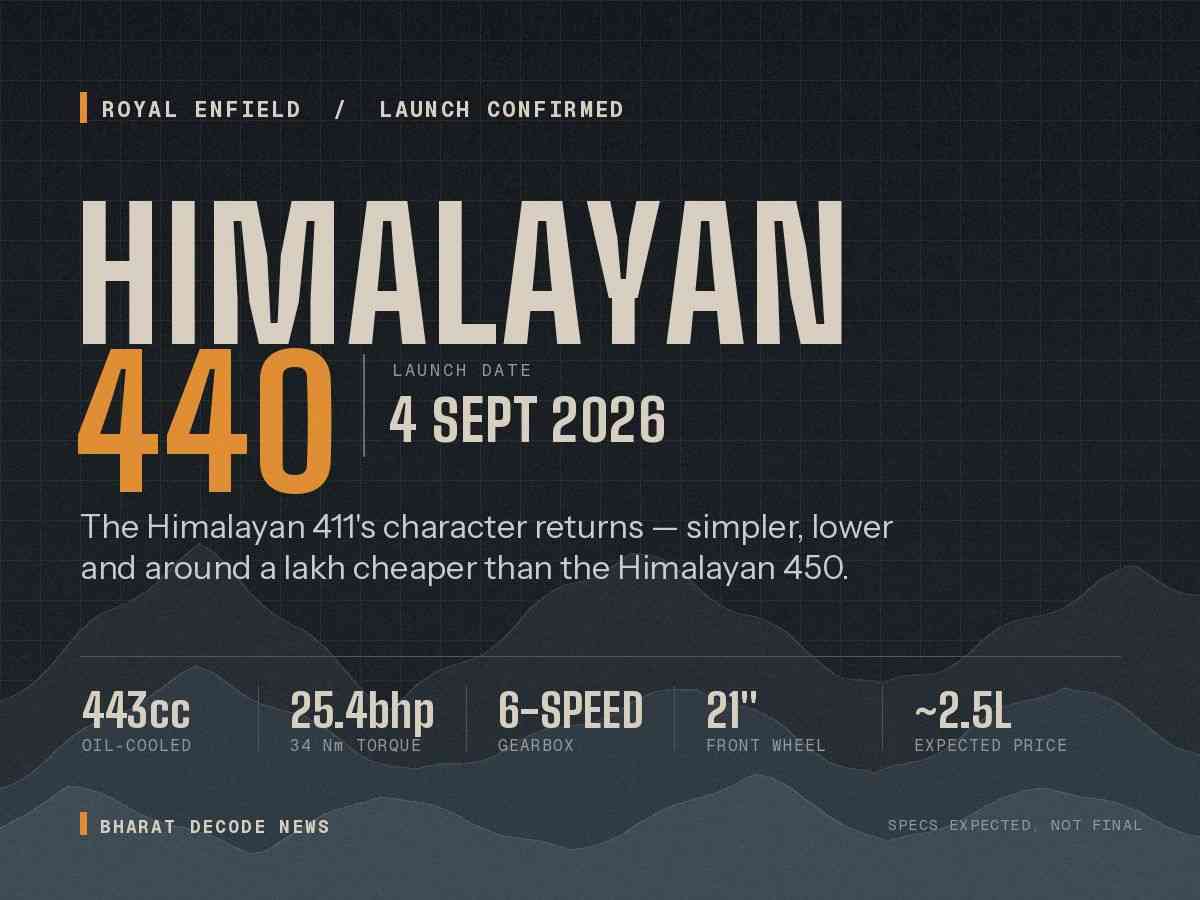
The Royal Enfield Himalayan 440 launches in India on September 4, 2026. It is built on the Scram 440 platform and uses the same 443cc air- and oil-cooled single-cylinder engine (roughly 25.4bhp, 34Nm, six-speed gearbox), but wrapped in the rugged look and easy-going character of the old Himalayan 411. Industry estimates put the ex-showroom price somewhere between Rs 2.4 lakh and Rs 2.7 lakh, which would make it significantly cheaper than the Himalayan 450.
That is the headline. The more interesting story is why Royal Enfield is doing this at all — because on paper, going backwards to an older engine and simpler hardware makes very little sense. In practice, it makes complete sense, and anyone who owned a Himalayan 411 already knows why.
Key Takeaways
- The Royal Enfield Himalayan 440 launches in India on September 4, 2026, confirmed by the company itself.
- It is based on the Scram 440 platform but styled after the discontinued Himalayan 411.
- Engine: 443cc, air/oil-cooled, roughly 25.4bhp and 34Nm, six-speed gearbox.
- Expect a 21-inch front wheel and a seat height near 800mm — the accessible ADV formula returns.
- Estimated price: Rs 2.4–2.7 lakh ex-showroom, well below the Himalayan 450’s Rs 3.39 lakh top variant.
- Ride modes, traction control and a full TFT display are unlikely at this price point.
Why Royal Enfield is bringing back the smaller Himalayan
When the Himalayan 411 arrived in 2016, it did something no other motorcycle in India had managed: it made adventure touring affordable. Ladakh, Spiti, the North East — for nearly seven years, this was the bike you saw parked outside every mountain homestay.
Its appeal was never the power figure. It was the long-stroke engine that pulled cleanly from low revs, returned sensible fuel efficiency and could hold a relaxed pace for hours without wearing the rider down.
Then came the Himalayan 450 in 2023. By every technical measure it was the better motorcycle — a liquid-cooled Sherpa 450 engine, upside-down front forks, a TFT dash with turn-by-turn navigation, ride-by-wire throttle. But it also brought three things along with it: a higher price, a taller seat and more complexity.
That left a gap in the range. The Scram 440 sat at one end, more road-biased than anything else. The Himalayan 450 sat above Rs 3 lakh at the other. Nothing occupied the middle. The Himalayan 440 exists to fill exactly that space.
Engine: familiar simplicity, slightly sharper
The Himalayan 440 gets the 443cc, single-cylinder, air- and oil-cooled LS440 engine already doing duty in the Scram 440. In that application it produces roughly 25.4bhp at 6,250rpm and 34Nm at 4,000rpm, mated to a six-speed gearbox. Royal Enfield may retune it slightly for ADV duty, but a major change is unlikely.
Here is how the three bikes stack up:
| Parameter | Himalayan 411 (old) | Himalayan 440 (expected) | Himalayan 450 |
|---|---|---|---|
| Engine | 411cc, air-cooled | 443cc, air/oil-cooled | 452cc, liquid-cooled |
| Power | ~24.5hp @ 6,500rpm | ~25.4hp @ 6,250rpm | ~40hp |
| Torque | ~32Nm @ 4,250rpm | ~34Nm @ 4,000rpm | ~40Nm |
| Gearbox | 5-speed | 6-speed | 6-speed |
| Front suspension | Telescopic | Telescopic (expected) | USD fork |
| Seat height | ~800mm | ~800mm (expected) | 825mm |
The power bump is small — about one horsepower, thanks largely to a 3mm larger bore. The real upgrade is the sixth gear. The single loudest complaint about the 411 was that it ran out of breath above 100kmph and buzzed uncomfortably on long highway stretches. An extra ratio changes that character meaningfully. Riders who moved from the Scram 411 to the Scram 440 reported the same thing: marginal on paper, clearly better on the road.
Design and hardware: the 411’s soul, updated
Reports suggest the Himalayan 440 will lean heavily on the original 411’s design language — the tall windscreen, the tank-mounted frame guards, the upright riding triangle — refreshed with newer colours and graphics rather than reworked from scratch.
The wheel setup is the most important difference from its donor bike. The Scram 440 runs a 19-inch front wheel because it is built for tarmac. The Himalayan 440 is expected to use a 21-inch front and 17-inch rear, which is what gives an ADV its genuine off-road manners. Spoked rims with tube-type dual-purpose tyres are the likely fitment; tubeless cross-spoke wheels would push the price up and are not expected as standard.
Suspension should be a telescopic fork up front with a monoshock at the rear, with discs at both ends and dual-channel ABS (rear switchable). Seat height is tipped to land near 800mm, against the Himalayan 450’s 825mm. That is a meaningful difference for shorter riders — and a large part of why the 411 sold as well as it did.
Features: where the cost-cutting will show
This is a budget-focused motorcycle, and the equipment list will reflect that.
Expected:
- Tripper navigation pod with Bluetooth connectivity
- Switchable dual-channel ABS
- LED headlamp
- A 411-style semi-digital instrument cluster
Unlikely:
- The full TFT Tripper Dash with Google Maps mirroring from the Himalayan 450
- Ride modes and traction control
- Slipper clutch
- Tubeless wheels as standard
Note that reports disagree on ride modes and traction control — some expect them, others say they will be dropped entirely to protect the price. Treat that section as unsettled until launch day.
If a modern electronics package matters to you, the Himalayan 450 remains the right bike. The 440 is aimed squarely at riders who would rather have fewer things that can go wrong 200km from the nearest service centre.
How much will the Himalayan 440 cost?
Royal Enfield has not announced pricing. But the positioning makes the range fairly easy to predict. The Scram 440’s top variant currently sits at about Rs 2.32 lakh and the Himalayan 450’s top variant at about Rs 3.39 lakh (ex-showroom). That leaves roughly a lakh of clear space in between.
Most estimates therefore land between Rs 2.4 lakh and Rs 2.7 lakh. If Royal Enfield manages to open below Rs 2.5 lakh, this becomes the most affordable 21-inch-front-wheel adventure motorcycle on sale in India.
Who should buy it and who shouldn’t
Consider it if:
- This is your first adventure bike and the budget stops short of Rs 3 lakh
- You are shorter and have struggled with tall ADV seat heights
- Your riding is a mix of highway, broken roads and light trails
- You value simple mechanicals and low running costs
Look elsewhere if:
- You want to cruise consistently above 120kmph
- A TFT screen, navigation and ride modes are non-negotiable
- You ride serious off-road terrain that demands more power and better suspension
What to keep in mind before launch day
One important caveat: apart from the launch date itself, everything above is expectation rather than confirmation. The specifications are extrapolated from the Scram 440’s hardware, spy shots and reporting by established publications. Final output figures, the feature list, variants and pricing will only be confirmed on September 4, 2026.
If you are seriously considering one, book a test ride after launch and ride the Scram 440 back to back. They share an engine, so the real difference will come down to ergonomics, wheel size and riding position — and that is what should decide it for you, not the spec sheet.
FAQs
Q1. When is the Royal Enfield Himalayan 440 launching?
It launches in India on September 4, 2026. Royal Enfield announced the date through its official social media channels.
Q2. What will the Himalayan 440 cost?
Official pricing comes on launch day. Industry estimates place it between Rs 2.4 lakh and Rs 2.7 lakh (ex-showroom).
Q3. Which engine does the Himalayan 440 use?
The same 443cc single-cylinder, air- and oil-cooled LS440 unit as the Scram 440, producing roughly 25.4bhp and 34Nm with a six-speed gearbox.
Q4. How is the Himalayan 440 different from the Himalayan 450?,
The 450 has a liquid-cooled Sherpa 450 engine, USD forks and a TFT display, and is considerably more powerful. The 440 is simpler, lower and cheaper, prioritising comfort, accessibility and low maintenance.
Q5. Is the Himalayan 440 replacing the Himalayan 411?
Effectively yes. The 411 was discontinued in late 2023, and the 440 is its spiritual successor in both design and character.
Q6. Will it get tubeless tyres?
Current reporting points to spoked wheels with tube-type tyres. A tubeless option has not been confirmed.
Q7. Is the Himalayan 440 good enough for a Ladakh trip?
Yes. The long-stroke engine, 21-inch front wheel and upright riding position suit long-distance touring well — just don’t expect sustained speeds above 120kmph.
More in Breaking
 BreakingNational Handloom Day 2026: Date, Theme, History, Significance and Why India Celebrates Its Weaving Heritage6 Aug 2026
 BreakingNew-Gen Toyota Fortuner India Launch: Expected Design, Features, Engine Options & Launch Timeline31 Jul 2026
 BreakingVaibhav Sooryavanshi Continues Dream Run, Scores Back-to-Back T20 Fifties Against Zimbabwe26 Jul 2026
 BreakingDharmendra Pradhan Resignation: What Happened, Why It Matters, and What’s Next25 Jul 2026
 BreakingAnthropic Launches Claude Opus 5: Everything You Need to Know About Its Most Powerful AI Model Yet25 Jul 2026
 BreakingWhat’s Your Home Decoration Style? A Complete Guide to Finding the Perfect Look for Your Space24 Jul 2026
Read Next
 SportsAsian Games 2026: India Schedule, Medal Tally, Cricket Results, Matches and Latest Updates22 Sep 2026
 TechGrok 4.7 Launches With Focus on Coding, Long-Running Tasks and Knowledge Work21 Sep 2026
 SportsAsian Games 2026 Live: India and Pakistan Schedule, Results, Medal Tally, Cricket, Hockey and Latest Updates20 Sep 2026