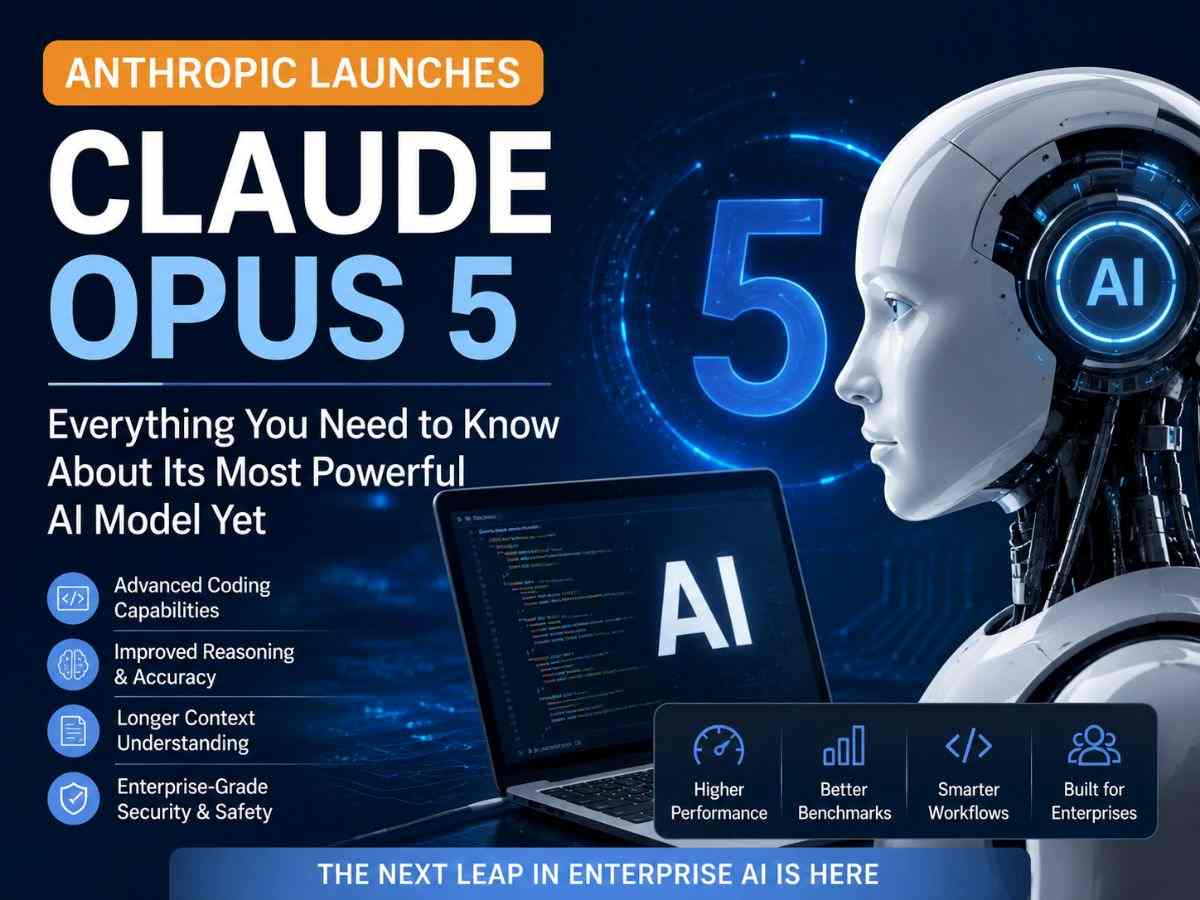
The artificial intelligence race has entered another exciting chapter. AI startup Anthropic has officially introduced Claude Opus 5, describing it as its most capable large language model (LLM) to date. The launch brings significant improvements in coding, reasoning, long-context understanding, and enterprise-focused AI capabilities, placing Claude Opus 5 in direct competition with models from OpenAI, Google, xAI, and other leading AI companies.
The announcement has quickly become one of the biggest technology stories of the week, with developers, businesses, and AI enthusiasts eager to understand what makes the new model different. Searches for “Claude Opus 5,” “Claude Code update,” and “Claude benchmarks” have surged as users look for reliable information about the release.
Here’s a closer look at what Claude Opus 5 offers, who it’s designed for, and why it matters in the rapidly evolving AI landscape
What Is Claude Opus 5?
Claude Opus 5 is Anthropic’s latest flagship AI model, built to perform complex reasoning, software development tasks, content generation, data analysis, and enterprise workflows more effectively than previous versions.
The model is designed to understand long documents, follow detailed instructions, write and debug code, summarize large amounts of information, and assist professionals across industries.
Like earlier Claude models, Opus 5 emphasizes helpfulness, accuracy, and responsible AI behavior while expanding its ability to handle sophisticated business and technical tasks.
Key Features of Claude Opus 5
Anthropic has focused on improving several areas that are important for both individual users and enterprise customers.
Advanced Coding Assistance
One of the biggest upgrades is coding performance.
Claude Opus 5 can assist developers with:
- Writing code from natural language prompts
- Debugging software
- Refactoring existing code
- Explaining complex programming concepts
- Generating documentation
- Reviewing pull requests
- Creating test cases
These improvements make it useful for software engineers, startups, and large development teams.
Improved Reasoning
Modern AI models are increasingly judged by their reasoning abilities rather than simply producing fluent text.
Claude Opus 5 is designed to:
- Solve multi-step problems
- Analyze complicated documents
- Follow logical workflows
- Reduce errors in longer tasks
- Handle complex business reasoning
This makes it more useful for legal, financial, research, and enterprise applications.
Better Long-Context Understanding
Businesses frequently work with lengthy reports, contracts, technical manuals, and research papers.
Claude Opus 5 is optimized to process long documents more efficiently, allowing users to ask detailed questions without repeatedly splitting files into smaller sections.
This capability improves productivity across many industries.
Claude Code Gets Smarter
Alongside the new model, Anthropic has also expanded Claude Code, its AI-powered coding assistant.
Developers can use Claude Code to:
- Generate production-ready code
- Explain unfamiliar codebases
- Automate repetitive development tasks
- Identify bugs
- Improve software quality
- Speed up development cycles
As AI-assisted programming becomes more common, tools like Claude Code are expected to play an increasingly important role in software engineering.
Enterprise AI Remains a Major Focus
Unlike consumer-focused chatbots, Anthropic continues to prioritize enterprise customers.
Claude Opus 5 supports organizations looking to:
- Automate customer support
- Summarize internal documentation
- Analyze contracts
- Generate reports
- Assist research teams
- Improve internal knowledge management
Businesses value AI systems that can process large volumes of information securely while maintaining consistent performance.
Safety Continues to Be a Core Priority
Anthropic has consistently emphasized AI safety in its product development.
The company says Claude Opus 5 has been developed with safeguards intended to improve reliability and reduce harmful or misleading outputs.
Responsible AI practices remain an important differentiator as organizations increasingly deploy generative AI in real-world workflows.
Users should still verify AI-generated content, particularly in areas such as law, medicine, finance, and scientific research, where human expertise remains essential.
How Claude Opus 5 Compares With Other AI Models
The latest release positions Claude Opus 5 alongside other advanced AI systems.
Areas where Claude Opus 5 aims to compete include:
- Software development
- Agentic workflows
- Long-context reasoning
- Enterprise productivity
- Knowledge management
- Document analysis
- Coding assistance
Rather than focusing on a single benchmark, organizations often evaluate AI models based on how well they perform in real-world tasks such as writing code, analyzing data, or answering customer questions.
Why Developers Are Paying Attention
The developer community has shown particular interest in Claude Opus 5 because coding remains one of the fastest-growing applications for generative AI.
Potential use cases include:
- Building web applications
- Creating APIs
- Writing SQL queries
- Generating Python scripts
- Explaining JavaScript frameworks
- Assisting DevOps workflows
- Automating documentation
Many engineering teams now use AI assistants to reduce repetitive work while allowing developers to focus on architecture and problem-solving.
Business Applications
Claude Opus 5 extends beyond software development.
Organizations may use AI for:
Marketing
- Drafting campaign content
- SEO planning
- Product descriptions
- Email marketing
Customer Support
- Ticket summaries
- Chat automation
- Knowledge-base generation
Finance
- Report analysis
- Spreadsheet explanations
- Financial document summaries
Legal
- Contract review
- Clause comparison
- Legal document summarization
Healthcare Administration
- Administrative documentation
- Medical literature summaries
- Workflow automation
These applications demonstrate how AI is increasingly becoming a productivity tool across multiple sectors.
Pricing and Availability
Anthropic offers Claude through several access options, including free and paid plans, as well as API access for developers and enterprise customers.
Specific pricing and feature availability may vary depending on the subscription tier, API usage, and region. Users should consult Anthropic’s official pricing page for the latest details before selecting a plan.
What Makes Claude Opus 5 Different?
Several characteristics distinguish Claude Opus 5 from earlier generations:
- Strong emphasis on enterprise use
- Enhanced coding capabilities
- Improved reasoning performance
- Better long-document handling
- Expanded developer tools
- Continued focus on AI safety and reliability
Rather than aiming to replace human expertise, the model is designed to help users complete complex tasks more efficiently.
Why This Launch Matters
The release of Claude Opus 5 highlights how quickly the AI industry continues to evolve. Competition among leading AI companies is driving rapid improvements in coding assistance, reasoning, productivity, and enterprise automation.
For businesses, the focus is shifting from experimenting with AI to integrating it into everyday operations. Organizations increasingly expect AI systems to support software development, knowledge management, customer service, and decision-making while maintaining high standards of reliability and security.
For individual users, these advances mean more capable AI assistants that can handle complex projects, analyze large volumes of information, and collaborate on creative and technical work.
Anthropic’s launch of Claude Opus 5 marks another important milestone in the development of generative AI. With stronger reasoning, enhanced coding capabilities, better long-context processing, and enterprise-focused improvements, the model reflects the industry’s move toward AI systems that are not only more intelligent but also more practical for real-world use.
As organizations continue evaluating AI platforms, the most effective choice will depend on specific needs, such as coding support, document analysis, content creation, or workflow automation. Claude Opus 5 adds another powerful option to a competitive field, giving businesses and developers more flexibility in how they adopt AI technologies.
Also Read: Devshayani Ekadashi 2026: Dos and Don’ts to Follow While Observing the Vishnu Fast
FAQs:
- What is Claude Opus 5?
- Claude Opus 5 is Anthropic’s latest flagship AI model designed for advanced reasoning, coding, content generation, document analysis, and enterprise applications.
- What are the main improvements in Claude Opus 5?
- Key enhancements include stronger coding assistance, improved reasoning, better handling of long documents, expanded developer tools, and continued emphasis on AI safety.
- Who can benefit from Claude Opus 5?
- Software developers, businesses, researchers, content creators, customer support teams, legal professionals, and enterprise organizations can all benefit from its capabilities.
- Is Claude Opus 5 only for developers?
- No. While it includes significant coding improvements, it also supports writing, research, document analysis, workflow automation, customer service, and business productivity.
- How does Claude Opus 5 compare with other AI models?
- Claude Opus 5 competes with other advanced AI systems by focusing on coding performance, reasoning, enterprise use cases, long-context understanding, and responsible AI development. Users should evaluate models based on their specific workflows and requirements rather than relying solely on benchmark scores.
More in Breaking
 BreakingRoyal Enfield Himalayan 440 Launch Confirmed for September 4: Price, Engine and Everything We Know14 Aug 2026
 BreakingNational Handloom Day 2026: Date, Theme, History, Significance and Why India Celebrates Its Weaving Heritage6 Aug 2026
 BreakingNew-Gen Toyota Fortuner India Launch: Expected Design, Features, Engine Options & Launch Timeline31 Jul 2026
 BreakingVaibhav Sooryavanshi Continues Dream Run, Scores Back-to-Back T20 Fifties Against Zimbabwe26 Jul 2026
 BreakingDharmendra Pradhan Resignation: What Happened, Why It Matters, and What’s Next25 Jul 2026
 BreakingWhat’s Your Home Decoration Style? A Complete Guide to Finding the Perfect Look for Your Space24 Jul 2026
Read Next
 SportsAsian Games 2026 Live: India and Pakistan Schedule, Results, Medal Tally, Cricket, Hockey and Latest Updates20 Sep 2026
 EntertainmentMunmun Dutta Shares Empty Taarak Mehta Ka Ooltah Chashmah Set: ‘Looks Haunted’ When Nobody Is Shooting19 Sep 2026
 EntertainmentBhuvan Bam on India’s Got Latent Season 2 Episode 7: Panel, Samay Raina Show & What Happened18 Sep 2026