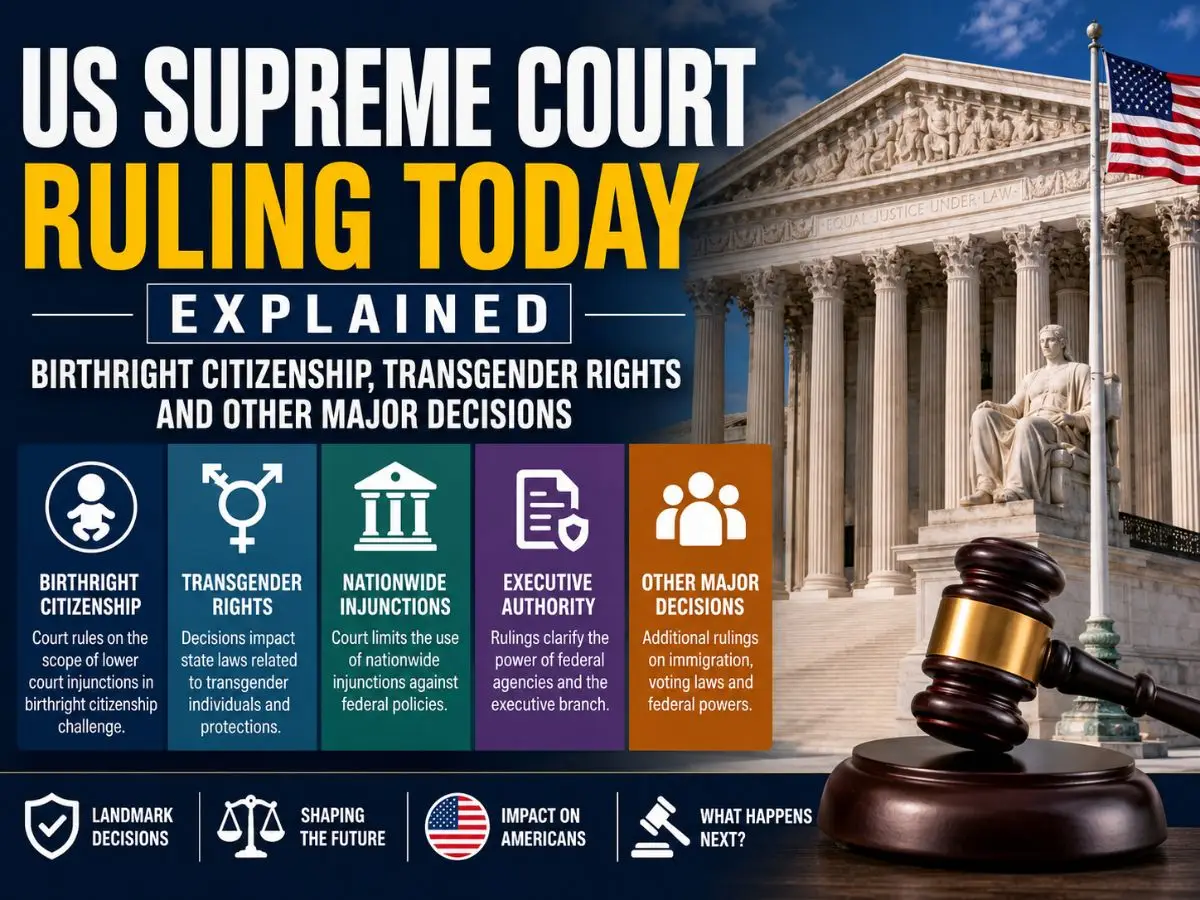
The US Supreme Court ruling today has sparked nationwide debate after the nation’s highest court delivered several major decisions on issues including birthright citizenship, transgender rights, immigration, voting laws, and federal judicial powers. These rulings could shape legal and political discussions for years to come. Whether you are following the latest court news or trying to understand how these decisions affect Americans, here is a complete breakdown of what happened, why it matters, and what could happen next.
What Did the US Supreme Court Decide Today?
The Supreme Court released multiple opinions covering several high-profile legal disputes that have dominated headlines over the past few months.
The biggest decisions involved:
- Birthright citizenship
- Transgender rights
- Nationwide injunctions
- Federal executive powers
- Immigration-related legal challenges
Some rulings resolved long-running legal battles, while others sent cases back to lower courts for further review.
What Is the Birthright Citizenship Case About?
Birthright citizenship refers to the constitutional principle that most people born on US soil automatically become American citizens under the 14th Amendment.
The recent legal challenge questioned whether the federal government could change or limit this long-standing interpretation through executive action.
The Supreme Court’s decision focused less on the constitutional definition itself and more on whether lower federal courts have the authority to block nationwide enforcement of executive policies before final judicial review.
As a result, the broader constitutional debate over birthright citizenship may continue in future cases.
Why Is Birthright Citizenship So Important?
Birthright citizenship has been part of American constitutional law for more than 150 years.
Supporters argue it guarantees equal protection under the Constitution and prevents discrimination based on parents’ immigration status.
Critics believe the policy encourages illegal immigration and should be reconsidered.
Because of these competing views, any Supreme Court decision involving birthright citizenship receives enormous public and political attention.
What Did the Supreme Court Say About Nationwide Injunctions?
One of the most significant parts of today’s rulings involved nationwide injunctions.
These injunctions allow a single federal judge to temporarily stop a federal policy across the entire country while lawsuits continue.
The Supreme Court examined whether such broad judicial orders should remain common practice.
Several justices expressed concerns that nationwide injunctions may exceed the proper role of lower courts because they affect millions of people beyond the parties involved in the lawsuit.
Legal experts say today’s ruling could reshape how future presidential policies are challenged in federal courts.
What Happened in the Transgender Rights Cases?
Another closely watched issue involved transgender rights.
The Court addressed legal disputes concerning state laws affecting transgender individuals, including policies related to healthcare, education, and discrimination protections.
Some decisions allowed state laws to remain in effect while litigation continues, whereas others clarified procedural standards that lower courts must follow.
These rulings are expected to influence ongoing legal battles across multiple states.
Civil rights organizations welcomed some aspects of the decisions, while conservative groups praised others, highlighting how divided public opinion remains.
Why Are These Decisions So Significant?
Supreme Court rulings create legal precedents that influence courts nationwide.
Today’s decisions could affect:
- Immigration policy
- Constitutional rights
- Federal executive authority
- State government powers
- Civil rights litigation
- Future presidential administrations
Because the Supreme Court serves as the final interpreter of federal law, its opinions often shape national policy long after individual political administrations change.
How Could These Rulings Affect Americans?
For most Americans, the impact may not be immediate.
However, these decisions could influence:
Immigration Policies
Future executive actions involving immigration may face different legal standards depending on how courts apply today’s ruling.
Federal Lawsuits
Lower courts may become more limited when issuing nationwide injunctions against federal policies.
Civil Rights Cases
Ongoing lawsuits involving transgender rights and constitutional protections will likely rely on today’s legal reasoning.
Political Debate
The rulings are expected to become major issues during upcoming election campaigns as political leaders respond to the Court’s decisions.
What Did the Justices Disagree About?
As is common in major constitutional cases, the justices were divided on several issues.
Some argued courts should exercise greater restraint when blocking government policies nationwide.
Others believed broad judicial authority remains necessary to protect constitutional rights while legal challenges proceed.
Several opinions included strong dissents that criticized the majority’s reasoning, reflecting continuing ideological differences within the Court.
How Have Political Leaders Responded?
The rulings generated immediate reactions across Washington.
Supporters of the decisions described them as important victories for constitutional limits on judicial power.
Opponents argued some rulings could weaken protections for vulnerable communities and create uncertainty for future legal challenges.
Civil rights groups, immigration advocates, state governments, and legal organizations are now reviewing the opinions to determine their next legal steps.
What Happens Next?
Although today’s decisions resolved several important questions, many legal battles remain unfinished.
Some cases return to lower federal courts for additional proceedings.
Others could eventually return to the Supreme Court if new constitutional issues arise.
Legal experts believe disputes involving immigration, executive authority, and transgender rights will continue appearing before federal courts over the coming years.
Also Read: Who Is Justice Samuel Alito? Everything to Know After His Surprise Retirement
FAQ’s
- Did the Supreme Court end birthright citizenship?
- No. The Court did not eliminate birthright citizenship. Instead, it addressed procedural legal questions regarding how lower courts may block federal policies while constitutional challenges continue.
- What are nationwide injunctions?
- Nationwide injunctions are court orders that temporarily prevent the federal government from enforcing a policy across the entire United States before a case reaches a final decision.
- Did the Court decide all transgender rights cases?
- No. Today’s opinions addressed specific legal disputes. Many other transgender rights cases remain active in lower courts and may eventually reach the Supreme Court.
- Why are Supreme Court decisions important?
- Supreme Court rulings establish legal precedents that guide lower courts, influence government policies, and shape constitutional interpretation across the United States.
- Can Congress change these rulings?
- Congress can sometimes pass new legislation to address issues raised by Supreme Court decisions. However, constitutional interpretations by the Court often remain controlling unless changed through future judicial decisions or constitutional amendments.
More in World
 WorldIndus Waters Treaty Row: Ishaq Dar Seeks India Dialogue, Data Sharing29 Aug 2026
 WorldMcDonald’s Spicy Chicken McNuggets Are Back: September 2026 Return28 Aug 2026
 WorldChandra Grahan 2026: August 28 Lunar Eclipse Date, Time, Visibility in India, Sutak and Blood Moon Explained27 Aug 2026
 WorldLunar Eclipse August 2026: Date, Time, Visibility, Sturgeon Moon and Why India Won’t See It25 Aug 2026
 WorldGayle King Criticises Hayden Panettiere’s Mother Over Statement: ‘Thanks, Mom, For Nothing’20 Aug 2026
 WorldModerna Cancer Vaccine: mRNA Melanoma Shot Succeeds in First Phase 3 Trial19 Aug 2026
Read Next
 EntertainmentMunmun Dutta Shares Empty Taarak Mehta Ka Ooltah Chashmah Set: ‘Looks Haunted’ When Nobody Is Shooting19 Sep 2026
 EntertainmentBhuvan Bam on India’s Got Latent Season 2 Episode 7: Panel, Samay Raina Show & What Happened18 Sep 2026
 SportsAbhishek Sharma Hits Fastest T20I Century: 30-Ball Hundred Breaks Rohit Sharma’s Record17 Sep 2026