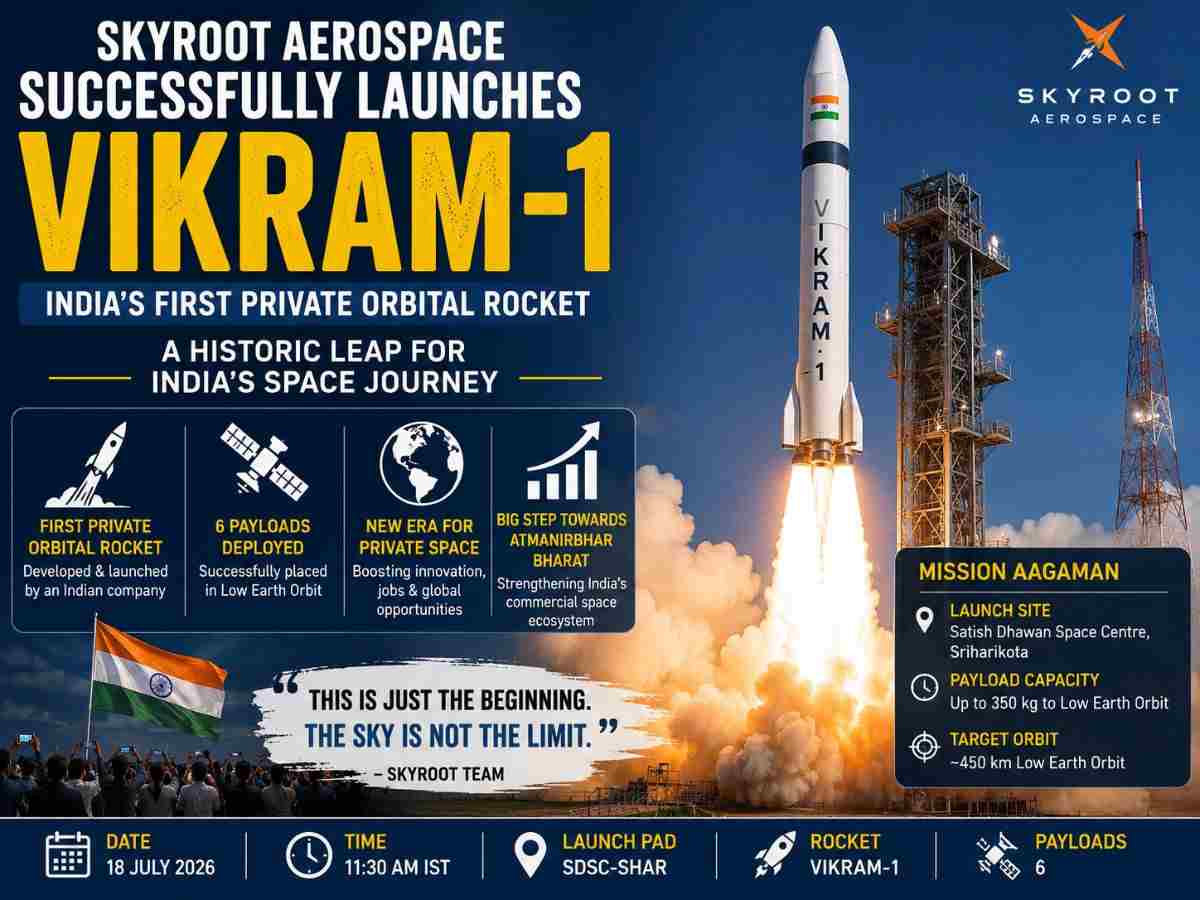
India has entered a historic new chapter in space exploration with Skyroot Aerospace’s successful launch of Vikram-1, the country’s first privately developed orbital rocket. The milestone mission, named Mission Aagaman, lifted off from the Satish Dhawan Space Centre (SDSC-SHAR) in Sriharikota and successfully deployed multiple payloads into Low Earth Orbit (LEO), marking a breakthrough for India’s rapidly growing private space industry.
The achievement is more than just another rocket launch—it demonstrates how India’s space ecosystem has evolved from being dominated by government agencies to embracing innovative private companies capable of delivering world-class launch services. For Skyroot Aerospace, founded just a few years ago, Vikram-1 represents the culmination of years of research, engineering, and testing.
A Historic Milestone for India’s Space Sector
The successful launch of Vikram-1 makes Skyroot Aerospace the first Indian private company to develop, launch, and place an orbital-class rocket into space. The mission highlights the growing maturity of India’s commercial space ecosystem following the government’s decision to open the sector to private participation in 2020.
Industry experts believe this achievement will encourage more startups, attract global investment, and strengthen India’s position in the international launch services market.
What Is Vikram-1?
Vikram-1 is Skyroot Aerospace’s first orbital launch vehicle, named after Dr. Vikram Sarabhai, the father of India’s space programme.
The rocket has been designed to provide affordable and reliable launch services for small satellites heading to Low Earth Orbit.
Key Specifications
- Mission Name: Mission Aagaman
- Rocket: Vikram-1
- Launch Site: Satish Dhawan Space Centre, Sriharikota
- Height: Approximately 22 metres
- Payload Capacity: Up to 350 kg to Low Earth Orbit
- Target Orbit: Around 450 km Low Earth Orbit
- Technology: Carbon-composite structure, solid propulsion stages and a 3D-printed liquid orbital adjustment engine.
Mission Aagaman: A New Beginning
Skyroot named its maiden orbital mission Mission Aagaman, symbolising the arrival of India’s private space launch era.
After a brief countdown hold, the rocket lifted off successfully and completed its mission by deploying multiple customer payloads into the planned orbit approximately 15 minutes after launch. The mission validated critical systems including propulsion, navigation, guidance, stage separation and orbital insertion.
Multiple Payloads Successfully Deployed
One of Vikram-1’s biggest achievements was successfully carrying and deploying six payloads, including technology demonstration missions and satellites from Indian and international customers.
The payload manifest included:
- Skyroot’s SCOPE satellite
- Grahaa Space’s SOLARAS mission
- Cosmoserve Space’s EMBRACE robotic technology
- DCUBED technology demonstration payload
- Additional symbolic and commercial payloads.
Successfully placing these payloads into orbit demonstrates the rocket’s readiness for future commercial missions.
Why This Launch Is Important
The Vikram-1 mission is significant because it shows India’s private companies can now independently build and operate orbital launch vehicles.
This achievement could help:
- Reduce launch costs for small satellites.
- Expand commercial launch opportunities.
- Increase global confidence in Indian space startups.
- Create high-skilled jobs in aerospace engineering.
- Accelerate innovation in satellite technology.
The launch also strengthens India’s ambitions to become a leading player in the global commercial space market.
From Vikram-S to Vikram-1
Skyroot’s journey did not begin with Vikram-1.
In 2022, the company successfully launched Vikram-S, India’s first privately developed suborbital rocket under Mission Prarambh. That mission validated several key technologies—including propulsion, avionics and carbon-composite structures—which later formed the foundation for the orbital-class Vikram-1 rocket.
The successful orbital launch now marks the next major milestone in Skyroot’s roadmap.
A Boost for India’s Private Space Ecosystem
India’s space sector has changed dramatically over the past few years.
Government reforms have enabled private companies to work alongside ISRO and access launch infrastructure, testing facilities and regulatory support.
Today, dozens of Indian space startups are developing:
- Launch vehicles
- Satellites
- Space manufacturing technologies
- Earth observation services
- Deep-space technologies
Skyroot Aerospace is among the pioneers leading this transformation.
Prime Minister Congratulates Skyroot Team
Following the successful launch, Prime Minister Narendra Modi congratulated the Skyroot Aerospace team and praised the mission as an inspiration for India’s youth and scientific community.
He noted that the achievement reflects the country’s growing technological capabilities and highlights the success of reforms that opened the space sector to private innovation.
How Vikram-1 Compares Globally
Private space companies have transformed the global launch industry over the last decade.
With Vikram-1’s success, India joins a select group of nations where private companies have demonstrated orbital launch capability, further strengthening the country’s role in the international commercial space economy.
Industry analysts expect increasing demand for small-satellite launches as communication, Earth observation, defence and scientific missions continue to expand worldwide.
What Comes Next for Skyroot Aerospace?
The company has indicated that Vikram-1 is only the beginning.
Future plans include:
- Additional orbital launches.
- Regular commercial launch services.
- Next-generation Vikram launch vehicles.
- Increased payload capacity.
- International launch partnerships.
Skyroot also aims to make satellite launches more frequent, affordable and accessible for customers around the world.
Why This Matters for India’s Economy
India’s space economy is projected to grow significantly over the coming years.
According to government projections, the sector could expand from approximately USD 8.4 billion today to USD 40–45 billion by 2030, with a longer-term goal of reaching USD 100 billion by 2040. Successful private launches like Vikram-1 are expected to play a major role in achieving these ambitions.
More in Breaking
 BreakingRoyal Enfield Himalayan 440 Launch Confirmed for September 4: Price, Engine and Everything We Know14 Aug 2026
 BreakingNational Handloom Day 2026: Date, Theme, History, Significance and Why India Celebrates Its Weaving Heritage6 Aug 2026
 BreakingNew-Gen Toyota Fortuner India Launch: Expected Design, Features, Engine Options & Launch Timeline31 Jul 2026
 BreakingVaibhav Sooryavanshi Continues Dream Run, Scores Back-to-Back T20 Fifties Against Zimbabwe26 Jul 2026
 BreakingDharmendra Pradhan Resignation: What Happened, Why It Matters, and What’s Next25 Jul 2026
 BreakingAnthropic Launches Claude Opus 5: Everything You Need to Know About Its Most Powerful AI Model Yet25 Jul 2026
Read Next
 EntertainmentMunmun Dutta Shares Empty Taarak Mehta Ka Ooltah Chashmah Set: ‘Looks Haunted’ When Nobody Is Shooting19 Sep 2026
 EntertainmentBhuvan Bam on India’s Got Latent Season 2 Episode 7: Panel, Samay Raina Show & What Happened18 Sep 2026
 SportsAbhishek Sharma Hits Fastest T20I Century: 30-Ball Hundred Breaks Rohit Sharma’s Record17 Sep 2026