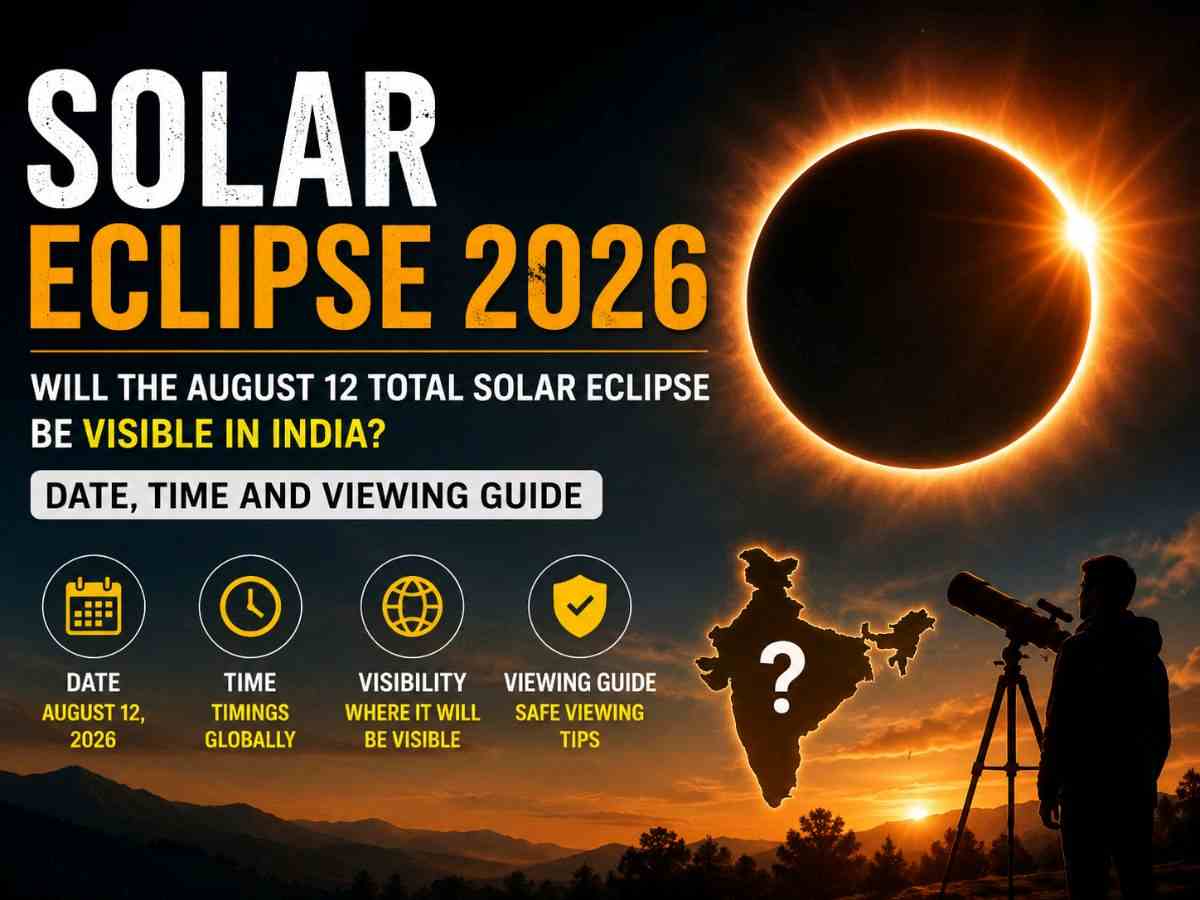
The Total Solar Eclipse of August 12, 2026, is shaping up to be one of the most anticipated astronomical events of the decade. Skywatchers, astronomy enthusiasts, photographers, and curious observers across the globe are eagerly awaiting this rare celestial phenomenon. As search interest around keywords such as “Solar Eclipse 2026,” “August 12 Solar Eclipse,” and “Will the Solar Eclipse 2026 be visible in India?” continues to rise, many people are looking for reliable information about the event.
In this guide, we’ll explore the date, timing, visibility, scientific significance, and safe viewing methods for the August 12, 2026, Total Solar Eclipse.
What Is a Solar Eclipse?
A solar eclipse occurs when the Moon passes between the Earth and the Sun, blocking all or part of the Sun’s light from reaching Earth.
There are four main types of solar eclipses:
- Total Solar Eclipse
- Partial Solar Eclipse
- Annular Solar Eclipse
- Hybrid Solar Eclipse
A Total Solar Eclipse is considered the most spectacular because the Moon completely covers the Sun, turning day into twilight for a few minutes and revealing the Sun’s outer atmosphere, known as the corona.
When Is the Solar Eclipse in 2026?
The Total Solar Eclipse will take place on August 12, 2026.
Astronomers have already identified it as one of the most significant sky events of the year due to its long visibility path across parts of Europe, Greenland, Iceland, and the Arctic region.
Key Details
| Event | Details |
|---|---|
| Eclipse Type | Total Solar Eclipse |
| Date | August 12, 2026 |
| Duration | Varies by location |
| Best Viewing Regions | Spain, Iceland, Greenland, Portugal and parts of Europe |
| Visibility in India | Limited/Not Total |
| Scientific Importance | High |
Will the August 12 Solar Eclipse Be Visible in India?
This is currently one of the most searched questions online.
Unfortunately, India will not witness the total phase of the August 12, 2026 Solar Eclipse.
The path of totality primarily passes through:
- Greenland
- Iceland
- Spain
- Portugal
- Northern Atlantic regions
Depending on final astronomical calculations and geographic location, some regions may observe a slight partial phase through online broadcasts and scientific observatories’ tracking systems, but India is not among the major viewing locations for the eclipse.
For Indian skywatchers hoping to experience the dramatic “day turns into night” effect, this eclipse will not provide that opportunity locally.
Why Is the 2026 Solar Eclipse So Special?
Every solar eclipse is unique, but the August 2026 event stands out for several reasons.
1. Rare Path Across Europe
Europe has not witnessed a major total solar eclipse across several populated regions in recent years. Countries like Spain are expected to become major destinations for eclipse tourism.
2. Opportunity for Scientific Research
Scientists use total solar eclipses to study:
- Solar corona
- Solar winds
- Magnetic activity
- Space weather patterns
These observations help researchers understand how the Sun influences Earth and satellite communications.
3. Once-in-a-Lifetime Experience
For many people living within the path of totality, this could be the only total solar eclipse they see in their lifetime.
What Happens During a Total Solar Eclipse?
The sequence of events during a total eclipse is fascinating.
Partial Phase Begins
The Moon slowly starts covering the Sun.
Temperature Drops
As sunlight decreases, temperatures can noticeably fall.
Animals React
Birds may stop singing, and some animals behave as if night has arrived.
Totality Begins
The Sun becomes completely covered.
At this stage, observers can see:
- The solar corona
- Bright stars and planets
- A twilight-like sky during daytime
Totality Ends
The Sun gradually reappears, and daylight returns.
Best Places to Watch the Solar Eclipse 2026
Travel experts and astronomy organizations expect these locations to attract thousands of eclipse chasers.
Spain
Spain is considered one of the best destinations because of:
- Clear August skies
- Good infrastructure
- Accessible viewing locations
Iceland
Iceland offers dramatic landscapes combined with eclipse viewing opportunities.
Greenland
Parts of Greenland lie directly in the eclipse path and will provide unique Arctic viewing experiences.
Portugal
Some regions are expected to witness excellent eclipse conditions.
How to Watch the Solar Eclipse Safely
One of the most important aspects of eclipse viewing is eye safety.
Never Look Directly at the Sun
Looking at the Sun without protection can permanently damage your eyesight.
Use Certified Eclipse Glasses
Only use glasses that meet international solar-viewing safety standards.
Solar Filters for Cameras
Photographers should install proper solar filters before capturing eclipse images.
Use Projection Methods
Pinhole projectors provide a safe way to observe the eclipse indirectly.
Why Scientists Study Solar Eclipses
A total solar eclipse creates conditions that are otherwise impossible to replicate.
Researchers use these events to examine:
Solar Corona
The corona becomes visible only during totality.
Space Weather
Solar activity can affect:
- GPS systems
- Satellite communications
- Power grids
Magnetic Fields
Scientists analyze magnetic interactions surrounding the Sun.
These studies contribute to better forecasting of solar storms that can impact technology worldwide.
Solar Eclipse Myths vs Scientific Facts
Myth: Solar Eclipses Bring Bad Luck
There is no scientific evidence supporting this claim.
Myth: Food Becomes Unsafe During an Eclipse
Scientific research has found no connection between eclipses and food contamination.
Myth: Pregnant Women Must Stay Indoors
This is a cultural belief rather than a scientifically proven risk.
Fact
A solar eclipse is simply an astronomical alignment involving the Earth, Moon, and Sun.
How to Watch the Eclipse from India
Although India is not in the path of totality, enthusiasts can still enjoy the event through:
- Live streams from space agencies
- Astronomy websites
- Planetariums
- Educational broadcasts
- YouTube live coverage from observatories
Organizations such as international space agencies and astronomical societies are expected to provide extensive live coverage.
What Does This Eclipse Mean for Astronomy Enthusiasts?
For astronomy lovers, the August 12, 2026 Solar Eclipse represents more than a visual spectacle.
It offers a chance to:
- Learn about celestial mechanics
- Observe rare astronomical events
- Participate in global science discussions
- Inspire interest in space exploration
The event also highlights humanity’s continued fascination with the cosmos and our desire to understand the universe.
Final Thoughts
The August 12, 2026 Total Solar Eclipse is set to become one of the most talked-about astronomical events of the year. While India will not experience the dramatic total phase, millions of people worldwide will witness this rare celestial alignment. From Spain and Iceland to Greenland and Portugal, the eclipse will provide unforgettable views and valuable scientific opportunities.
For Indian viewers, live broadcasts and educational programs will offer a front-row seat to this extraordinary event. Whether you’re a seasoned astronomer or simply curious about the night sky, the 2026 Solar Eclipse serves as a reminder of the incredible wonders that continue to unfold above us.
Also Read: H1N1 Cases Jump 6 Times in Delhi: Doctors Explain Symptoms, Prevention and Risk Factors
More in World
 WorldIndus Waters Treaty Row: Ishaq Dar Seeks India Dialogue, Data Sharing29 Aug 2026
 WorldMcDonald’s Spicy Chicken McNuggets Are Back: September 2026 Return28 Aug 2026
 WorldChandra Grahan 2026: August 28 Lunar Eclipse Date, Time, Visibility in India, Sutak and Blood Moon Explained27 Aug 2026
 WorldLunar Eclipse August 2026: Date, Time, Visibility, Sturgeon Moon and Why India Won’t See It25 Aug 2026
 WorldGayle King Criticises Hayden Panettiere’s Mother Over Statement: ‘Thanks, Mom, For Nothing’20 Aug 2026
 WorldModerna Cancer Vaccine: mRNA Melanoma Shot Succeeds in First Phase 3 Trial19 Aug 2026
Read Next
 EntertainmentMunmun Dutta Shares Empty Taarak Mehta Ka Ooltah Chashmah Set: ‘Looks Haunted’ When Nobody Is Shooting19 Sep 2026
 EntertainmentBhuvan Bam on India’s Got Latent Season 2 Episode 7: Panel, Samay Raina Show & What Happened18 Sep 2026
 SportsAbhishek Sharma Hits Fastest T20I Century: 30-Ball Hundred Breaks Rohit Sharma’s Record17 Sep 2026