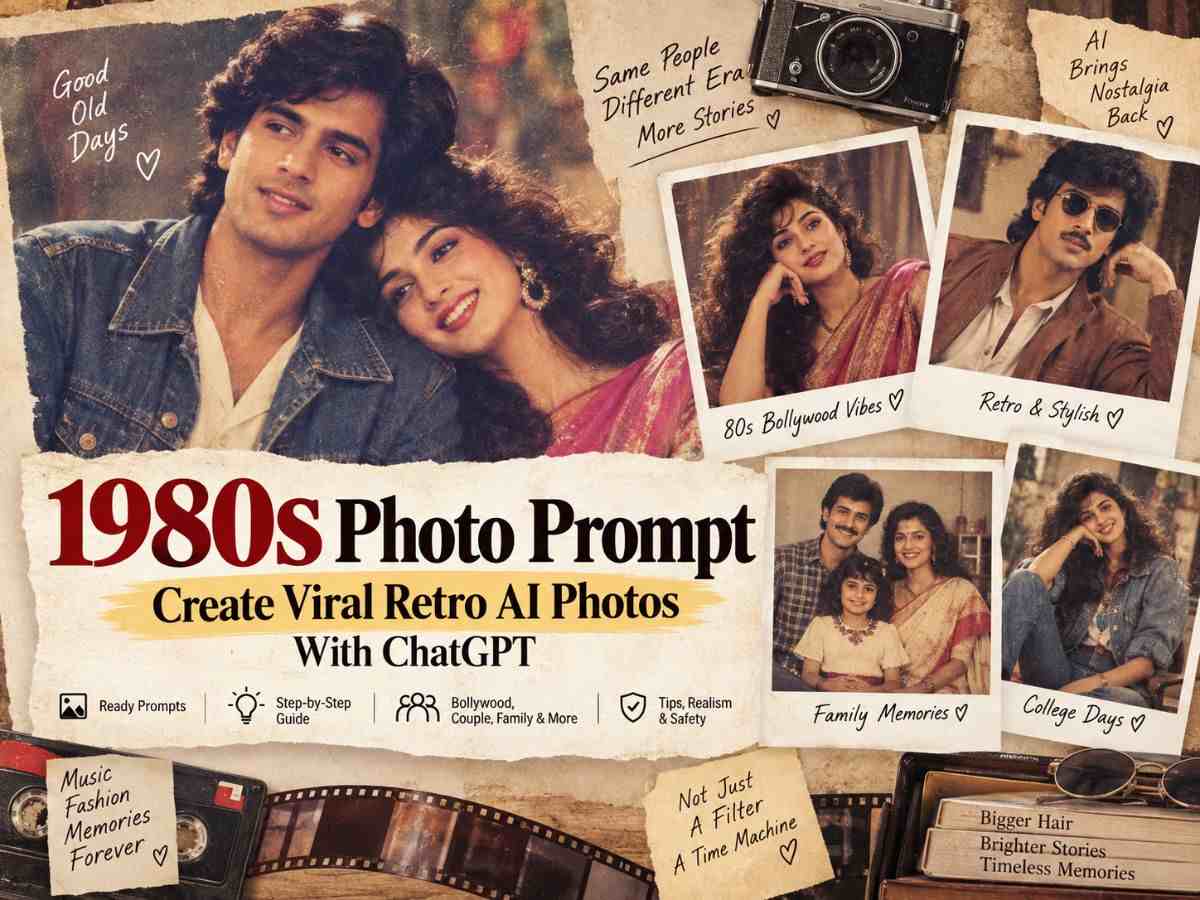
The 1980s photo trend is taking over Instagram, with users turning modern selfies and personal photographs into AI-generated portraits inspired by the fashion, hairstyles, lighting and photography of the decade. Instead of applying a simple vintage filter, people are using detailed prompts to change the entire visual setting while keeping their faces recognisable. The trend has spread across Instagram posts, Stories, Reels and the platform’s “Add Yours” format, with users experimenting with Bollywood-inspired portraits, family-album pictures, magazine covers and retro street looks.
What makes the trend interesting is that the prompt does most of the creative work. A short instruction such as “make this photo look old” can produce a generic result, while a carefully written 1980s photo prompt can specify the hairstyle, clothing, location, lighting, camera character and film texture. That gives users much more control over the final image.
This guide explains what the trend is, how it differs from a regular vintage filter, how to write better prompts, which photos work best, how to preserve facial identity, and how to create Indian, Bollywood, couple, family, wedding and college-themed 1980s AI photos.
What Is the Viral 1980s Photo Trend?
The 1980s photo trend on Instagram is an AI image-editing trend in which users upload a present-day photo and ask an AI image generator to reinterpret it as if it had been photographed during the 1980s.
The result can include period-appropriate clothing, larger hairstyles, retro accessories, warm studio lighting, softer focus, analogue film grain and vintage backgrounds. Current coverage of the trend shows users creating everything from classic Bollywood-inspired portraits to family-album and magazine-style images.
The key difference is that AI can reinterpret the entire visual scene, rather than simply placing a colour filter over an existing photograph. That means the same modern selfie can potentially become a fictional 1980s studio portrait, a vintage wedding photograph or an old Bollywood-style magazine cover.
The appeal is partly nostalgia. For older users, the look can resemble photographs from their youth or family albums. For younger audiences, it offers a way to experiment with an era they never personally experienced.
The trend is also highly shareable. People can create a portrait, post it to Instagram and use Add Yours to invite friends to create their own versions.
Why the 1980s Aesthetic Looks Different From a Normal Vintage Filter
A normal vintage filter changes the appearance of an existing photograph. It might make colours warmer, reduce contrast, add grain or create a faded effect.
An AI transformation works differently.
It can reinterpret:
- Hair: turning a modern hairstyle into a fuller, period-inspired style
- Clothing: replacing contemporary outfits with 1980s fashion
- Background: moving the subject into a retro studio, home or street setting
- Accessories: adding era-appropriate jewellery, sunglasses or bags
- Lighting: recreating the softer or warmer character associated with older photography
- Composition: changing the framing and overall portrait style
- Camera character: creating the appearance of analogue photography
- Film texture: adding restrained grain, softness and colour variation
That is why a detailed 80s photo prompt can produce a much more convincing result than simply asking an AI tool to “make this image vintage.” Current reporting on the trend specifically distinguishes AI recreation from a basic vintage filter.
The goal should not be to make the image look damaged. A convincing retro image usually feels like a photograph that could genuinely have been taken in that period.
The Formula Behind a Good 1980s Photo Prompt
A strong prompt is easier to create when you break it into predictable parts.
The basic formula is:
Subject + identity preservation + decade + outfit + hairstyle + setting + lighting + camera style + film texture + realism instruction
For example:
Transform my uploaded photo into an authentic 1980s Indian portrait. Preserve my facial structure, identity, natural skin tone and expression. Give me period-appropriate Indian clothing, an era-inspired hairstyle and subtle retro accessories. Place me in an authentic 1980s Indian setting with warm studio lighting, soft analogue photography, natural shadows and subtle film grain. Keep the result photorealistic and avoid modern objects, excessive ageing effects or artificial-looking skin.
Each part has a specific job.
Subject tells the model what image you are transforming.
Identity preservation reduces the chance that the generated person looks like someone else.
Era establishes the visual period.
Clothing and hairstyle create recognisable 1980s cues.
Setting gives the image historical context.
Lighting controls mood and photographic character.
Camera style and film texture help the image feel like a real photograph rather than a modern digital image with a filter.
This method is more flexible than copying one fixed prompt. You can change the setting or outfit while keeping the same core structure.
What Kind of Photo Works Best for an 80s AI Prompt?
A good source image can make a major difference to the final result.
For the best 1980s AI photo, start with a relatively clear image showing the person’s face. Front-facing and three-quarter portraits are particularly useful because the facial features are easier for an image model to interpret.
Better source photos usually have:
- Clear facial details
- Good or even lighting
- Minimal motion blur
- A visible face and hairstyle
- Reasonably high resolution
- A simple composition
Photos to avoid:
- Extremely dark selfies
- Severe blur
- Heavy beauty filters
- Faces hidden behind sunglasses or objects
- Complicated group photographs
- Very low-resolution images
The point is not that a poor-quality photo can never work. It is simply harder for an AI model to preserve a person’s appearance when the original image contains limited information.
A useful rule is simple: the cleaner the original photograph, the more control you generally have over the transformation.
The Master 1980s Photo Prompt for Indian Users
For an Indian audience, generic “retro” instructions can miss the visual details that make the era feel locally authentic.
Try this: Transform my uploaded photo into a realistic 1980s Indian photograph. Keep my facial identity, facial structure, natural skin tone and expression recognisable. Give me authentic 1980s Indian fashion, an era-appropriate hairstyle and subtle period accessories. Place me in a believable Indian setting from the 1980s with warm studio lighting, natural shadows, soft analogue-camera character and subtle film grain. Use realistic skin texture and slightly softened colours. Remove modern smartphones, contemporary furniture, modern cars, LED lighting and present-day objects. Make the image look like a genuine photograph taken in India during the 1980s, not a modern image with a vintage filter.
This works because it combines Indian context + identity preservation + visual period cues + realism.
Current trend coverage similarly highlights Indian fashion, Bollywood styling, retro hair, statement jewellery, warm lighting and analogue film texture as recurring visual elements.
1980s Bollywood Heroine Photo Prompt
For a classic Bollywood-inspired look: Transform my uploaded photo into a glamorous 1980s Bollywood heroine portrait. Preserve my facial features, identity, natural skin tone and expression. Style me in a classic Indian saree with a period-appropriate printed blouse, elegant retro jewellery and voluminous 1980s hair. Use warm studio lighting, soft focus, realistic skin texture, subtle analogue film grain and a vintage Bollywood photography atmosphere. Keep the final image photorealistic and avoid modern styling, excessive beauty retouching or artificial ageing.
The important point is to capture the era, rather than imitate a particular living actor’s face.
1980s Bollywood Hero Photo Prompt
For a male retro look: Turn my uploaded photo into an authentic 1980s Indian Bollywood hero portrait. Keep my face, identity, expression and natural skin tone recognisable. Add period-appropriate high-waisted trousers, an open-collar shirt, a classic 1980s hairstyle and subtle vintage sunglasses. Use a warm studio backdrop, analogue camera character, natural shadows, soft film grain and realistic skin texture. Avoid modern clothing, current accessories and excessive cinematic effects.
This gives the model clear instructions without depending on a particular celebrity.
1980s Couple Photo Prompt
Couple prompts are particularly useful because the current search landscape is also showing interest in 1980s photo prompt couple searches.
Use: Transform this couple photo into an authentic 1980s Indian photograph. Preserve both people’s facial identities, natural skin tones and expressions. Give them coordinated 1980s Indian clothing, period-appropriate hairstyles and subtle accessories. Create a natural pose in a vintage family-album or studio setting with warm lighting, analogue camera softness and subtle film grain. Remove modern objects, smartphones and contemporary styling. Keep both faces recognisable and make the photograph look naturally captured in the 1980s.
For couples, identity preservation is especially important because the AI is processing two faces at once.
1980s Family Album Prompt
This can create a nostalgic old-family-photo feeling: Transform this family photograph into an authentic 1980s Indian family album picture. Keep every family member recognisable and preserve their facial structure and natural skin tones. Dress everyone in realistic 1980s Indian clothing and place them in a modest period-appropriate living room. Use slightly soft analogue-camera focus, gentle flash photography, natural shadows, mild film grain and slightly faded colours. Avoid modern furniture, smartphones, LED lights and present-day objects. Make the result feel like a genuine family photograph preserved in an old album.
The family-album look has become one of the recurring creative directions around this trend.
1980s Wedding Photo Prompt
For a wedding-themed transformation: Recreate this photograph as an authentic 1980s Indian wedding photograph. Preserve the faces and identities of all people. Add realistic period-appropriate wedding clothing, traditional jewellery, vintage floral decoration and an old-fashioned studio or wedding-hall backdrop. Use warm flash photography, soft analogue film texture, slight colour fading and realistic skin tones. Avoid modern decoration, contemporary clothing and artificial-looking effects. Make it feel like a real wedding photograph from an Indian family album in the 1980s.
The key is to keep the image grounded in period details, not generic “old photo” effects.
1980s Street-Style and College Photo Prompt
For a younger, more casual version: Transform my photo into a realistic 1980s Indian college street-style photograph. Preserve my face, expression and identity. Give me authentic 1980s casual clothing such as denim, a printed shirt and a period-inspired bag. Place me on an Indian college campus or local street with vintage scooters, old storefronts and period-appropriate surroundings. Use natural daylight, analogue camera softness and subtle film grain. Remove modern vehicles, smartphones, signage and present-day objects.
This approach turns the trend into a more specific lifestyle image instead of another formal studio portrait.
How to Make the AI Photo Look Real Instead of AI-generated
One of the biggest problems with AI retro photos is that they can become too perfect.
Real older photographs often contain small imperfections: uneven lighting, slight softness, modest colour variation and natural skin texture.
To create a believable image, add instructions such as:
- Preserve natural skin texture
- Keep realistic facial proportions
- Use subtle film grain
- Avoid plastic-looking skin
- Avoid excessive sharpening
- Keep natural shadows
- Make hands and fingers anatomically realistic
- Avoid modern beauty retouching
- Use restrained colour fading
The aim is photographic realism, not maximum digital detail.
A useful line is: Make the image look naturally photographed on an analogue camera, with subtle imperfections and realistic texture rather than a heavily processed AI appearance.
Current reporting also warns users to inspect AI-generated images because faces and small details can sometimes be changed unintentionally.
How to Keep Your Face Recognisable in an 80s Transformation
One of the most common complaints about AI photo generation is:
“The clothes changed, but my face also changed.”
To reduce that problem, explicitly separate what should change from what should remain.
Use: Preserve my facial structure, recognisable features, natural skin tone, expression and identity. Change only the hairstyle, clothing, accessories, background and photographic style. Do not turn me into a different person.
Think of your prompt in two groups.
Change: Clothing + hairstyle + background + accessories + lighting + camera appearance
Preserve: Identity + facial structure + expression + natural skin tone
This makes the instruction clearer and gives the model a stronger constraint.
How to Change Only the Background Without Changing Your Face
You do not always need to transform the entire photograph.
A useful editing prompt is: Keep my face, expression, skin tone, clothing, body shape and overall appearance unchanged. Replace only the background with an authentic 1980s Indian setting. Add period-appropriate architecture, furniture, and environmental details while maintaining realistic lighting and perspective.
This is particularly useful when you already like your original outfit and want only the retro environment.
How to Change Outfit, Hair, and Accessories Separately
Trying to change every element in one giant prompt can sometimes produce inconsistent results.
An easier workflow is to edit progressively.
Step 1: Change the era
Ask the AI to establish the overall 1980s visual style.
Step 2: Change the clothing
Specify the exact type of outfit you want.
Step 3: Change the hairstyle
Describe the hair separately instead of relying only on “80s style.”
Step 4: Add the environment
Move the subject into a specific room, street, studio, wedding setting or magazine shoot.
Step 5: Add photographic texture
Finish with analogue-camera softness, subtle grain and realistic lighting.
This iterative approach gives you more control because you can evaluate each change instead of asking for ten transformations simultaneously.
5 Prompt Mistakes That Make 1980s AI Photos Look Fake
1. Too many unrelated instructions
A prompt packed with contradictory ideas can confuse the model.
Fix: Organise the request in a logical order: subject → era → styling → setting → photography.
2. Mixing modern and 1980s objects
A retro portrait with a smartphone, modern car or LED light can instantly break the illusion.
Fix: Add an explicit instruction to remove modern objects.
3. Overusing “ultra-realistic”
Repeating words such as “8K ultra-realistic hyper-detailed cinematic” does not automatically make the image historically convincing.
Fix: Describe the actual photographic characteristics you want.
4. Forgetting identity preservation
Without a clear instruction, the AI may significantly alter the person’s face.
Fix: Tell it exactly which facial characteristics should remain unchanged.
5. Adding too much film damage
Heavy scratches, extreme dust and dramatic sepia effects can make the image look like a fake “old photo.”
Fix: Ask for subtle grain and restrained ageing.
How to Avoid Modern Objects in Your Retro Photo
Historical consistency matters.
A simple negative instruction can make a big difference: Remove all modern smartphones, contemporary cars, LED lighting, modern furniture, current logos, modern jewellery, present-day architecture and other objects that did not fit the 1980s setting.
You can make the instruction even more specific by naming the environment.
For example, in an Indian living-room scene, ask for period furniture, old television design, traditional decor and era-appropriate lighting rather than leaving the setting generic.
1980s vs 1990s: Which AI Retro Look Should You Choose?
The trend is already expanding beyond the 1980s, with current coverage showing interest in 1990s and early-2000s prompts as users experiment with different nostalgia eras.
1980s aesthetic
Usually works well with:
- Bigger or more voluminous hairstyles
- Bolder fashion
- Stronger studio-portrait styling
- More dramatic accessories
- Softer analogue photography
- Classic retro Bollywood influence
1990s aesthetic
Often feels:
- More casual
- More relaxed in clothing
- More varied in hairstyles
- Less formal in portrait composition
- Different in colour and pop-culture references
The best choice depends on the story you want your image to tell.
A family-album portrait may work beautifully with an early-1980s look, while a casual college image may fit a 1990s aesthetic better.
How to Turn Your AI 80s Photo Into an Instagram Post or Story
Once your image is ready, the trend is particularly suited to social sharing. Current coverage notes that users are posting their creations on Instagram, including Stories, Reels and the Add Yours feature.
Instagram Feed: Use the finished retro portrait as your main image and keep the caption short.
Suggested caption: What if this photo was taken in the 1980s?
Instagram Story: Try a before-and-after format:
Original photo → AI 1980s version
Then add: Would you survive the 80s?
Instagram Reel: Create a quick transformation:
Modern photo → transition → 1980s version
Add Yours: Upload your own image and use Instagram’s Add Yours feature to encourage followers to create their own version.
The important thing is to show the transformation rather than simply posting a static result.
Privacy and Safety: Think Before Uploading Personal Photos
AI photo trends are fun, but personal images should still be handled thoughtfully.
Before uploading a photograph, especially one containing family members or children, consider whether you are comfortable sharing that image with an AI service and whether you want the final version publicly available.
A few practical precautions are sensible:
- Do not upload passports, IDs or other sensitive documents.
- Be careful with private family photographs.
- Avoid exposing unnecessary information about children.
- Check the generated image for unexpected changes.
- Review the image before publishing it publicly.
- Follow the relevant platform’s rules and policies.
Current coverage of the 80s trend has also highlighted privacy, consent and the importance of checking AI-generated results before sharing them publicly.
When using another person’s photograph, make sure you have the appropriate permission to edit and publish it.
10 Ready-to-Copy 1980s Photo Prompts
1. Classic 80s Portrait: Transform my uploaded photo into a realistic 1980s portrait. Preserve my identity, facial structure and natural skin tone. Add period-appropriate hairstyle, clothing, accessories, warm analogue lighting and subtle film grain. Remove modern objects and keep the result photorealistic.
2. Retro Bollywood Heroine: Create an authentic 1980s Bollywood-inspired portrait from my photo with classic Indian fashion, voluminous retro hair, statement jewellery, warm studio lighting and subtle analogue film grain. Keep my face recognizable and avoid excessive beauty editing.
3. Retro Bollywood Hero: Turn my photo into an authentic 1980s Indian Bollywood hero portrait with an open-collar shirt, high-waisted trousers, retro hairstyle and vintage studio lighting. Preserve my facial identity and use realistic analogue photography.
4. Vintage Couple: Transform this couple photo into a realistic 1980s Indian portrait. Preserve both faces and identities, add coordinated period clothing and hairstyles, and place them in a vintage studio or family setting with warm analogue lighting and subtle film grain.
5. Family Album: Recreate this photograph as a genuine 1980s Indian family-album picture with period clothing, a vintage living room, analogue flash photography, soft focus and mild colour fading. Preserve everyone’s identity and remove modern objects.
6. Wedding Photograph: Transform this image into an authentic 1980s Indian wedding photograph with period-appropriate wedding clothing, traditional jewellery, floral decoration, warm flash photography and realistic analogue film texture. Keep all faces recognisable.
7. College Street Style: Turn my photograph into a realistic 1980s Indian college street portrait with denim, a printed shirt, retro accessories, vintage scooters and a period-appropriate local setting. Use natural lighting and subtle film grain.
8. Magazine Cover: Transform my photo into a stylish 1980s Indian fashion-magazine portrait. Preserve my face and identity while adding period clothing, dramatic studio lighting, retro typography space and authentic analogue camera texture.
9. Classic Studio Portrait: Recreate my photo as a professionally photographed 1980s studio portrait with soft lighting, period hairstyle, vintage clothing and subtle film grain. Keep my facial structure and natural skin texture unchanged.
10. Old Indian Cinema Poster: Reimagine my uploaded photo as an original 1980s Indian cinema-inspired portrait with bold period fashion, dramatic but realistic studio lighting and authentic analogue texture. Preserve my identity and avoid copying any specific living actor.
1980s Photo Prompt and ChatGPT Trend FAQs
- What is the 1980s photo trend on Instagram?
- It is an AI image trend in which people upload modern photographs and use detailed prompts to recreate them as realistic-looking 1980s portraits with period clothing, hairstyles, backgrounds and analogue photography effects.
- What prompt should I use for an 80s photo?
- Use a prompt that specifies the person, 1980s styling, hairstyle, clothing, setting, lighting, camera character and film texture while explicitly asking the AI to preserve the person’s facial identity.
- How do I make an 80s photo using ChatGPT?
- Upload a clear photograph to a compatible image-generation workflow and describe the 1980s style you want. Detailed prompts generally provide more control than simply asking for a vintage filter. Current coverage of the trend describes the same upload-and-prompt workflow.
- How do I make my AI photo look more realistic?
- Use realistic lighting, natural skin texture, subtle film grain, restrained colour fading and specific period details. Avoid excessive sharpening, plastic skin and dramatic artificial ageing effects.
- Can I turn a couple of photos into an 80s photo?
- Yes. A couple prompt should preserve both people’s faces and identities while specifying coordinated clothing, hairstyles, background and lighting.
- Can I create an 80s Bollywood-style photo?
- Yes. You can request Indian clothing, classic Bollywood-inspired styling, retro studio lighting and analogue film texture without copying a specific living person’s face.
- Can I use the trend with a family photo?
- Yes, provided you have the right to use and edit the photograph. For private family images, consider privacy and consent before uploading or publishing the result.
- Why does my AI photo change my face?
- The AI may reinterpret facial details while changing the rest of the image. Explicitly tell it to preserve facial structure, identity, expression and natural skin tone. Using a clear source photograph can also help.
- How do I preserve my identity in an AI photo?
- Separate the instructions clearly: tell the AI what it may change—clothing, hair, background and lighting—and what it must preserve—face, identity, skin tone and expression.
- Can I share AI-generated 80s photos on Instagram?
- Yes, users are currently sharing these images through Instagram posts, Stories and Reels. You should still review the finished image for accuracy and consider whether the image needs to be identified as AI-generated based on your context and platform requirements.
Final Takeaway
The best 1980s photo prompt does much more than say “make this picture retro.” It tells the AI exactly what the era should look like: the clothing, hairstyle, accessories, setting, lighting, camera character and film texture. Just as importantly, it clearly defines what should not change—your identity, facial structure, expression and natural appearance.
For an Indian audience, adding authentic local details can make the difference between a generic vintage picture and a convincing 1980s-inspired photograph. Start with a clear source image, build the prompt systematically, make changes step by step and inspect the final result before sharing it.
The same approach can also be adapted for 1980s Bollywood portraits, couples, family albums, weddings, college photographs and magazine-style images, while the growing interest in 1990s and Y2K variations gives the trend room to evolve further
Also Read: Deepika Padukone Maternity Photos: Ranveer Shares Family Pics With Dua
More in Entertainment
 EntertainmentMunmun Dutta Shares Empty Taarak Mehta Ka Ooltah Chashmah Set: ‘Looks Haunted’ When Nobody Is Shooting19 Sep 2026
 EntertainmentBhuvan Bam on India’s Got Latent Season 2 Episode 7: Panel, Samay Raina Show & What Happened18 Sep 2026
 EntertainmentAnant Nag to Receive Dadasaheb Phalke Award 2024: Age, Movies, Wife, Family, Career and Kannada Cinema Legacy16 Sep 2026
 EntertainmentAjaz Khan Controversy: Woman Shares Alleged ‘Coffee or Wine’ Messages14 Sep 2026
 EntertainmentMumbai Cha Raja 2026 First Look: Aagman Date, Theme, Darshan, Location and What to Know13 Sep 2026
 EntertainmentLalbaugcha Raja 2026 First Look: Date, Theme, Aagman & Darshan11 Sep 2026
Read Next
 SportsAbhishek Sharma Hits Fastest T20I Century: 30-Ball Hundred Breaks Rohit Sharma’s Record17 Sep 2026
 BusinessUPI Charges 2026: What Changes Above ₹2,000 From October 15? 0.4% MDR, Who Pays and Full Rules Explained15 Sep 2026
 BusinessBRICS Summit 2026 Delhi: New Delhi Declaration, Key Decisions & India Impact12 Sep 2026