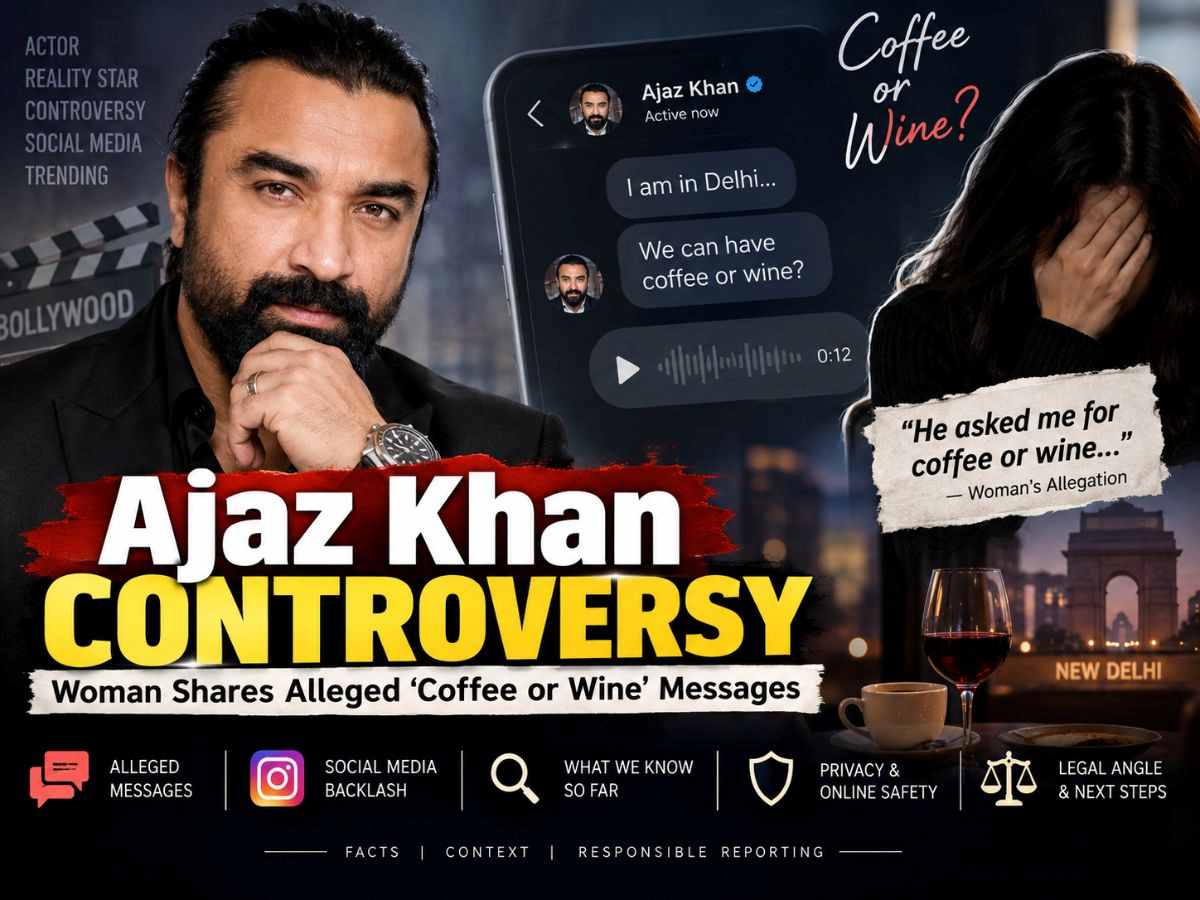
Actor Ajaz Khan is facing fresh online attention after a Noida-based content creator, identified in current reports as Niyati, shared a video describing an alleged interaction with him. She claims the actor contacted her and suggested meeting in Delhi for a “coffee or wine.” She also shared an alleged voice note as part of her account of the conversation. The claims have since drawn criticism and discussion across social media.
The key point, however, is that the material being circulated should still be treated as an allegation rather than an independently established fact. The current reports describe what the woman says happened and reproduce the alleged voice-note exchange, but they do not establish through independent records that every element of the interaction is authentic.
Here is what is known, what remains unclear and why the controversy is gaining attention.
What Is the Ajaz Khan Controversy?
The current controversy centres on an interaction that a woman says she had with Ajaz Khan online.
According to a report published on September 14, the woman, identified as Noida-based content creator Niyati, said the actor asked where she was from. After she replied that she was from Noida, she said Khan told her that he was in Delhi and asked whether she wanted to “catch up.” She reportedly responded by asking what he had in mind.
She later shared an alleged voice note in which a man identified as Ajaz Khan can reportedly be heard saying that he was in Delhi and suggesting that they could meet for coffee or wine.
That exchange is now at the centre of the online discussion.
The wording has generated criticism from users who interpreted the invitation differently, while the broader question is whether the conversation is being presented with all of its original context.
What Exactly Is the Woman Alleging?
The woman’s account is that the contact started as a direct message and moved toward a possible meeting in Delhi.
Current reporting says she described the exchange as something that made her uncomfortable. She said that when Khan suggested catching up, she felt she understood where the conversation might be heading, although she initially decided to give him the benefit of the doubt.
The alleged sequence reported so far is:
- She says Khan asked where she was from.
- She said she was from Noida.
- She says Khan replied that he was in Delhi.
- She says he asked if she wanted to catch up.
- She asked what for.
- An alleged voice note then suggested meeting for “coffee or wine.”
It is important not to move beyond those claims without additional evidence.
The reported interaction does not, by itself, establish what Khan’s intentions were. That is something readers may interpret differently, but an article should distinguish the wording of a message from assumptions about motive.
What Do the Shared Messages or Voice Note Actually Show?
The current story is slightly different from a typical screenshot-only controversy because the latest report says that the woman shared an alleged voice note, along with her account of the interaction.
That makes the source material important, but it does not automatically settle questions of authenticity or context.
When examining any viral digital conversation, readers should look for:
- The original account or post from which the material came
- The date and context of the interaction
- Whether the complete conversation is available
- Whether the account shown can be independently linked to the person being named
- Whether the material has been altered, clipped or selectively presented
A short clip can show what was said in that section of a conversation without showing what came before or after it.
That does not mean the woman’s account is false. It means the evidentiary status of the material should be stated accurately.
Can screenshots or short clips prove that a conversation is genuine?
Not on their own. They can provide evidence or context, but independent verification is stronger when the original source, complete conversation, platform records or statements from the people involved are available.
“Coffee or Wine”: Why One Line Became the Focus
The phrase “coffee or wine” has become the most recognisable part of the story because it appears in the alleged voice note described in current coverage.
Online discussion has focused heavily on what that invitation could imply.
But there is an important difference between what the words literally say and what someone thinks the speaker intended.
The available reporting establishes the wording being attributed to the voice note. It does not establish the speaker’s motive.
That distinction matters in celebrity controversies because short quotes often travel without the wider conversation. A sentence that appears straightforward in one context can be interpreted very differently after being reposted with a different caption.
For readers, the useful question is therefore not simply “Was the phrase sent?”
It is also: “What is the complete context around the phrase, and what evidence independently supports the account?”
That is a more reliable way to understand a viral allegation.
Has Ajaz Khan Responded?
At the time of publication, the current report reviewed for this article does not include a public response from Ajaz Khan to the latest allegation. The report focuses on the woman’s account and the alleged voice note.
That means the story currently has an important unresolved element.
A responsible article should not treat silence as agreement, and it should not describe a denial unless Khan has actually made one.
For this reason, the status should be presented as:
No public response from Ajaz Khan to this specific latest allegation was identified in the current reporting reviewed for this article.
That wording can be updated immediately if the actor posts a statement, video, interview or clarification.
This is particularly important for a developing entertainment story because social-media posts can change the factual picture within hours.
What Is Verified — And What Is Still Unclear?
The clearest way to understand the story is to divide the available information into two categories.
What is currently reported
- A Noida-based content creator identified as Niyati has publicly discussed an interaction she says involved Ajaz Khan.
- She says the exchange included an invitation to meet in Delhi.
- She shared an alleged voice note involving the “coffee or wine” invitation.
- The allegation has attracted online attention and criticism.
What remains unestablished
- Whether all circulated versions of the material are complete
- Whether every screenshot or clip being reposted is original
- Whether the material has been independently authenticated
- The full context of the conversation
- The intention behind the alleged invitation
- Whether any formal complaint has been filed about this particular incident
- Whether Ajaz Khan will issue a response
This distinction is central to responsible reporting.
The article should not turn a social-media allegation into a confirmed event simply because several websites repeat the same claim.
Why Is the Ajaz Khan Story Spreading So Quickly?
The speed of the story is partly explained by the format.
A screenshot, voice note or short video is much easier to repost than a detailed article. Once a celebrity’s name becomes attached to it, thousands of users can encounter the same material within a short period.
There are several reasons such stories travel quickly:
Celebrity recognition: Ajaz Khan already has a significant online audience and a public profile from television and films.
Short-form content: A short clip can be watched and shared in seconds.
Strong reactions: Personal allegations naturally generate stronger responses than routine entertainment news.
Reposting: Users may share material without checking the original source.
Loss of context: Captions added by later accounts can change how the original material is interpreted.
That leads to a simple rule for readers:
The number of times something has been reposted is not proof that it is authentic.
Virality measures distribution, not verification.
The Digital Privacy Question Behind the Controversy
There is another issue underneath the current story: the public circulation of private conversations.
When personal messages or voice notes are shared publicly, the discussion can quickly move beyond the original allegation.
People may repost usernames, phone numbers, profile photographs or other identifying details. Those details can expose individuals to unwanted contact or harassment.
A responsible publication should therefore avoid reproducing unnecessary private information.
That means:
- Blur phone numbers
- Avoid publishing private contact details
- Do not reproduce personal information that is irrelevant to the story
- Do not encourage harassment
- Do not identify a person who has not publicly identified themselves
- Avoid embedding unverified intimate material
The same caution applies to alleged screenshots created or altered using editing software or AI tools.
The existence of a screenshot is not enough to establish that it is genuine.
Could the Screenshots or Clips Be Edited or Miscontextualised?
Readers asking “Are the Ajaz Khan message screenshots real?” should understand what can and cannot be concluded from a social-media post.
Some warning signs include:
Cropped conversations: A screenshot may show only selected messages.
Missing timestamps: Without dates or sequence information, it can be difficult to establish when the exchange occurred.
Missing earlier messages: A reply can look different when the preceding question is removed.
Different reposted versions: Multiple copies may have different captions, crops or added text.
Unknown original source: A screenshot that has been reposted dozens of times may no longer link back to the first person who published it.
Edited audio or video: Short clips can be cut without making the edit obvious to someone watching quickly.
None of these points proves that the current material is fake.
They simply explain why independent verification matters.
What Has the Woman Said About the Interaction?
The current report says Niyati described the actor’s approach as making her uncomfortable. She said she initially gave him the benefit of the doubt but felt she understood where the conversation could be heading when the discussion shifted toward meeting.
Her decision to share the exchange publicly is therefore a central part of the story.
A complete news report should allow the woman’s account to be understood without adding conclusions that she herself did not make.
That means describing:
- What she says happened
- Why she said she felt uncomfortable
- What material she chose to publish
- What response, if any, she is seeking
rather than assigning an intention to either party.
Has Any Police Complaint or Legal Action Been Confirmed?
At the time of this article’s publication, the current report reviewed does not establish a police complaint, FIR or court proceeding arising specifically from this latest “coffee or wine” allegation.
That point should remain separate from earlier legal matters involving Ajaz Khan.
The actor has faced previous controversies and legal proceedings over other incidents, but those cases should not be used as evidence that the present allegation is true.
That is an important distinction in entertainment reporting.
A person’s earlier history may be relevant in a separate story, but it cannot independently establish the facts of a new allegation.
If police, lawyers or a court later confirm action concerning this latest incident, that development should be added as a separate update.
Why Earlier Ajaz Khan Controversies Should Not Be Mixed Into This Story
Ajaz Khan has been involved in other public controversies in previous years, including legal disputes linked to social-media content. For example, a Delhi High Court matter from 2025 involved allegations concerning sexually explicit remarks and a related FIR. The court granted him anticipatory bail in that case.
However, that is a different matter.
It should not be used to suggest that the latest “coffee or wine” allegation is therefore established.
Keeping separate incidents separate is particularly important when reporting allegations involving a public figure. It prevents a reader from assuming that an earlier case is evidence for an unrelated current claim.
For this article, the focus should remain on the latest interaction described by the woman and the evidence currently being circulated about it.
What Happens Next in the Ajaz Khan Controversy?
The story could develop in several ways over the next few days.
- Ajaz Khan could respond: A statement, interview or social-media video could provide his account of the interaction.
- More material could emerge: the woman could publish additional messages, the complete conversation or a longer version of the alleged voice note.
- Independent verification could happen : The platforms, individuals involved or other credible evidence could potentially clarify whether the material is authentic and complete.
- A formal complaint could be filed: If either party approaches the police or cybercrime authorities, that would provide a more formal development that can be independently reported.
- The story could simply move on: Online controversies do not always result in formal proceedings. Sometimes the only new information is a response or clarification from one of the people involved.
The most important principle is to update the story when new evidence arrives rather than repeating old social-media claims.
What Readers Should Know Before Sharing the Messages
The safest approach is simple.
Do not share personal phone numbers, addresses or private contact information.
Do not encourage people to contact or harass either party.
Do not present an unverified screenshot as a confirmed fact.
Do not assume that an edited clip represents the complete interaction.
And do not use sexually suggestive or inflammatory captions simply to increase engagement.
Readers can discuss the public allegation without spreading private information that is not necessary to understand the story.
For news publishers, the same principle applies. A story can explain what has been alleged without reproducing every piece of private material circulating online.
What We Know About Ajaz Khan
Ajaz Khan is an Indian actor and television personality who became widely known to television audiences through Bigg Boss 7 and has appeared in films and television projects.
Current reports about the latest controversy identify him as the person the woman says contacted her. The latest allegation should, however, be considered separately from his broader career and previous public controversies.
A useful background section should remain brief.
The current story is not about his entire career. It is about a specific alleged interaction and the response to material shared online.
The Bigger Issue: Celebrity DMs in the Age of Viral Screenshots
The Ajaz Khan controversy also reflects a wider change in how celebrity stories now develop.
A few years ago, a dispute might first appear in a television interview or newspaper report. Today, the sequence can be:
Private conversation → screenshot/voice note → Instagram post → reposts → reaction videos → news articles → public debate
That speed makes verification more difficult.
It also means that the original context can disappear very quickly.
For journalists and readers, the challenge is to slow down the information cycle enough to establish:
- Who made the claim?
- What evidence was presented?
- Has the other person responded?
- Has anyone independently verified the evidence?
- Is there any official action?
These five questions can prevent a developing story from becoming a collection of unsupported assumptions.
FAQs
- What is the Ajaz Khan controversy?
- The latest controversy involves a Noida-based content creator who says Ajaz Khan contacted her and suggested meeting in Delhi for “coffee or wine.” She shared an alleged voice note and her account of the interaction, which has since attracted online attention.
- Why is Ajaz Khan trending?
- Ajaz Khan is trending after a woman publicly discussed an alleged interaction with him and shared an alleged voice note connected to an invitation to meet in Delhi.
- What did the woman allege?
- She alleged that Khan contacted her, asked where she was from, said he was in Delhi and suggested that they could catch up for coffee or wine.
- What are the “coffee or wine” messages?
- The phrase refers to an alleged voice note that the woman says was sent by Ajaz Khan. Current reporting quotes the alleged voice note as suggesting a meeting for coffee or wine.
- Did Ajaz Khan send the messages?
- The material is being attributed to Ajaz Khan by the woman, but the available current report does not independently establish the authenticity of every part of the exchange.
- Has Ajaz Khan responded?
- No public response from Ajaz Khan to this specific latest allegation was identified in the current reporting reviewed for this article. This should be updated if he issues a statement.
- Are the screenshots or voice notes verified?
- The current reporting does not provide independent authentication of the complete material. Readers should distinguish between material shared by a person involved in the story and independently verified evidence.
- Has a police complaint been filed?
- No police complaint or FIR relating specifically to this latest allegation was independently confirmed in the current reporting reviewed.
- Should people share the private messages?
- Readers should avoid spreading personal information, phone numbers or unverified private material. Discussion of a public allegation does not require the unnecessary circulation of private data.
- Why is verification important in a story like this?
- Because screenshots, audio clips and short videos can be cropped, edited or presented without the full context. Viral distribution does not establish authenticity.
Final Takeaway
The latest Ajaz Khan controversy centres on a woman’s public account of an alleged interaction with the actor and an alleged voice note in which an invitation to meet in Delhi for “coffee or wine” is described. The allegation has attracted online criticism and media attention, but the available reporting does not independently establish every element of the interaction.
For readers, the most important distinction is between what the woman has alleged, what the shared material appears to show and what has actually been independently verified.
At the time of publication, no public response from Ajaz Khan to this specific allegation was identified in the current report reviewed, and no police complaint concerning this particular incident was independently confirmed.
The story may change quickly. A response from Khan, additional material, a clarification, or any formal legal development would materially change the picture.
Until then, the most responsible way to report the controversy is to keep the allegation attributed, avoid assumptions about intent and treat viral screenshots or voice notes as material requiring verification rather than proof on their own.
Also Read: Mumbai Cha Raja 2026 First Look: Aagman Date, Theme, Darshan, Location and What to Know
More in Entertainment
 EntertainmentMunmun Dutta Shares Empty Taarak Mehta Ka Ooltah Chashmah Set: ‘Looks Haunted’ When Nobody Is Shooting19 Sep 2026
 EntertainmentBhuvan Bam on India’s Got Latent Season 2 Episode 7: Panel, Samay Raina Show & What Happened18 Sep 2026
 EntertainmentAnant Nag to Receive Dadasaheb Phalke Award 2024: Age, Movies, Wife, Family, Career and Kannada Cinema Legacy16 Sep 2026
 EntertainmentMumbai Cha Raja 2026 First Look: Aagman Date, Theme, Darshan, Location and What to Know13 Sep 2026
 EntertainmentLalbaugcha Raja 2026 First Look: Date, Theme, Aagman & Darshan11 Sep 2026
 Entertainment5 Reasons Your 1980s AI Photo Looks Fake & How to Fix It10 Sep 2026
Read Next
 SportsAbhishek Sharma Hits Fastest T20I Century: 30-Ball Hundred Breaks Rohit Sharma’s Record17 Sep 2026
 BusinessUPI Charges 2026: What Changes Above ₹2,000 From October 15? 0.4% MDR, Who Pays and Full Rules Explained15 Sep 2026
 BusinessBRICS Summit 2026 Delhi: New Delhi Declaration, Key Decisions & India Impact12 Sep 2026