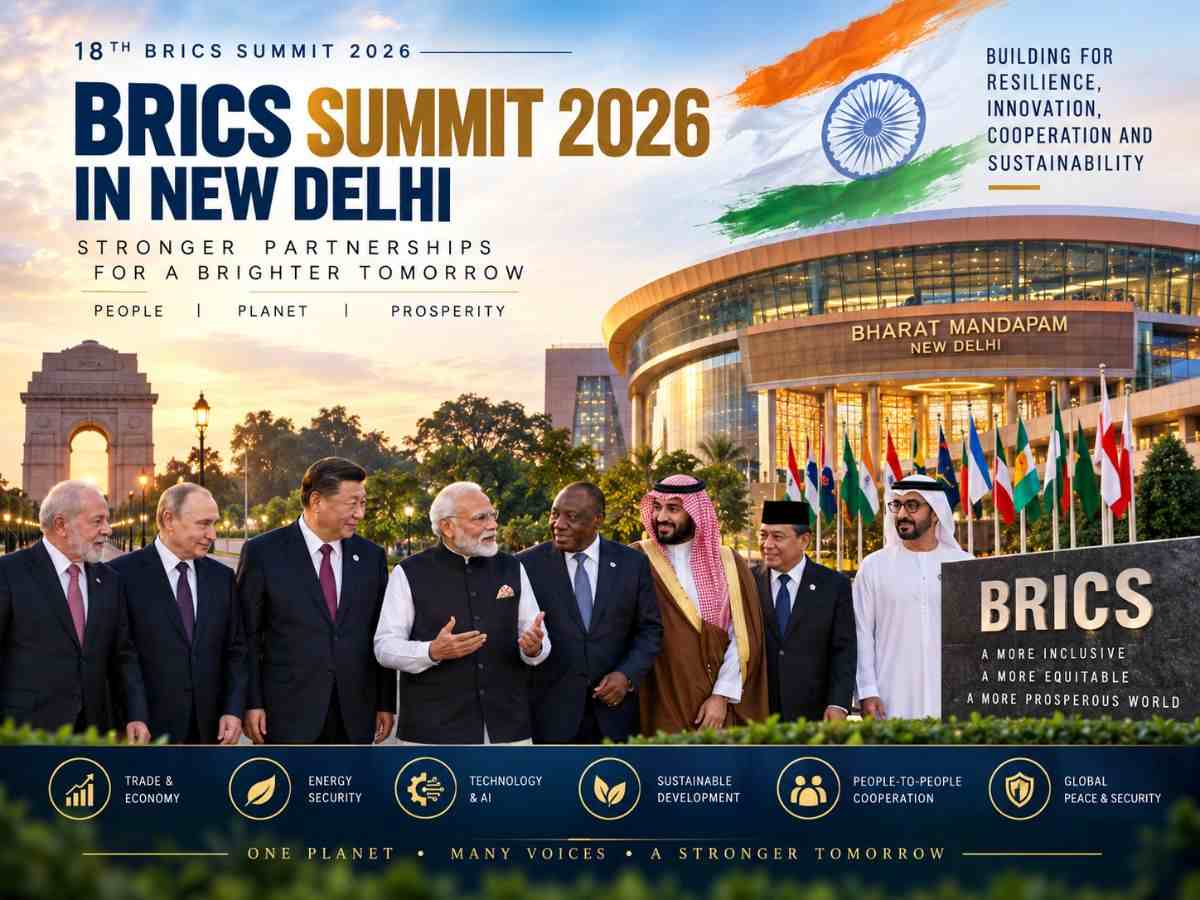
The 18th BRICS Summit 2026 is being held in New Delhi on September 12 and 13, with India hosting the grouping for the fourth time under its 2026 chairship. India has placed development, sustainability, innovation and practical cooperation at the centre of its BRICS agenda under the theme “Building for Resilience, Innovation, Cooperation and Sustainability.”
The summit comes at a difficult moment for the global economy and international security. Leaders are discussing the impact of wars and geopolitical tensions, trade barriers, tariffs, energy security, global governance reform and the changing role of emerging economies. On September 12, BRICS leaders adopted the New Delhi Declaration 2026, with current reports describing a 140-point, 45-page document covering security, conflict resolution, trade, tariffs, energy and broader Global South priorities.
For India, however, the summit is about more than diplomacy. Throughout its 2026 chairship, New Delhi has pushed cooperation on artificial intelligence, digital public infrastructure, startups, MSMEs, energy storage, smart grids, health, urban development, disaster management and critical minerals. That makes the Delhi summit both a geopolitical meeting and a test of whether BRICS can convert broad political declarations into practical projects.
What Is the BRICS Summit 2026 About?
The BRICS Summit 2026 is the annual leaders’ meeting of the BRICS grouping, being hosted by India in New Delhi on September 12–13. India’s stated objective is to make BRICS a more effective and solutions-oriented platform while strengthening cooperation among emerging economies and advancing the priorities of the Global South.
The meeting is taking place against the backdrop of renewed conflict in West Asia, pressure on global trade routes, concerns around tariffs and sanctions, and continuing debates about reform of institutions such as the IMF, World Bank and United Nations.
The most important immediate outcome is the New Delhi Declaration, which brings together areas where members were able to reach common ground. Reuters reported that the declaration urged restraint over the Middle East conflict and emphasised dialogue, consultation and diplomacy, while also criticising unilateral tariff and non-tariff measures affecting global trade.
The bigger question is what follows the declaration. A summit can produce a long document, but its real value depends on whether ministries, businesses, financial institutions and working groups turn those commitments into measurable outcomes.
BRICS Summit 2026 Date, Venue and Host
The BRICS Summit 2026 is being held in New Delhi on September 12 and 13, 2026. It is the 18th BRICS Summit, and India is holding its fourth BRICS chairship. The main summit is taking place at Bharat Mandapam, the major international convention complex in New Delhi.
India formally assumed the BRICS chairship on January 1, 2026. Rather than concentrating its entire year around the leaders’ meeting, India conducted hundreds of meetings and high-level engagements across multiple Indian cities.
A government overview says more than 350 meetings and high-level engagements were held across 25 cities during India’s chairship, covering the three traditional BRICS pillars: political and security cooperation; economic and financial cooperation; and cultural and people-to-people exchanges.
A simple timeline shows how the year has unfolded:
January 1, 2026: India takes over BRICS chairship.
Throughout 2026: Ministerial, working-group and business meetings across India.
September 11–12: Bharat Innovates Exposition at Bharat Mandapam.
September 12–13: 18th BRICS Leaders’ Summit in New Delhi.
This broad schedule matters because many of the summit’s headline outcomes were actually developed through months of technical and ministerial discussions rather than being created during the two-day leaders’ meeting.
What Does BRICS Actually Stand For?
BRICS began as BRIC, referring to Brazil, Russia, India and China. South Africa joined later, creating the BRICS name used today.
The group is not a conventional political alliance like NATO, nor is it an economic union like the European Union. It is better understood as a coordination forum where members cooperate on common economic, political, development and people-to-people priorities while retaining their own foreign policies.
The BRICS framework traditionally operates around three broad pillars:
- Politics and security
- Economy and finance
- People-to-people cooperation
The official BRICS information portal describes the organisation as a political and diplomatic coordination forum for countries of the Global South and says decisions among members are based on consensus.
That consensus model is important. BRICS members can disagree sharply on some issues and still cooperate on others. India and China may have bilateral disagreements while working together on trade or multilateral questions. Iran and UAE can have different regional interests while remaining part of the same BRICS framework.
This diversity is both BRICS’ strength and its weakness.
It gives the grouping a broad international footprint, but reaching common language on wars, tariffs, sanctions and financial systems can be difficult.
BRICS Members 2026: Complete List
India’s official BRICS 2026 material currently lists 11 members:
| BRICS Member | Broader significance |
|---|---|
| Brazil | Major Latin American economy |
| Russia | Energy and geopolitical influence |
| India | Host and major Global South economy |
| China | Major manufacturing and trading power |
| South Africa | Important African representative |
| Egypt | African and Arab regional presence |
| Ethiopia | African growth market |
| Indonesia | Major Southeast Asian economy |
| Iran | West Asian and energy importance |
| Saudi Arabia | Major Gulf and energy economy |
| UAE | Gulf finance, logistics and trade hub |
Together, these countries represent approximately 49.5% of the world’s population, 40% of global GDP and 26% of global trade, according to Indian government figures.
These figures help explain why the organisation attracts such attention. The importance of BRICS is not simply the number of member states; it is the size of the markets, energy resources, populations and production systems represented inside the grouping.
BRICS Partner Countries: How Are They Different From Members?
One of the most misunderstood aspects of the expanded BRICS structure is the distinction between full members and partner countries.
The partner-country category was created at the Kazan Summit in 2024. Partner countries are not automatically full BRICS members. They can participate in selected leaders’ and ministerial meetings according to the agreed framework and consensus among members.
The current partner-country group includes:
Belarus, Bolivia, Cuba, Kazakhstan, Malaysia, Nigeria, Thailand, Uganda, Uzbekistan and Vietnam.
Are BRICS partner countries full members?
No. They are a separate participation category.
This matters because online discussions sometimes count partners and members together and then produce different BRICS numbers. A good explainer should make that distinction clear.
There are also BRICS Outreach and BRICS Plus formats, which allow wider engagement with countries beyond formal membership and partnership arrangements.
Why India’s 2026 BRICS Chairship Matters
India’s 2026 chairship is the country’s fourth time leading BRICS, following previous chairships in 2012, 2016 and 2021. Its official theme is “Building for Resilience, Innovation, Cooperation and Sustainability.”
The theme is not just a slogan. Different ministries have used it to organise specific programmes across energy, health, communications, transport, urbanisation, women, youth and science.
India’s chairship has repeatedly emphasised:
- Practical cooperation
- Development
- Sustainability
- Innovation
- Institutional effectiveness
- Global South priorities
The government’s stated aim is to convert BRICS’ growing representation into meaningful cooperation and tangible outcomes rather than simply expanding the size of the group.
That is why initiatives such as the startup fund, MSME portal, smart-grid cooperation and AI collaboration are important. They give the chairship a practical dimension beyond summit diplomacy.
New Delhi Declaration 2026: What Is It?
The New Delhi Declaration 2026 is the principal political document adopted by BRICS leaders at the Delhi summit.
Current reporting describes it as a 45-page document with 140 points. It covers major issues ranging from terrorism and international conflicts to trade, tariffs, energy and global governance.
A summit declaration is important because it represents the areas where governments have been able to reach common language.
It does not mean every BRICS country agrees on every international issue.
Instead, the document records what members are collectively prepared to support.
That is especially significant for a grouping as diverse as BRICS.
The 2026 declaration includes discussions around:
- Security and terrorism
- International conflicts
- Global trade
- Tariffs and unilateral measures
- Renewable energy
- Sustainable development
- Global governance
- Global South representation
The declaration also stressed restraint and diplomacy in response to the ongoing Middle East conflict. Reuters reported that members called for maximum restraint and a peaceful resolution through dialogue and diplomacy.
Pahalgam Terror Attack: Why It Matters at BRICS
Terrorism has been a long-standing issue in BRICS discussions, but for India the subject carries particular significance because of the Pahalgam terror attack.
Current reporting on the New Delhi Declaration says BRICS condemned the attack and reiterated a position of zero tolerance towards terrorism.
For India, the importance is not only symbolic.
New Delhi has consistently sought stronger international cooperation against:
- Terror financing
- Safe havens
- Terror networks
- Digital platforms used by extremist groups
- Cross-border terrorism
A broader BRICS role could involve intelligence coordination, capacity building, financial tracking and cooperation against the use of emerging technologies for terrorist purposes.
The challenge is implementation. A declaration can establish political consensus, but turning that consensus into coordinated enforcement requires national agencies to work together.
That is one reason terrorism is likely to remain an important long-term BRICS priority.
Middle East Conflict: The Biggest Test of BRICS Unity
The Delhi summit is taking place during renewed conflict involving the United States, Israel and Iran, creating one of the toughest diplomatic tests BRICS has faced since its recent expansion.
The difficulty is obvious: Iran is a BRICS member, while the UAE also belongs to the grouping and maintains a very different regional relationship.
Reuters reported that these internal differences made agreement on a joint declaration more challenging. Nevertheless, members ultimately adopted a statement calling for restraint, dialogue and diplomacy.
China’s President Xi Jinping has called on BRICS to take a peacemaking role in the Middle East crisis and argued that the conflict does not benefit the international community. China is also scheduled to assume the BRICS chairship in 2027.
For India, the priority has been to support diplomacy while protecting trade, energy supplies and Indian citizens.
This leads to an important question:
Can BRICS act as a crisis-management platform when its own members have conflicting interests?
The answer remains uncertain. But the Delhi declaration itself demonstrates that consensus, although difficult, remains possible.
Why Maritime Security and Seafarers Are Now a BRICS Issue
The impact of Middle East conflicts goes beyond diplomacy.
The Strait of Hormuz and other key sea routes are critical to energy shipments, commercial shipping and global supply chains. Disruptions can affect oil prices, insurance costs, freight rates and delivery times.
Prime Minister Narendra Modi has emphasised freedom of navigation, secure maritime commerce and the safety of seafarers in discussions with Iranian President Masoud Pezeshkian. Reuters reported that maritime security was also linked directly to global trade during the BRICS Business Forum.
For India, this has a very practical dimension.
India has a large community of citizens working in international shipping. Any prolonged disruption to major sea routes can affect both their safety and the cost of transporting goods and energy.
This is why maritime security has become much more than a defence issue. It is also an economic, energy and human-safety issue.
BRICS and Global Trade: The Economic Core
Economic cooperation remains one of the most important reasons BRICS exists.
India has pushed BRICS members to focus on market access, easier regulations, payment connectivity, local currencies and stronger economic cooperation.
For businesses, the practical questions are straightforward:
Can products move more easily between BRICS countries?
Can companies receive and make cross-border payments more cheaply?
Can regulatory requirements be simplified?
Can supply chains become less vulnerable to political shocks?
Can emerging economies build more resilient trade relationships?
These questions matter because BRICS countries include large producers and consumers of energy, food, medicines, electronics, machinery and industrial goods.
India’s trade agenda has also highlighted sectors such as pharmaceuticals, agriculture, engineering, electronics, automobiles and emerging technologies.
But it is important not to overstate what BRICS can do. The group does not replace national trade agreements, customs systems or WTO rules. Its role is primarily one of coordination and policy cooperation.
BRICS and Local-Currency Trade: What Is Actually Being Discussed?
One of the most discussed BRICS topics is the idea of reducing dependence on traditional payment channels and increasing the use of local currencies.
However, two concepts are often incorrectly mixed together:
Local-currency settlement
Countries or companies use their own currencies for some cross-border transactions, reducing the need for an intermediate currency in every transaction.
Common BRICS currency
This would involve creating a new shared currency, which is a far more complicated undertaking.
These are not the same thing.
BRICS financial discussions have focused on strengthening payment interoperability and exploring ways to make cross-border transactions faster, cheaper and more secure, rather than announcing the immediate creation of a single BRICS currency.
That distinction is important for readers because sensational claims about an imminent BRICS currency can make the issue appear much simpler than it actually is.
A fully integrated currency system would require enormous coordination on monetary policy, exchange rates, financial regulation, liquidity and central-bank arrangements.
For now, payment connectivity and local-currency settlement are the more practical areas to watch.
BRICS and the Dollar: What Changes and What Does Not?
The financial debate should also not be reduced to a simple “BRICS versus the dollar” narrative.
BRICS countries have reasons to diversify payment arrangements, including sanctions risk, transaction costs and the desire for greater financial autonomy.
But diversification does not automatically mean the end of the dollar’s international role.
A realistic assessment is:
- More local-currency trade may increase.
- Cross-border payment systems may become more interoperable.
- Countries may seek more financial flexibility.
But:
Dollar dominance does not disappear simply because BRICS expands alternative payment channels.
The technical and regulatory challenges remain substantial.
That is why payment interoperability is a more realistic near-term story than predictions of a complete global monetary replacement.
BRICS New Development Bank: Why It Matters
The New Development Bank, or NDB, is one of BRICS’ most important long-term institutions.
Its purpose is to support infrastructure and sustainable-development projects in emerging economies.
For BRICS, the NDB represents an attempt to increase development financing options beyond existing global financial institutions.
The bank has supported projects across sectors including:
- Transport
- Renewable energy
- Water
- Urban infrastructure
- Digital infrastructure
- Sustainable development
Financial cooperation under BRICS also includes discussions around greater use of local currencies and improving cross-border payment mechanisms.
The important question is not whether BRICS will replace the World Bank or IMF. That is unlikely to happen simply through the NDB.
A more realistic objective is to provide another financing channel and give emerging economies a larger role in development finance.
Tariffs, Sanctions and Global Trade Pressure
Trade tensions are another major part of the 2026 BRICS discussion.
The New Delhi Declaration criticised unilateral tariff and non-tariff measures that disrupt global trade, according to current reporting.
BRICS finance chiefs have also called for reforms to global development institutions and argued that trade and financial restrictions can create additional pressure on emerging economies. They have simultaneously pushed for better payment-system interoperability and more efficient cross-border transactions.
For developing economies, the concern is predictability.
Businesses make investment decisions based on expectations about:
- Tariffs
- Market access
- Transport costs
- Currency risk
- Rules and standards
Frequent policy changes can increase uncertainty.
BRICS can provide a forum for discussing these problems, but it cannot unilaterally determine global trade policy. The effectiveness of its trade agenda will depend on whether member countries can reduce barriers among themselves while participating in the broader international trading system.
BRICS AI Agenda: From Chatbots to Global South Infrastructure
Artificial intelligence is emerging as one of the most modern dimensions of BRICS cooperation.
India has used its 2026 chairship to promote cooperation around:
- Shared computing infrastructure
- Collaborative data platforms
- Multilingual AI models
- Researcher mobility
- Open scientific infrastructure
- Responsible AI
- Digital capacity
India’s science and technology track has explicitly discussed these areas.
This matters because most discussions about AI focus on large technology companies. For BRICS countries, however, the bigger issue may be access.
How can a developing country get enough computing power?
How can local languages be represented in AI systems?
How can governments use AI safely?
How can healthcare, agriculture and education benefit?
How can researchers share data without compromising security?
These questions make AI a development issue, not just a technology issue.
Can India’s Digital Public Infrastructure Model Work Across BRICS?
India’s experience with digital public infrastructure, interoperable digital systems and digital payments has become one of the country’s strongest technology-related BRICS talking points.
The communications track under India’s chairship has focused on digital infrastructure, cybersecurity, digital skills, innovation, startups and emerging connectivity technologies.
The potential opportunity is not necessarily to copy one Indian system country by country.
Instead, BRICS members could learn from each other’s approaches to:
- Digital identity
- Payment infrastructure
- Public-service delivery
- Cybersecurity
- Interoperability
- Digital inclusion
The difficult part is adaptation. Every country has different laws, institutions, languages and technical infrastructure.
That makes interoperability a more realistic objective than simply exporting one country’s entire model.
BRICS Startup Innovation Fund
One of the most interesting economic initiatives under India’s chairship is the focus on startups.
The BRICS Startup Innovation Fund and associated incubator network are intended to connect entrepreneurs, investors, accelerators and innovation ecosystems across member countries.
For startups, the potential benefit is significant.
A founder in India may gain access to:
- Foreign investors
- International mentors
- New customers
- Regional partners
- Incubators
- Technology collaborations
But the real test will be measurable outcomes.
The useful question is not simply: “Was a startup fund announced?”
It is: How many startups receive funding, enter new markets or form cross-border partnerships?
That is the kind of metric that can show whether the initiative becomes meaningful.
BRICS Incubator Network
The incubator network complements the startup fund by creating connections between organisations that already support entrepreneurs.
An Indian incubator could potentially connect a startup with an accelerator in Brazil, UAE, Indonesia or another BRICS market.
The value of these connections often lies beyond direct funding.
A company may need:
- A local partner
- Regulatory guidance
- Market knowledge
- Distribution
- Technology support
- Talent
The network can therefore reduce the difficulty of entering unfamiliar markets.
Again, implementation matters. The network will need active referrals, programmes and measurable participation to move beyond a list of institutions.
BRICS MSME Portal and Small-Business Opportunity
The BRICS agenda is not only for large corporations.
India has also supported cooperation on micro, small and medium enterprises, including an MSME cooperation portal and discussions on access to finance and internationalisation.
For a small Indian exporter, this could eventually mean easier access to information about:
- Overseas markets
- Potential buyers
- Business networks
- Technology
- Training
- Financing
- Regulatory systems
This is the point where a geopolitical summit becomes relevant to ordinary businesses.
A textile manufacturer, engineering supplier, food processor or technology company is more likely to care about market access and payment systems than diplomatic language.
The success of the MSME agenda should therefore be judged by actual business participation and cross-border transactions.
Energy Security: One of the Biggest BRICS Stories
Energy is at the heart of BRICS because the grouping includes major energy producers, consumers and transit economies.
India structured its 2026 energy agenda around:
- Energy Security and Sustainability
- Energy Access and Equity
- Technology and Innovation.
The issue is especially important while oil prices, maritime trade and supply chains are being affected by geopolitical tensions.
BRICS energy cooperation can involve:
- Oil and gas
- Renewable energy
- Grid infrastructure
- Energy storage
- Efficiency
- Technology
- Access to electricity
India’s 2026 energy ministerial meeting also highlighted a BRICS Digital Centre of Excellence for Smart Grids and Energy Storage.
Smart Grids and Energy Storage
Renewable electricity creates a basic challenge: generation does not always match demand.
Solar generation is strongest during daylight hours. Wind availability changes. Electricity demand also changes throughout the day.
Energy storage and smart-grid technology can help manage these differences.
India’s BRICS energy track has introduced cooperation around smart grids and energy storage, including guiding principles and a digital centre of excellence.
For developing economies, this can have practical significance.
Better storage and grid management can support:
- Renewable integration
- Grid stability
- Industrial growth
- Electrification
- Lower energy losses
This is an example of the type of BRICS initiative that may matter much more over time than a single summit speech.
Climate-Resilient Cities and Urban Mobility
Rapid urbanisation creates shared challenges for BRICS countries.
India hosted the 13th BRICS Urbanisation Forum in New Delhi in June 2026 under the theme “Cities for People: BRICS Cooperation for Inclusive and Resilient Urban Futures.”
The agenda included:
- Urban resilience
- Mobility
- Infrastructure
- Sustainability
- Disaster preparedness
- Knowledge sharing
BRICS has also discussed an Urban Mobility Hub, climate-resilient urban infrastructure principles and an Urban Research and Knowledge Network.
For cities such as Delhi, Mumbai, Bengaluru and Hyderabad, these discussions connect directly with everyday issues such as transport, flooding, heat and infrastructure pressure.
BRICS and Disaster Management
Climate-related disasters do not respect national borders.
Floods, cyclones, heatwaves and earthquakes create similar problems across many developing countries.
India’s BRICS disaster-risk agenda has focused on:
- Multi-hazard early-warning systems
- Resilient infrastructure
- Nature-based solutions
- Disaster financing
- Community preparedness
The idea is simple: countries do not need to experience the same disaster to learn from one another.
Data, forecasting systems, emergency planning and resilient construction can all benefit from international cooperation.
This may be one of the least headline-grabbing areas of BRICS, but it can have direct public benefit.
BRICS Health Cooperation
Health cooperation is another area where BRICS can deliver practical outcomes.
India’s 2026 health track has focused on building resilient health systems and includes ongoing work on areas such as:
- Tuberculosis
- Digital health
- Preventive healthcare
- Mental wellness
- Traditional medicine
- Health research
- Pandemic preparedness
The first BRICS Health Working Group meeting in 2026 also introduced healthy lifestyles and promotion of mental wellness as priority areas.
For BRICS countries, affordable healthcare is closely connected to development.
Cooperation can include sharing research, regulatory experience, health technologies, vaccines, diagnostics and digital tools.
AI and Health: The Under-Covered Connection
AI in healthcare sounds futuristic, but the practical challenge is often much more basic:
Can countries safely collect and share reliable data?
India’s BRICS health discussions have highlighted the importance of:
- Data quality
- Interoperability
- Clinical validation
- Cybersecurity
- Digital infrastructure
That is important because an AI model is only as useful as the data, infrastructure and clinical processes around it.
For BRICS countries, cooperation in health AI could eventually support:
- Diagnostics
- Disease surveillance
- Digital records
- Research
- Public-health planning
But technology cannot replace doctors or health systems. It has to operate within appropriate clinical, privacy and regulatory frameworks.
Critical Minerals and Supply Chains
The global transition toward electric vehicles, batteries, renewable energy and advanced electronics has increased the importance of critical minerals.
These include materials such as:
- Lithium
- Cobalt
- Rare earth elements
These resources are important for batteries, electronics, electric vehicles and clean-energy technologies.
India has identified the need for more secure and resilient critical-mineral supply chains within its BRICS agenda.
The reason is straightforward.
If countries depend too heavily on a single source for strategically important minerals, disruptions can affect manufacturing and energy transition plans.
BRICS cooperation could potentially involve:
- Geological research
- Mining technology
- Processing
- Recycling
- Supply-chain diversification
- Investment
Agriculture and Food Security
Food security is another issue that links BRICS economies.
Members include large agricultural producers, huge food markets and countries that remain vulnerable to climate and supply-chain shocks.
Cooperation can cover:
- Agricultural technology
- Climate-resilient farming
- Food storage
- Logistics
- Research
- Fertiliser security
- Food trade
The most useful way to explain this to readers is simple:
A BRICS agricultural agreement matters only if it helps farmers produce more efficiently, reduces losses, stabilises supply chains or improves access to markets.
That is the difference between a diplomatic announcement and a measurable economic outcome.
Science, Research and Young Innovators
India’s science track under BRICS has also placed emphasis on young scientists, research infrastructure, mobility and shared scientific platforms.
For researchers, international collaboration can provide access to:
- Laboratories
- Data
- Equipment
- Expertise
- Funding
- International networks
This matters particularly in fields where no country can easily solve major problems alone, including climate science, AI, energy, health and advanced materials.
The next generation of scientists can also become one of the most durable parts of BRICS cooperation because research relationships can continue even when political relations become more complicated.
Bharat Innovates: India’s Deep-Tech Showcase at BRICS
One of the most distinctive parts of India’s 2026 chairship is the Bharat Innovates Exposition, organised on September 11–12 at Bharat Mandapam alongside the summit.
The programme is showcasing 37 Indian deep-tech innovators and is designed to connect India’s innovation ecosystem with investors, corporations, incubators, universities, research institutes and other global stakeholders.
This is significant because it changes the image of a BRICS summit from a purely diplomatic event into a platform for technology and commercial connections.
For participating startups, the opportunity is not just publicity.
Potential benefits include:
- International investors
- Strategic partnerships
- Market access
- Research collaboration
- Technology licensing
- Expansion into other BRICS markets
The long-term success of this effort will depend on what deals and partnerships emerge after the exhibition closes.
Women and Youth in BRICS
The 2026 chairship has also included dedicated tracks for women and youth.
The BRICS Women Working Group has focused on:
- Women in leadership
- Digital and financial inclusion
- Women’s entrepreneurship
- Skills
- Climate action
- Food security
- Nutrition
The youth track has covered:
- Education
- Skills
- Entrepreneurship
- Science and innovation
- Health
- Sports
- Environment
- Inclusion
- Youth exchange
This is important because the future of BRICS is not only about governments and central banks. The size and youthfulness of many member-country populations means employment, education and entrepreneurship will shape the grouping’s economic future.
BRICS Business Forum: What Companies Are Looking For
Government discussions set the policy direction, but businesses ultimately care about practical barriers.
At the BRICS Business Forum, the key areas include:
- Market access
- Investment
- Manufacturing
- Technology
- Services
- Logistics
- Payment systems
- Cross-border partnerships
India’s commerce agenda has placed emphasis on simpler regulations and stronger payment connectivity as ways to improve business cooperation.
For companies, the most important question is therefore not whether BRICS trade grows in percentage terms alone.
It is whether the cost and complexity of doing business between BRICS economies actually falls.
India-China Dynamic at the BRICS Summit
The relationship between India and China is one of the most important internal dynamics at the summit.
Chinese President Xi Jinping arrived in New Delhi for the BRICS summit on September 12, his first visit to India in seven years. Reuters described the visit as part of a cautious effort to improve bilateral ties after the serious deterioration that followed the 2020 border clash.
The relationship has two layers.
At the bilateral level, India and China still have strategic disagreements.
At the BRICS level, both countries have strong reasons to cooperate on issues such as:
- Trade
- Multilateral reform
- Development
- Climate
- Technology
- Global South priorities
The question is whether BRICS can provide a stable space for cooperation while the two countries continue to manage their differences.
Xi’s visit is therefore important not only as a BRICS event but also as a signal about the direction of India-China relations.
India-Russia Relationship Through the BRICS Lens
India and Russia also maintain a significant strategic relationship, particularly around energy, defence and trade.
Prime Minister Modi and Russian President Vladimir Putin held bilateral talks in New Delhi before the leaders’ summit. Reuters reported discussions around trade, defence, energy and the effects of conflicts on transport and maritime commerce. The two countries have also discussed increasing bilateral trade toward $100 billion by 2030.
The relationship illustrates another feature of BRICS.
India can cooperate with Russia within BRICS while also maintaining relationships with the United States, Europe and other partners.
That is why describing BRICS simply as an anti-Western alliance misses the complexity of India’s foreign-policy approach.
Iran’s Role in BRICS
Iran’s membership gives BRICS a major connection to West Asian geopolitics and energy.
At the Delhi summit, Iran’s role is particularly important because of the ongoing conflict involving the United States and Iran.
Prime Minister Modi met Iranian President Masoud Pezeshkian on September 11, with discussions including diplomacy, maritime security, freedom of navigation and the safety of seafarers.
For India, the Iran relationship has economic and strategic dimensions.
Iran is relevant to:
- Energy
- West Asian connectivity
- Maritime routes
- Regional diplomacy
- India’s access to Central Asia
The challenge is balancing these interests while supporting broader regional stability.
Why the UAE’s Role Matters
The UAE adds another important dimension.
As a Gulf financial, trade and logistics centre, the UAE plays an important role in global shipping, investment and energy markets.
Its presence alongside Iran inside BRICS also demonstrates the complexity of the enlarged grouping.
BRICS is not made up of countries with identical foreign-policy positions.
It is a forum in which countries with different regional interests attempt to find enough common ground to cooperate.
That makes every jointly agreed declaration more significant than it might initially appear.
Global South: What Does BRICS Want to Change?
One of the central arguments behind BRICS is that global institutions do not always reflect the economic weight of emerging economies.
BRICS members have therefore repeatedly called for greater representation of developing and emerging countries in:
- IMF
- World Bank
- WTO
- UN institutions
- Other international decision-making bodies
Ahead of the Delhi summit, BRICS finance chiefs called for reforms to international development financial institutions to make them more representative, transparent and accountable.
India has also continued to support reform of the UN Security Council and greater representation for emerging economies.
For BRICS, the argument is essentially about representation.
If emerging economies account for a much larger share of global population and economic activity than they did decades ago, they argue that governance structures should reflect that reality.
Is BRICS Anti-Western?
This is one of the biggest misunderstandings around the grouping.
There are clearly elements of BRICS cooperation that challenge aspects of the existing Western-led system:
- Local-currency payment discussions
- Criticism of unilateral sanctions
- Calls for financial reform
- Demands for greater representation in global institutions
However, that does not make BRICS a conventional anti-US military or political alliance.
India in particular maintains relationships with both BRICS countries and Western powers.
AP has also reported Modi’s position that BRICS should not be viewed simply as a counterweight to the West.
The more accurate description is that BRICS is trying to increase the bargaining power and representation of emerging economies.
Also Read: 1980s Photo Prompt: How to Create Viral Retro AI Photos With ChatGPT
Internal Divisions: The Biggest Challenge for BRICS
BRICS’ greatest strength—its diversity—is also its biggest weakness.
The expanded organisation includes countries with different:
- Foreign policies
- Economic systems
- Security priorities
- Regional interests
- Relationships with the United States and Europe
India and China have unresolved strategic differences.
Russia has a very different relationship with Western countries.
Iran is directly involved in current geopolitical tensions.
The UAE has its own Gulf interests.
Brazil and India often emphasise economic cooperation and development, while Russia and China sometimes give greater weight to geopolitical transformation.
Reuters has highlighted these divisions as a major challenge to BRICS cohesion, particularly after its recent expansion.
The fact that members still reached agreement on a joint declaration during the current crisis shows that compromise is possible.
But it also shows how much diplomatic work is required.
What Can the 2026 Summit Actually Deliver?
It is useful to divide the summit’s outcomes into three levels.
Immediate
These include:
- New Delhi Declaration
- Political commitments
- Working-group decisions
- Institutional announcements
- New cooperation frameworks
Medium-term
These could involve:
- Startup partnerships
- MSME cooperation
- Payment interoperability
- Energy projects
- Research collaboration
- Digital cooperation
Long-term
These include:
- Reform of global governance
- Stronger Global South representation
- More resilient financial systems
- Deeper economic integration
The distinction matters because an announcement is not the same as implementation.
The real impact of the summit will be visible months and years later.
From Declaration to Implementation: The Real Test
The most important question after the leaders leave Delhi is:
What happens next?
A useful way to track BRICS outcomes is:
Declaration → Ministries → Working Groups → Funding → Projects → Measurable Results
For example:
| Initiative | 2026 direction | What to watch next |
|---|---|---|
| Startup Innovation Fund | Cross-border startup support | Actual investments |
| MSME cooperation | Market and finance access | Business participation |
| Smart grids | Technical cooperation | Pilot projects |
| AI cooperation | Shared infrastructure and research | Joint projects |
| Payment interoperability | Faster cross-border payments | Real-world adoption |
This is where a good BRICS article can remain useful even after the summit is no longer a breaking-news story.
What Does BRICS Mean for Ordinary Indians?
International diplomacy can sound abstract, but BRICS decisions can influence everyday life indirectly.
- Fuel and energy: More resilient energy cooperation can help countries manage supply risks.
- Jobs: Startup, manufacturing and trade cooperation can create new opportunities.
- Exports: Better access to BRICS markets can benefit Indian businesses.
- Digital payments: Improved payment interoperability could eventually make some international transactions easier.
- Healthcare: Research and digital health cooperation can support affordable and scalable healthcare solutions.
- Food: Agricultural cooperation can strengthen supply chains.
- Technology: AI, deep-tech and digital infrastructure partnerships can create new research and commercial opportunities.
The key word is potential. A summit does not automatically produce these benefits. It creates frameworks through which they may develop.
What Does the Summit Mean for Indian Businesses?
For Indian companies, BRICS becomes meaningful when cooperation reduces real-world friction.
A manufacturer may care about:
- Import duties
- Standards
- Payments
- Logistics
- Market access
- An Indian startup may care about:
- Funding
- Incubators
- Customers
- Local partners
- A pharmaceutical company may care about:
- Regulatory cooperation
- Market approval
- Supply chains
A technology company may care about:
- Data
- AI infrastructure
- Cybersecurity
That is why the business side of BRICS deserves as much attention as the political side.
What Does BRICS Mean for India’s Startup Ecosystem?
India enters the summit with a large and increasingly international startup ecosystem.
The combination of:
Startup Innovation Fund
Incubator Network
Bharat Innovates
BRICS Business Forum
creates the possibility of linking Indian founders with investors, accelerators and businesses across member countries.
The opportunity is particularly strong in areas such as:
- AI
- Climate technology
- Health technology
- Advanced manufacturing
- Fintech
- Deep tech
The test will be whether those relationships continue after the summit.
Delhi as a Global Diplomatic Stage
Hosting BRICS gives New Delhi a rare concentration of international diplomatic attention.
The city becomes a meeting point for:
- Heads of government
- Ministers
- Business leaders
- Diplomats
- International organisations
- Media
Bharat Mandapam has already hosted the Bharat Innovates Exposition, linking the summit to India’s technology and education ecosystem.
For India, hosting the summit provides diplomatic visibility.
But the more important benefit may be institutional: dozens of ministers, officials and experts have already travelled to different Indian cities as part of the wider chairship.
The summit is therefore the public face of a much larger year-long diplomatic effort.
Also Read: 5 Reasons Your 1980s AI Photo Looks Fake & How to Fix It
Security and Traffic Impact in Delhi
Major international summits bring significant security arrangements and can affect movement around central Delhi.
For residents and visitors, the most relevant issues are usually:
- Traffic restrictions
- Controlled access near venues
- Security checks
- Airport and hotel movements
- Temporary road diversions
- Public advisories
Because these instructions can change quickly, readers should always rely on the latest Delhi Police, traffic police and government advisories rather than old social-media posts.
This is also an important local SEO opportunity because queries around BRICS Summit Delhi traffic, route diversions, venue access and security restrictions can emerge rapidly during the summit.
Key Leaders at BRICS Summit 2026
The most consequential leaders at the summit include:
- Narendra Modi — India: As host, Modi is responsible for setting the tone of India’s BRICS chairship and building consensus around the Delhi declaration.
- Xi Jinping — China: Xi’s Delhi visit is especially significant because it is his first visit to India in seven years. Reuters reported that the visit also carries importance for improving India-China relations.
- Vladimir Putin — Russia: Putin’s participation brings energy, geopolitics, sanctions and Russia’s broader strategic relationship with India into focus.
- Masoud Pezeshkian — Iran : Iran’s president is particularly relevant because of the current West Asia conflict, energy security and maritime concerns.
- Cyril Ramaphosa — South Africa: South Africa remains important to the African dimension of BRICS and its broader Global South agenda.
Other member governments are also represented, including Brazil, Egypt, Ethiopia, Indonesia, Saudi Arabia and UAE.
Bilateral Meetings on the Sidelines
A BRICS summit is never only about the BRICS meeting itself.
Leaders often use the occasion for bilateral talks.
During the Delhi summit period, Modi’s meetings have included discussions with:
- Xi Jinping
- Vladimir Putin
- Masoud Pezeshkian
- UN Secretary-General António Guterres
The meeting with Guterres covered multipolarity, UN reform, ongoing conflicts, freedom of navigation, sustainable development, human-centric AI, renewable energy and global food security.
It is important to distinguish between:
A BRICS decision and An India-to-country bilateral agreement
They are not the same thing.
What Is BRICS Plus?
BRICS Plus is a wider engagement format involving BRICS members and invited countries outside the core membership structure.
BRICS also uses an Outreach format, originally developed to increase engagement with countries in the region of the rotating chairship.
These formats help BRICS engage beyond its formal membership and support its broader Global South ambitions.
The distinction becomes increasingly important as more countries seek relationships with BRICS.
BRICS 2027: What Happens Next?
After India’s 2026 chairship, China is expected to take over the BRICS presidency in 2027 and host the 19th summit. Xi Jinping has already announced China’s upcoming chairship during the Delhi summit.
That creates an interesting transition.
India has placed strong emphasis on:
- Practical development
- AI
- Startups
- Energy
- MSMEs
- Sustainability
- Global South representation
China may place greater emphasis on other priorities.
The important question will be which Indian initiatives survive the chairship transition.
A successful BRICS initiative should not disappear simply because the presidency changes.
BRICS 2026 vs Previous BRICS Summit: What Is Different?
The 2026 summit builds on the work of the previous Brazilian chairship but places a stronger visible emphasis on resilience, technology, sustainability, and practical cooperation.
India’s approach has included a large number of sector-specific meetings across the country, creating an unusually broad domestic footprint.
The chairship has touched:
- AI
- Digital infrastructure
- Startups
- MSMEs
- Energy
- Transport
- Health
- Urban development
- Women
- Youth
This broad programme reflects India’s effort to make BRICS a platform that extends beyond traditional geopolitical discussions.
BRICS From 2006 to 2026: How the Group Evolved
BRICS has changed substantially since the term was first used.
- 2001: The BRIC acronym entered financial and economic discussion to describe Brazil, Russia, India and China.
- 2006: The four countries began formal political coordination under the BRIC framework.
- 2009: The first BRIC leaders’ summit took place.
- 2011: South Africa joined, creating BRICS.
- 2024–2025: The grouping expanded significantly, with Egypt, Ethiopia, Iran and UAE joining, followed by Indonesia becoming a full member in 2025.
- 2026: India hosts the enlarged grouping in New Delhi.
The evolution shows how BRICS moved from an economic acronym to a broader diplomatic coordination platform.
How Large Is BRICS?
According to India’s official 2026 BRICS overview, the 11-member grouping represents approximately:
- 49.5% of global population
- 40% of global GDP
- 26% of global trade
Those numbers explain why BRICS matters even when the group struggles to reach consensus. Its combined scale gives it economic and diplomatic weight.
But scale alone does not guarantee influence. Influence depends on whether countries can coordinate their policies and implement what they agree upon.
BRICS: Opportunities vs Limitations
| Opportunity | Limitation |
|---|---|
| Large combined markets | Different economic systems |
| Huge energy resources | Geopolitical disagreements |
| Global South representation | Difficult consensus |
| Local-currency payments | Technical barriers |
| Startup collaboration | Uneven ecosystems |
| AI cooperation | Different data rules |
| Financial cooperation | Currency and liquidity challenges |
| Global governance reform | Different foreign-policy priorities |
The best way to understand BRICS is therefore neither as a guaranteed new world order nor as an organisation with no practical influence.
It is somewhere in between: a large coordination forum whose effectiveness depends heavily on political compromise and implementation.
10 Biggest Takeaways From BRICS Summit 2026
- 1. New Delhi Declaration: BRICS leaders have adopted a joint declaration covering major political and economic issues.
- 2. Terrorism: The declaration includes a strong anti-terrorism position, including India’s focus on the Pahalgam attack.
- 3. Middle East conflict: Members called for restraint, dialogue and diplomacy.
- 4. Global trade: BRICS criticised unilateral tariff and non-tariff measures affecting trade.
- 5. Payments: Members continue to explore more efficient cross-border payment systems and local-currency cooperation.
- 6. AI: India has pushed cooperation around computing infrastructure, data platforms and multilingual AI.
- 7. Energy: Smart grids and energy storage are major practical initiatives under India’s chairship.
- 8. Startups and MSMEs: India has sought to connect businesses and entrepreneurs across BRICS.
- 9. Global South: BRICS continues to push for greater representation in global institutions.
- 10. China 2027: China will take over the BRICS chairship next year.
What to Watch After the BRICS Summit
The summit itself ends, but the important developments may come later. Watch for:
- Implementation of the New Delhi Declaration
- Payment-system pilots
- Startup fund activity
- MSME participation
- Energy-storage projects
- AI partnerships
- Trade and investment data
- Global governance reform efforts
- BRICS expansion discussions
- China’s 2027 chairship priorities
This is where the difference between headline diplomacy and structural change will become visible.
The summit can announce a framework in September. The results may not appear until months or years later.
BRICS Summit 2026 FAQs
- When is the BRICS Summit 2026?
- The 18th BRICS Summit is being held in New Delhi on September 12–13, 2026 under India’s fourth BRICS chairship.
- Where is the BRICS Summit 2026 being held?
- The leaders’ summit is being held in New Delhi, with Bharat Mandapam serving as an important summit venue.
- Who is hosting the BRICS Summit 2026?
- India is hosting the 2026 BRICS Summit and holds the group’s rotating chairship during 2026.
- What is the theme of BRICS 2026?
- India’s official BRICS 2026 theme is “Building for Resilience, Innovation, Cooperation and Sustainability.”
- How many BRICS members are there in 2026?
- India’s official BRICS 2026 material lists 11 member countries: Brazil, China, Egypt, Ethiopia, India, Indonesia, Iran, Russia, Saudi Arabia, South Africa and UAE.
- What is the New Delhi Declaration 2026?
- It is the main joint document adopted by BRICS leaders at the Delhi summit. Current reporting describes it as a 140-point, 45-page declaration covering security, conflict, trade, tariffs, energy and other Global South priorities.
- What were the major decisions at the BRICS Summit?
- The declaration addresses terrorism, international conflicts, trade, tariffs, energy cooperation and global governance. Other 2026 initiatives have focused on AI, startups, MSMEs, smart grids, digital cooperation and sustainable development.
- Did BRICS condemn the Pahalgam terror attack?
- Current reporting on the New Delhi Declaration says BRICS condemned the Pahalgam attack and reiterated its opposition to terrorism.
- What did BRICS say about the Middle East conflict?
- BRICS called for restraint and supported resolving the conflict through dialogue, consultation and diplomacy.
- Is BRICS launching a common currency?
- There is no basis in the current summit reporting for saying that a common BRICS currency has been launched. Current financial discussions focus more on local currencies, payment interoperability and improving cross-border settlement systems.
- What is the BRICS Startup Innovation Fund?
- It is part of India’s effort to strengthen startup cooperation across BRICS by connecting entrepreneurs, investors, incubators and innovation ecosystems.
- What is the BRICS MSME Portal?
- It is a cooperation mechanism intended to support small and medium-sized businesses through greater access to markets, information, finance and internationalisation opportunities.
- Why is AI important to BRICS?
- AI is increasingly relevant to healthcare, agriculture, education, research, manufacturing and public services. India has promoted cooperation on shared computing resources, data platforms, multilingual AI and scientific collaboration.
- What is BRICS’ role in global governance?
- BRICS members support greater representation of emerging and developing economies in international institutions and have called for reforms to global financial and political governance structures.
- Is BRICS an anti-US alliance?
- Not in the formal sense. BRICS is a coordination forum rather than a military alliance, and member countries have different foreign-policy relationships with the United States and Europe. The grouping’s push for greater strategic and financial autonomy should not automatically be interpreted as a single anti-US policy.
- Who will host BRICS in 2027?
- China will take the BRICS chairship in 2027 and host the 19th summit. Xi Jinping announced China’s upcoming chairship during the Delhi summit.
- What is the difference between a BRICS member and a partner country?
- Members participate in all BRICS meetings and take decisions through consensus. Partner countries have a separate status and participate according to the partner-country framework and invitations.
Final Takeaway: Why the BRICS Summit 2026 Matters
The BRICS Summit 2026 in New Delhi is important because the grouping is no longer simply a small forum of emerging economies. It has expanded, become more politically diverse and increasingly covers issues ranging from trade and finance to AI, energy, health, climate, startups and global governance.
India’s fourth BRICS chairship has tried to give that expansion a practical direction. The New Delhi Declaration, the focus on terrorism and international conflicts, trade and payment cooperation, and the wider work on AI, startups, MSMEs, energy storage, digital infrastructure and resilient cities all point toward a broader definition of what BRICS can be.
At the same time, the summit exposes the group’s limitations. BRICS members have different foreign-policy priorities and sometimes directly conflicting regional interests. Reaching consensus is therefore likely to remain difficult.
That is why the most important question is not simply what was announced in Delhi.
It is what gets implemented after the leaders leave Delhi.
The declaration can establish the direction. Ministries, companies, researchers and institutions will determine whether that direction produces tangible results.
For India, the summit offers a chance to demonstrate that its leadership of BRICS can leave behind more than diplomatic statements: a stronger network for trade, technology, energy, innovation and cooperation across the Global South.
Also Read: Lalbaugcha Raja 2026 First Look: Date, Theme, Aagman & Darshan
More in Business
 BusinessUPI Charges 2026: What Changes Above ₹2,000 From October 15? 0.4% MDR, Who Pays and Full Rules Explained15 Sep 2026
 BusinessWho Is Tengku Puteri Ilyana Alia? Meet the Malaysian Princess Who Married British Racer Chris Froggatt13 Aug 2026
 BreakingNational Handloom Day 2026: Date, Theme, History, Significance and Why India Celebrates Its Weaving Heritage6 Aug 2026
 BusinessITR Filing Last Date 2026: Deadline, Late Fee, Penalties & Filing Guide for AY 2026-2729 Jul 2026
 BusinessNew IRCTC Website Beta Version Live Today: Features, Login Process and Booking Guide15 Jul 2026
 Business8th Pay Commission Latest Update: Expected Salary Hike, Fitment Factor and What Central Government Employees Can Expect14 Jul 2026
Read Next
 SportsAsian Games 2026: India Schedule, Medal Tally, Cricket Results, Matches and Latest Updates22 Sep 2026
 TechGrok 4.7 Launches With Focus on Coding, Long-Running Tasks and Knowledge Work21 Sep 2026
 SportsAsian Games 2026 Live: India and Pakistan Schedule, Results, Medal Tally, Cricket, Hockey and Latest Updates20 Sep 2026