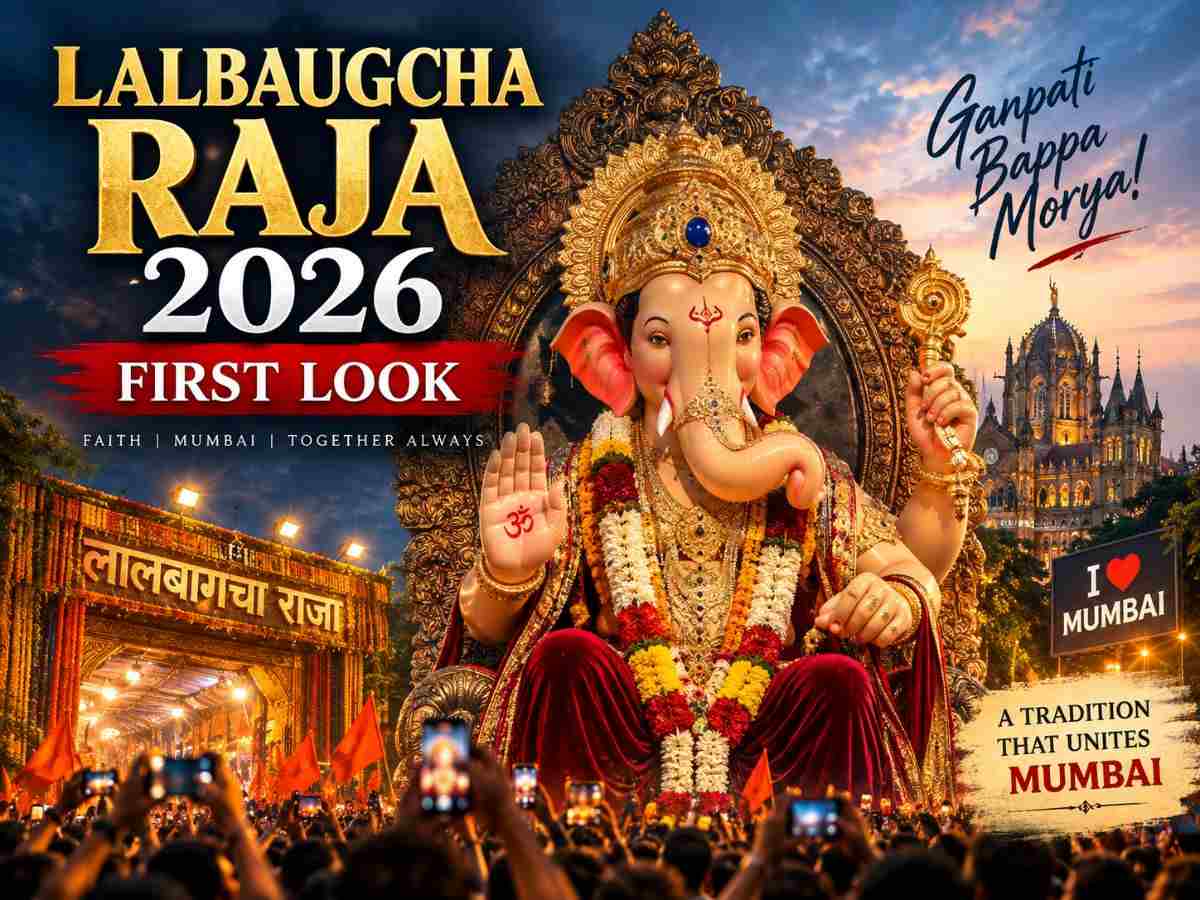
The wait is over for Mumbai’s most anticipated Ganpati reveal. Lalbaugcha Raja 2026 has now made its first appearance ahead of Ganesh Chaturthi, with the latest visuals giving devotees a glimpse of this year’s idol and the elaborate setup around the mandal. The first look was unveiled in Mumbai on September 11, 2026, just days before Ganesh Chaturthi begins on September 14.
The timing is significant because the Lalbaugcha Raja Sarvajanik Ganeshotsav Mandal is celebrating its 93rd year in 2026. According to the mandal’s official website, this year’s Ganeshotsav will run from Monday, September 14, to Friday, September 25, 2026, ending on Anant Chaturdashi. The mandal had already conducted its traditional Shree Ganesh Muhurta Pujan on June 9 at 5 am, formally beginning preparations for this year’s festival.
For devotees searching for Lalbaugcha Raja 2026 first look, Lalbaugcha Raja Aagman 2026, Lalbaugcha Raja first look date, Mumbai Cha Raja 2026 first look date and related updates, here is a complete guide to the latest developments, the 2026 setup, the festival dates, the historical significance of Lalbaugcha Raja and what to know before planning a visit.
Lalbaugcha Raja 2026 First Look Date

The Lalbaugcha Raja 2026 first look was unveiled on September 11, 2026, according to current reports from Mumbai. The reveal comes just three days before Ganesh Chaturthi, which falls on September 14 this year.
The first look is one of the most closely watched moments of Mumbai’s Ganeshotsav calendar. Thousands of devotees follow the annual reveal online, while Mumbai residents often plan their visits around the opening of darshan and the expected crowds in Lalbaug.
The mandal’s official website is also carrying “First Look of Lalbaugcha Raja 2026” among its current updates, alongside information about the 2026 festival and other activities.
The reveal has arrived after weeks of closely guarded preparations. In the days leading up to it, glimpses of the mandap construction had already appeared online, increasing curiosity around the final presentation.
What Does the Lalbaugcha Raja 2026 First Look Show?
The biggest visual talking point around the 2026 setup is the large temple-inspired entrance and the giant trishul visible above the structure.
Videos and photographs shared before the official reveal showed a large architectural gateway taking shape at the mandap. The structure features traditional temple-like elements and a prominent trishul, leading to widespread speculation about the religious inspiration behind this year’s decoration.
Reports on September 11 have since described the entry gate as being inspired by Ujjain Mahakaal. The large gateway includes a towering representation of Lord Shiva, with a damaru and kamandalu, while a trishul and Nandi are also part of the visual arrangement. A particularly striking feature is the depiction of a blinking red eye on the Shiva figure.
This is an important distinction for readers: the entry gate’s Mahakaal-inspired design can be discussed as a confirmed visual feature based on current reporting, while wider claims about an overall “official theme” should be made carefully unless formally confirmed by the mandal.
That distinction matters because the mandal traditionally keeps aspects of the decoration under wraps until the festival approaches. Earlier reports specifically noted that the full theme had not been officially announced while construction glimpses were circulating.
Lalbaugcha Raja 2026 Theme: What We Know So Far
The 2026 decoration has created a strong religious and architectural mood around the Lalbaugcha Raja mandap.
The Ujjain Mahakaal-inspired entry gate is currently the clearest reported theme element. Lord Shiva’s presence, the trishul and Nandi give the entrance a distinctly Shaivite visual language while the main attraction remains Lord Ganesha.
For a news article, it is better to avoid turning every visual clue into a confirmed theme statement.
For example, the presence of a trishul does not by itself prove that the entire mandap is dedicated to a particular religious narrative. That is why current reporting has separated what viewers can actually see from speculation about the final concept.
The practical takeaway for devotees is that 2026’s Lalbaugcha Raja setup is clearly embracing a grand temple-inspired design, while the Mahakaal connection has become one of the defining talking points of this year’s first look.
Why Lalbaugcha Raja’s First Look Creates So Much Buzz
The annual first look is more than a decoration reveal. Lalbaugcha Raja has developed into one of Mumbai’s biggest cultural and devotional events, attracting devotees from across India and beyond.
Part of the excitement comes from the fact that the idol itself has a distinctive identity. The traditional posture of Lalbaugcha Raja has remained recognisable over the years, while the throne, decorations and surrounding presentation can change. Historical accounts describe the idol’s characteristic expression and regal posture as part of what makes the Lalbaugcha Raja instantly recognisable.
There is also an element of anticipation. Mumbai’s major Ganpati mandals gradually reveal their preparations as Ganesh Chaturthi approaches, and Lalbaugcha Raja’s comparatively guarded presentation creates an annual guessing game among devotees.
That is why searches around “Lalbaugcha Raja 2026 first look”, “Lalbaugcha Raja 2026 first look video” and “Lalbaugcha Raja Aagman 2026” spike around this period.
The first look also works as a visual marker for the city. Once the pandal is ready and the idol is revealed, the countdown to Ganesh Chaturthi becomes very real for Mumbai.
Lalbaugcha Raja 2026 Ganeshotsav Dates
According to the mandal’s official website, the Lalbaugcha Raja 2026 Ganeshotsav will be celebrated from:
Ganesh Chaturthi: Monday, September 14, 2026
to
Anant Chaturdashi: Friday, September 25, 2026
The mandal describes 2026 as its 93rd year.
The festival therefore covers the main Ganesh Chaturthi period through the final immersion day.
For people searching Lalbaugcha Raja 2026 date, it is useful to distinguish between different milestones:
June 9, 2026: Shree Ganesh Muhurta Pujan
September 11, 2026: First look unveiled according to current reporting
September 14, 2026: Ganesh Chaturthi and start of the festival period
September 25, 2026: Anant Chaturdashi and conclusion of the festival period
This timeline is useful because searches for “first look date,” “Aagman date” and “Ganesh Chaturthi date” can refer to different events.
What Does Aagman Mean in the Context of Lalbaugcha Raja?
The term Aagman generally refers to the arrival or welcoming of Ganpati. During Mumbai’s Ganesh festival season, the word is frequently used for processions, idol arrivals and public celebrations associated with bringing Bappa into the mandal.
For Lalbaugcha Raja, however, readers should distinguish between the broader Ganeshotsav schedule, the idol’s arrival/installation, the first-look reveal and the start of public darshan.
These are not necessarily the same event or date.
This distinction is especially important for SEO content because users search phrases such as:
- Lalbaugcha Raja Aagman 2026
- Lalbaugcha Raja 2026 Aagman date
- Lalbaugcha Raja first look date
- Lalbaugcha Raja darshan date
A trustworthy article should identify the exact event being discussed rather than treating all four phrases as synonyms.
The mandal’s official 2026 calendar confirms the overall festival period from September 14 to September 25.
Where Is Lalbaugcha Raja Located?
The Lalbaugcha Raja Sarvajanik Ganeshotsav Mandal is located at Shree Ganesh Nagar, Dr Babasaheb Ambedkar Road, Lalbaug Market, Mumbai 400012. The address is listed on the mandal’s official contact page.
Lalbaug is in central Mumbai and is closely associated with the city’s historic mill and market districts.
The location is one reason the festival experience is so closely tied to Mumbai itself. During Ganeshotsav, the surrounding streets become part of the event, with large crowds, decorations, processions, music and devotional activity.
For visitors travelling from outside Mumbai, it is useful to plan the journey around the festival’s expected crowds rather than treating the visit like an ordinary temple trip.
Why Is Lalbaugcha Raja Called “Navsacha Ganpati”?
Lalbaugcha Raja is popularly known as Navsacha Ganpati, a name connected with the tradition of devotees making a navas, or vow, before Lord Ganesha.
The historical story of Lalbaugcha Raja is linked to the local market community. A Mumbai civic tourism document describes how a market near Peru Chawl was shut down in 1932, creating difficulties for local vendors and fishermen. The community prayed for a permanent market site, and after the market was established, a Ganesha idol was set up in September 1934 as an expression of gratitude.
Over time, the idol became associated with the belief that heartfelt wishes could be fulfilled.
That tradition remains central to the identity of Lalbaugcha Raja today. For many visitors, the journey is not simply about seeing a famous Ganpati idol; it is also connected with personal prayers, vows and family traditions.
Lalbaugcha Raja History: How It Began in 1934
The roots of Lalbaugcha Raja go back more than nine decades.
The official and historical accounts place the establishment of the idol in 1934, when local fishermen and traders connected with the Lalbaug market installed the Ganesha idol after the fulfilment of their wish for a permanent market. The Mumbai civic tourism document records the 1934 installation and the connection with the local marketplace.
The story reflects an important part of Mumbai’s social history.
Lalbaug was historically a working-class neighbourhood shaped by markets, textile mills, traders, fishermen and communities living in close-knit chawls. The story of the Raja emerged from this environment rather than from an institution created solely for large-scale public spectacle.
That history helps explain why Lalbaugcha Raja continues to have such a strong emotional connection with Mumbaikars.
It is not just a festival attraction. For many local families, visiting Bappa is an annual tradition passed from one generation to another.
Who Makes the Lalbaugcha Raja Idol?
The Kambli family has been associated with creating the Lalbaugcha Raja idol for generations.
Historical accounts identify the Kambli family as the sculptors responsible for the idol’s distinctive form, with the family’s involvement dating back to 1935. The family’s work has helped preserve the recognisable facial expression, posture and overall character of Lalbaugcha Raja while allowing the throne and surrounding visual presentation to evolve.
This continuity is an important part of the idol’s identity.
Unlike a completely new visual concept every year, devotees return to a form of Bappa that they can recognise immediately. That balance—traditional idol design with changing annual presentation—is one reason the first look continues to generate so much interest.
Lalbaugcha Raja Idol vs the Mandap Decoration
One useful distinction for readers is the difference between the idol itself and the world created around it.
The idol has a distinctive traditional posture and appearance. The mandap, throne, entrance and surrounding decorative elements can take on new forms from year to year.
In 2026, much of the current visual attention has gone toward the large entrance structure and its Mahakaal-inspired elements.
This means that when people search for the “Lalbaugcha Raja 2026 theme,” they may actually be interested in the decoration rather than a completely redesigned Ganesha idol.
That distinction is useful for visitors who want to know what is genuinely new this year.
How the 2026 Setup Compares With Previous Years
Interest in older editions is also visible in search behaviour, with users looking for Lalbaugcha Raja 2025, Lalbaugcha Raja 2024 and Lalbaugcha Raja 2023 alongside the 2026 first look.
The annual appeal comes partly from comparison. Devotees often look back at previous idols, thrones and mandap designs to see how the presentation has evolved.
For example, the 2023 first look was officially published by the Lalbaugcha Raja channel for September 15, 2023, while the official 2024 first-look video was published for September 5, 2024.
The dates themselves show why “first look” should not be confused with a permanently fixed annual date. The reveal timing can change from year to year depending on the festival calendar and the mandal’s preparations.
For 2026, the reveal has arrived on September 11, immediately ahead of Ganesh Chaturthi.
What Makes Lalbaugcha Raja Different From Other Mumbai Ganpati Mandals?
Mumbai has many famous Ganpati mandals, and each has its own traditions, visual style and following.
Lalbaugcha Raja stands out because of the combination of:
A long history: The idol tradition dates back to 1934.
A distinctive idol form: The traditional posture and expression have remained recognisable across generations.
The Navsacha Ganpati tradition: Devotees associate Lalbaugcha Raja with vows and wishes.
Large-scale public participation: The area becomes extremely busy during Ganeshotsav.
Annual visual anticipation: The mandap and first-look presentation create a fresh point of interest every year.
The result is a festival that is simultaneously religious, cultural, visual and deeply local to Mumbai.
What Should Devotees Keep in Mind Before Visiting in 2026?
Anyone planning to visit Lalbaugcha Raja should approach the trip as a major festival crowd experience, not a quick sightseeing stop.
The exact crowd conditions, queue arrangements and traffic controls can change close to the festival. Current travel coverage advises visitors to plan ahead, particularly because the Lalbaug area attracts very large crowds during Ganeshotsav.
A practical approach is to:
- Check the mandal’s official website for the latest announcements.
- Confirm current darshan arrangements before travelling.
- Carry only essential belongings.
- Allow significant extra travel time.
- Follow queue and crowd-management instructions.
- Check local transport and traffic information on the day of your visit.
Most importantly, don’t rely on old screenshots or social-media posts for time-sensitive arrangements. Festival logistics can change.
Can You Watch Lalbaugcha Raja Online?
Online darshan has also become an important part of Lalbaugcha Raja’s digital presence.
The mandal has previously offered live online darshan through its official digital channels. Its 2024 information, for example, states that online darshan was available through the official website and social-media platforms during the festival.
For 2026, devotees who cannot travel to Mumbai should check the official Lalbaugcha Raja website and verified social accounts for the latest online-darshan information rather than relying on unofficial streams.
This is particularly useful for devotees outside Mumbai or outside Maharashtra who still want to participate in the festival.
Lalbaugcha Raja 2026: What to Expect This Year
The 2026 edition arrives with a combination of tradition and a visually ambitious new presentation.
The 93rd-year celebration retains the historic identity of Lalbaugcha Raja, while this year’s entry design has introduced a striking Ujjain Mahakaal-inspired visual, complete with Lord Shiva, a giant trishul, Nandi and other architectural details.
The timing is also significant because Ganesh Chaturthi arrives on September 14, with the festival continuing through September 25.
For devotees, the first look is therefore only the beginning.
The larger story is the return of one of Mumbai’s most recognisable annual traditions: families making their way to Lalbaug, devotees seeking darshan, and the city’s streets transforming around Ganpati Bappa.
Lalbaugcha Raja 2026 FAQs
- When was the Lalbaugcha Raja 2026 first look released?
- The first look of Lalbaugcha Raja 2026 was unveiled in Mumbai on September 11, 2026, according to current reports.
- When is Ganesh Chaturthi 2026?
- Ganesh Chaturthi 2026 falls on Monday, September 14. The Lalbaugcha Raja Ganeshotsav is scheduled to run through September 25, Anant Chaturdashi.
- What is the Lalbaugcha Raja 2026 theme?
- The 2026 entry gate is reported to be inspired by Ujjain Mahakaal, featuring a large Lord Shiva figure, trishul and Nandi. Reports earlier in the week cautioned that the complete theme had not initially been officially revealed.
- Where is Lalbaugcha Raja located?
- The mandal is located at Shree Ganesh Nagar, Dr Babasaheb Ambedkar Road, Lalbaug Market, Mumbai 400012.
- Why is Lalbaugcha Raja called Navsacha Ganpati?
- The name is associated with the tradition of devotees making a navas, or vow, to Lord Ganesha and the long-standing belief that Lalbaugcha Raja fulfils sincere wishes.
- When was Lalbaugcha Raja established?
- The Lalbaugcha Raja tradition traces back to 1934, when local fishermen and traders installed the idol in connection with the establishment of the Lalbaug market.
- Who makes the Lalbaugcha Raja idol?
- The Kambli family has traditionally been responsible for creating the Lalbaugcha Raja idol, with the family’s association dating back to 1935.
- Is Lalbaugcha Raja the same as Mumbai Cha Raja?
- No. Lalbaugcha Raja refers specifically to the famous Ganpati idol and mandal in Lalbaug. “Mumbai Cha Raja” is a phrase that can be used for other prominent Mumbai Ganpati idols and should not automatically be treated as another name for Lalbaugcha Raja.
Final Takeaway
The Lalbaugcha Raja 2026 first look has arrived at exactly the moment Mumbai’s Ganeshotsav countdown reaches its final stage. Revealed on September 11, the 2026 presentation combines Lalbaugcha Raja’s familiar devotional identity with a striking new entrance inspired by Ujjain Mahakaal, featuring Lord Shiva, a giant trishul and Nandi.
The festival itself will run from September 14 to September 25, 2026, according to the mandal’s official schedule.
What makes the occasion bigger than a yearly decoration reveal is the history behind it. Lalbaugcha Raja began in the 1930s as part of the story of local fishermen, traders and the Lalbaug market, and over the decades became one of Mumbai’s most recognised symbols of faith and community.
For devotees planning a visit, the best source for changing information remains the official Lalbaugcha Raja website and verified channels, particularly for darshan arrangements, crowd management and online updates.
Also Read: 5 Reasons Your 1980s AI Photo Looks Fake & How to Fix It
More in Entertainment
 EntertainmentMunmun Dutta Shares Empty Taarak Mehta Ka Ooltah Chashmah Set: ‘Looks Haunted’ When Nobody Is Shooting19 Sep 2026
 EntertainmentBhuvan Bam on India’s Got Latent Season 2 Episode 7: Panel, Samay Raina Show & What Happened18 Sep 2026
 EntertainmentAnant Nag to Receive Dadasaheb Phalke Award 2024: Age, Movies, Wife, Family, Career and Kannada Cinema Legacy16 Sep 2026
 EntertainmentAjaz Khan Controversy: Woman Shares Alleged ‘Coffee or Wine’ Messages14 Sep 2026
 EntertainmentMumbai Cha Raja 2026 First Look: Aagman Date, Theme, Darshan, Location and What to Know13 Sep 2026
 Entertainment5 Reasons Your 1980s AI Photo Looks Fake & How to Fix It10 Sep 2026
Read Next
 SportsAbhishek Sharma Hits Fastest T20I Century: 30-Ball Hundred Breaks Rohit Sharma’s Record17 Sep 2026
 BusinessUPI Charges 2026: What Changes Above ₹2,000 From October 15? 0.4% MDR, Who Pays and Full Rules Explained15 Sep 2026
 BusinessBRICS Summit 2026 Delhi: New Delhi Declaration, Key Decisions & India Impact12 Sep 2026


You must be logged in to post a comment.